Introduction
The project Soldier Sikke Hiemstra has changed my perspective on the military. Through this project, I have become much more aware of the role of the armed forces, both today and in history. That is why I decided to take a closer look at the role of my own family within the military. I discovered that not only my great-grandfather served, but also my grandfather and my father. Although they are not directly related to each other, they are all connected through me (Lars, the author of this website). This article therefore reflects on three generations of military service.
Sikke (1925, 1928, 1930, 1939-1940).
Sikke, my great-grandfather, was conscripted and part of the 1925 draft. He served with the Royal Dutch Army for several weeks in 1925, 1928, and 1930. Therefore, Sikke had already gained some military experience before the outbreak of the Second World War. As tensions in Europe increased, the Dutch government decided to mobilize the army. During the 1939–1940 mobilization, Sikke was called up again. During this period, he kept a wartime diary in which he recorded his experiences. Sikke was first stationed at the depot battalion in Schoorl, where he underwent training. There, he was part of the 3rd Company of the 9th Regiment Depot Battalion, III Depot Infantry. From August through October 1939, he was based in Schoorl. In October 1939, he was transferred to Fort Uitermeer in Weesp, where he was assigned to the 5th Section, 2nd Company, 1st Battalion of the 31st Infantry Regiment. He spent most of the mobilization period (October 1939 – April 1940) at Fort Uitermeer. When Nazi Germany invaded Norway and Denmark in April 1940, there were plans to relocate Sikke’s battalion. In the end, only his section was moved to Muiderberg, where he became part of the 1st Company, 1st Battalion of the 31st Infantry Regiment.
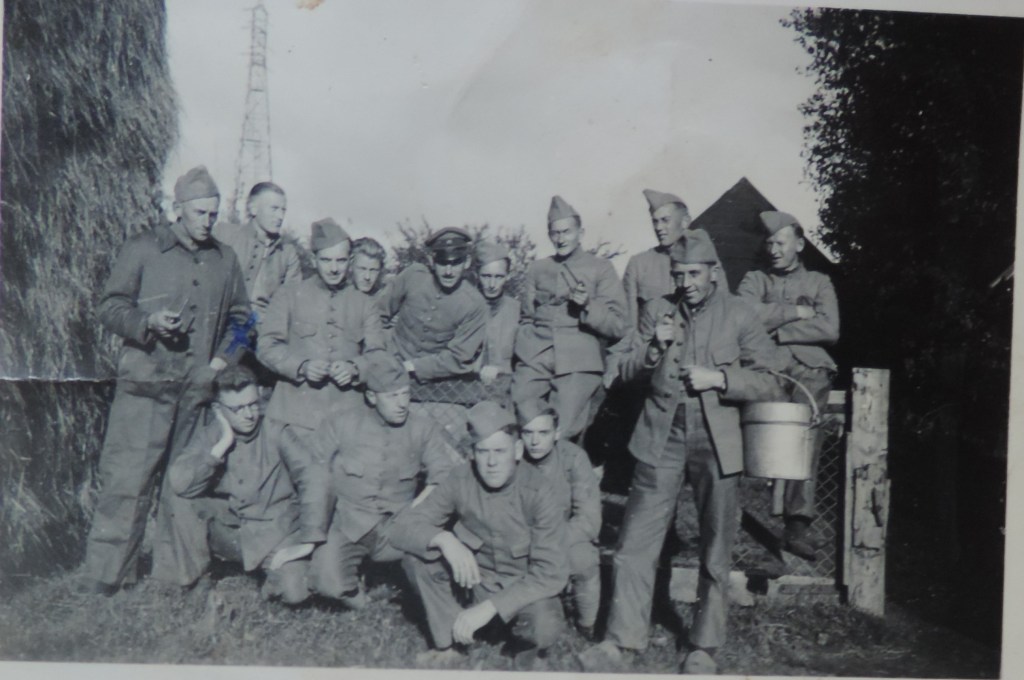
This photo was taken at farmer Galesloot’s place. In the photo, Sikke (bottom left) can be seen together with his fellow servicemen.
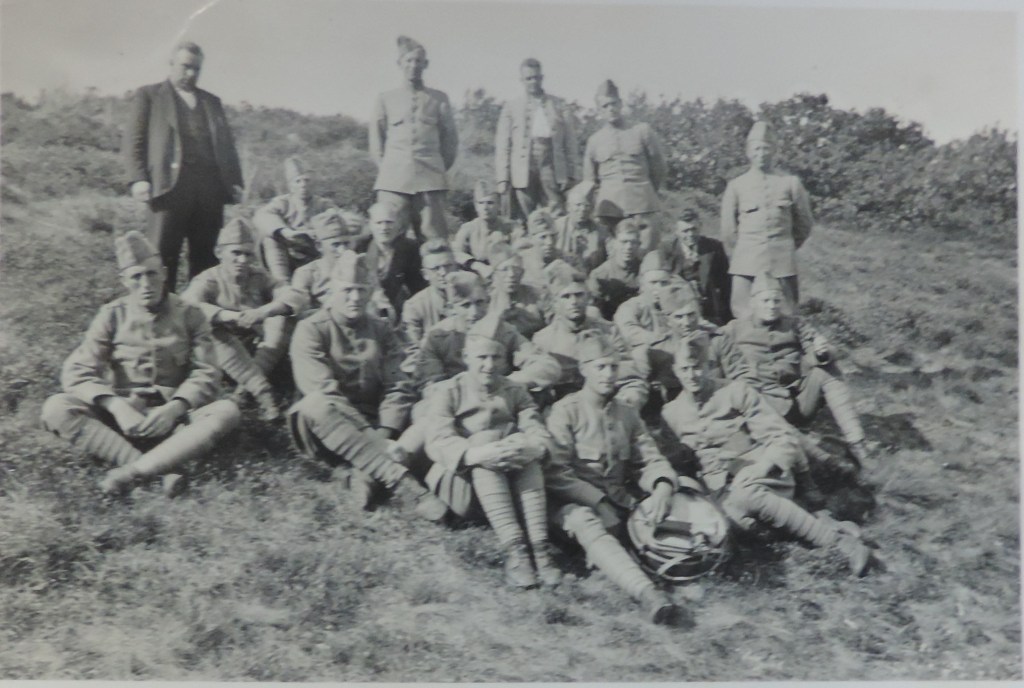
Sikke in the middle (without a hat and with glasses), presumably in Schoorl.
During the mobilization, Sikke often stood guard and manned positions. In addition, he received extensive training and lessons on military discipline, gas attacks, military conduct, the use of machine guns and pistols, as well as on diseases. In his free time, he regularly went to church, visited the military home, or attended performances organized by the Development and Recreation Committee. The mobilization period also brought challenges, such as the harsh mobilization winter and the flare-gun affair. His leave was also frequently revoked whenever tensions in Europe or the Netherlands increased.
However, his stay in Muiderberg would not last long because on May 10, 1940, Nazi Germany launched its attack on the Netherlands. On that day, Sikke took part in combat operations when his regiment opened fire on an aircraft. A day later, he was transferred to Amsterdam, where he was tasked with arresting suspicious individuals and, if necessary, taking action against parachutists. On May 15, 1940, the Dutch army capitulated and Sikke became a prisoner of war. He remained in captivity until May 30, 1940, after which he returned to civilian life.
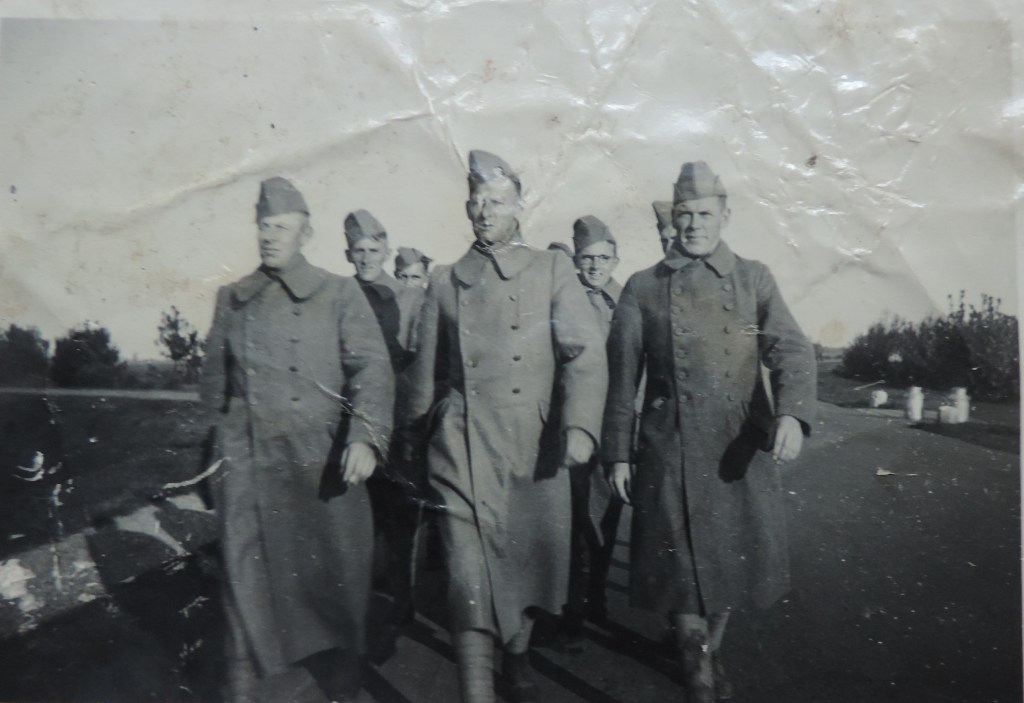
Marching was an important part of conscripted military service. In this photo, Sikke (the soldier with glasses) can be seen marching together with his fellow servicemen. It is unknown where and when this photo was taken.
Peter (1952-1954, 1957, 1960, 1963, 1965).
Peter, my grandfather, lived through the Second World War. Although he wanted to fight alongside the Canadians against the Germans during the liberation of Friesland, his mother stopped him. After all, he was far too young. Peter, too, was conscripted, but in a completely different era than Sikke. His conscription fell in the early years of the Cold War, when the threat no longer came from Germany but from the Soviet Union and the Warsaw Pact. Peter belonged to the 1948 draft class and entered military service with the Royal Dutch Navy in 1952. While Sikke served his conscription in the Royal Netherlands Army, Peter joined the Royal Naval Reserve.
He first had to report to the Naval Recruitment Center (MOC) in Voorschoten, where he underwent a medical examination. After the examination, he was sent to the Naval Training Camp (MOK) in Hilversum. There, he began his initial military training. After a few months, he continued his training at the Communications School in Amsterdam, as he wanted to be part of the communications service. This service was responsible for telecommunications. Peter worked in the Navy as a coder-telex operator. This was someone who typed, distributed, and encoded telex messages.
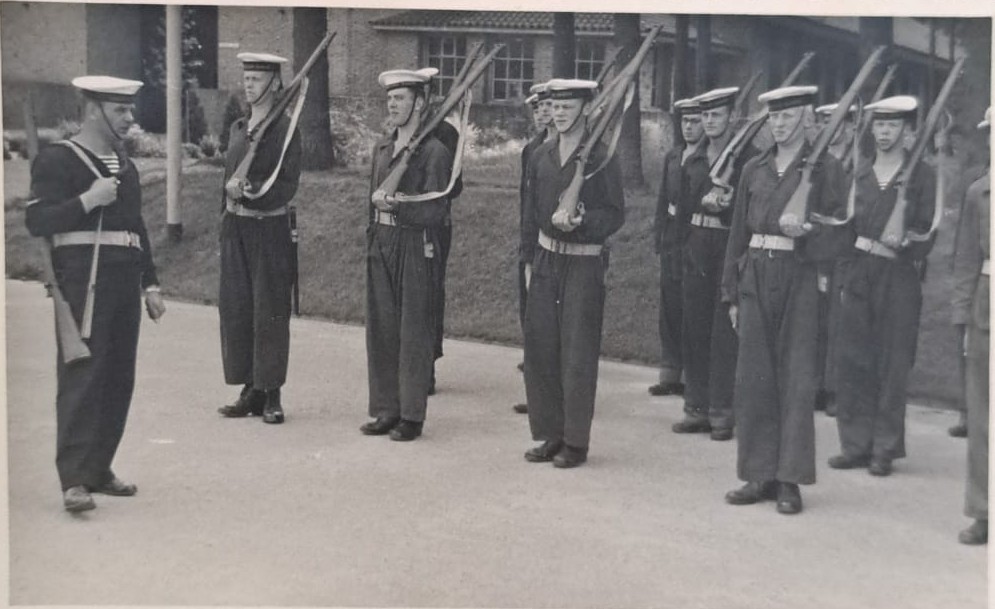
Peter (second of left) at the MOK in Hilversum.
In late 1952, Peter entered the Royal Netherlands Naval College, where he followed officer training. He received the rank of midshipman (officer cadet) and was officially commissioned as an officer in 1953. He was then stationed for several months at the Naval Air Base Valkenburg, which aligned well with his next posting. In October 1953, he was assigned to the aircraft carrier Hr. Ms. Karel Doorman. Afterwards, in 1954, he served for several more months on the cruiser Hr. Ms. Jacob van Heemskerck, before being discharged from active duty.
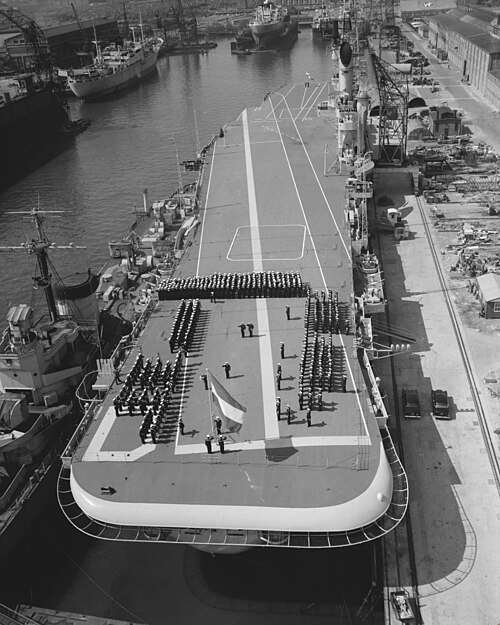
The Hr. Ms. Karel Doorman was the second and also the last aircraft carrier of the Netherlands. Peter served on this ship between October 1953 and January 1954.
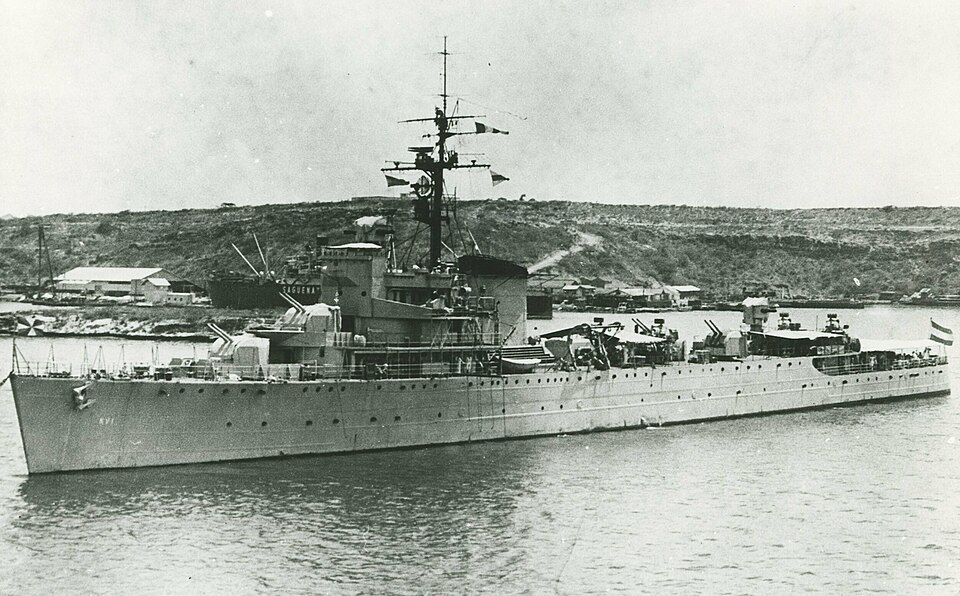
This was Hr. Ms. Ship Jacob van Heemskerck, a light cruiser. Peter served on this ship between January 1954 and April 1954. The second time he served on this ship was between September 17 and September 28, 1957.
In 1955, Peter was promoted to Lieutenant at Sea, Third Class, and in 1956 to Lieutenant at Sea, Second Class. In 1957, he returned to serve on Hr. Ms. Jacob van Heemskerck, but by then the ship had already been declared immobile. After that, he went on extended leave. Peter returned three more times for exercises. The first was the NATO exercise Fall Exercises (FALLEX 60) in 1960, which was intended to prepare NATO member states for the initial days of a war. During this exercise, he was stationed at the Maritime Headquarters Walcheren (MHQ). In 1963, he participated in a repeat exercise in Vlissingen called Searake. The exact nature of this exercise is unknown. In 1965, he took part in a NATO test exercise called Operation Match Maker, designed to train maritime units and supporting facilities. At that time, Peter served as a watch officer at the NATO communications center in Texel. After this exercise, he was promoted to Lieutenant at Sea, Second Class, Senior Category. He was eventually honorably discharged in 1973.
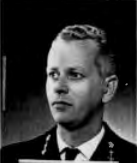
A photo of Peter as officer.
Peter grew up in a time of great tensions. He joined the navy while the Korean War (1950–1953) was ongoing. During this war, the Netherlands sent ground troops. During his period as a reservist, the Netherlands faced the threat of conflict with Indonesia, which was receiving support from the Soviet Union, over the issue of Papua New Guinea. This even led to a naval battle (the Battle of the Vlakke Hoek). Ultimately, the Netherlands managed to avoid war by ceding Papua New Guinea in 1962. Later that year, the Cuban Missile Crisis broke out, further escalating global tensions. However, it did not lead to a large-scale war in which Peter was involved, as Sikke had been in his time.
Roger (1987-1988)
Roger, my father, like Sikke, was subject to military conscription and had to complete his service in the army. In March or April 1987, he joined the Royal Dutch Army. He served as a conscript toward the end of the Cold War, a period during which tensions were easing but had not yet disappeared. In the Soviet Union, Gorbachev had been in power since 1985 and was implementing reforms, but at the same time tensions with the Soviet republics were rising. Furthermore, the Soviet Union was still engaged in a long-lasting war in Afghanistan (1979–1989). It was in this context that Roger completed his military service.
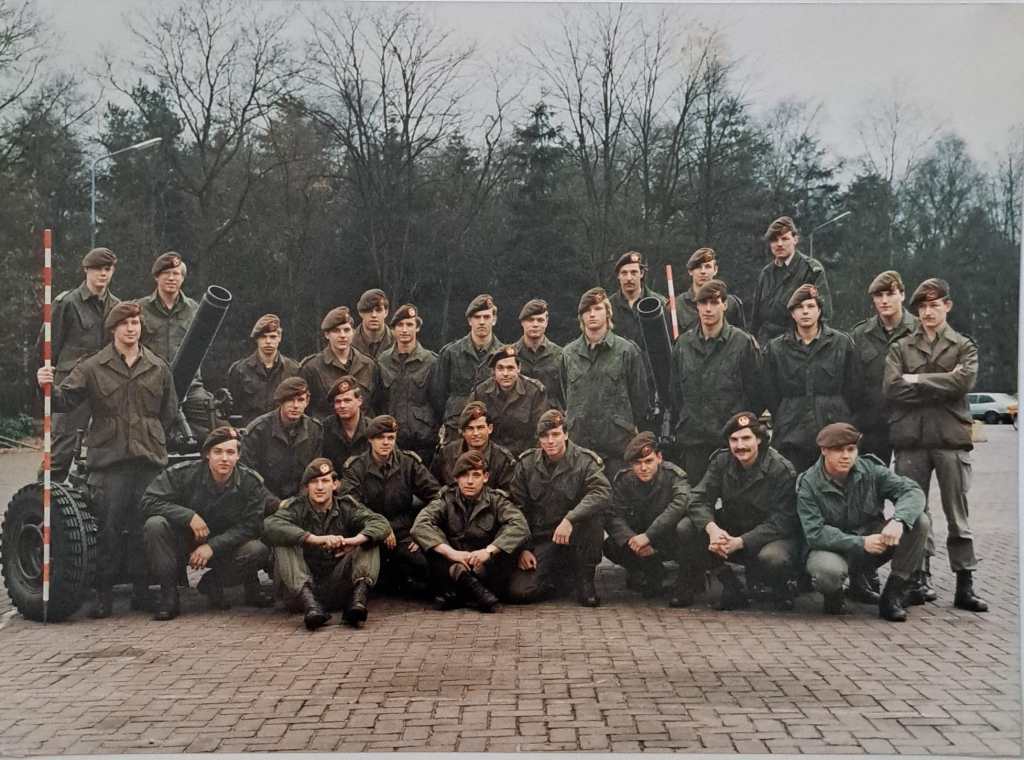
Roger in the middle together with his fellow servicemen.
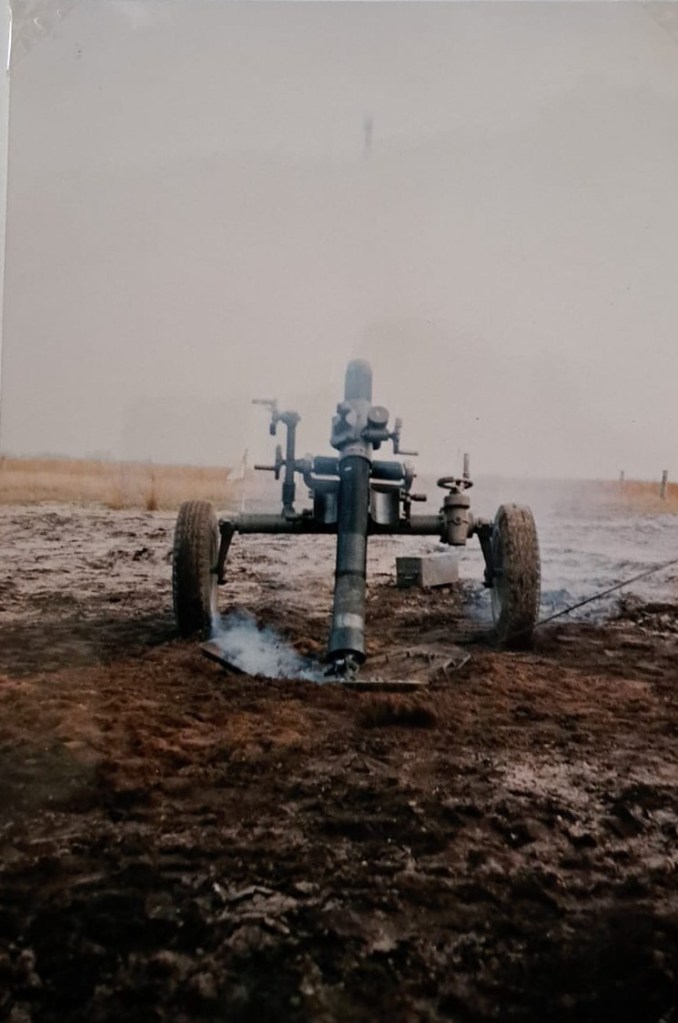
A mortar was fired. If you look closely, you can see the mortar flying.
Roger was stationed at the J. van den Kornput Barracks in Steenwijk, where he was part of the 45th Armored Infantry Battalion. This was a unit of the Regiment Infantry Oranje Gelderland. He was assigned to the mortar section, which had the task of supporting the armored infantry. Roger was very good at math, which made him well-suited for the mortars. He had to calculate the coordinates where the mortars were to strike quickly and accurately. Roger was promoted to non-commissioned officer and reached the rank of sergeant. In that role, he served as a fire controller.
In September 1988, Roger participated in a NATO exercise in West Germany, Operation Free Lion, under the command of the Dutch military leadership. The Netherlands provided approximately 33,000 troops for this, while Germany, the United Kingdom, and the United States together contributed about 10,000 troops. In total, Roger served in the military for around thirteen months and was discharged from military service in October 1988.
Like Peter, Roger did not have to play a role in a war in which the Netherlands was involved.
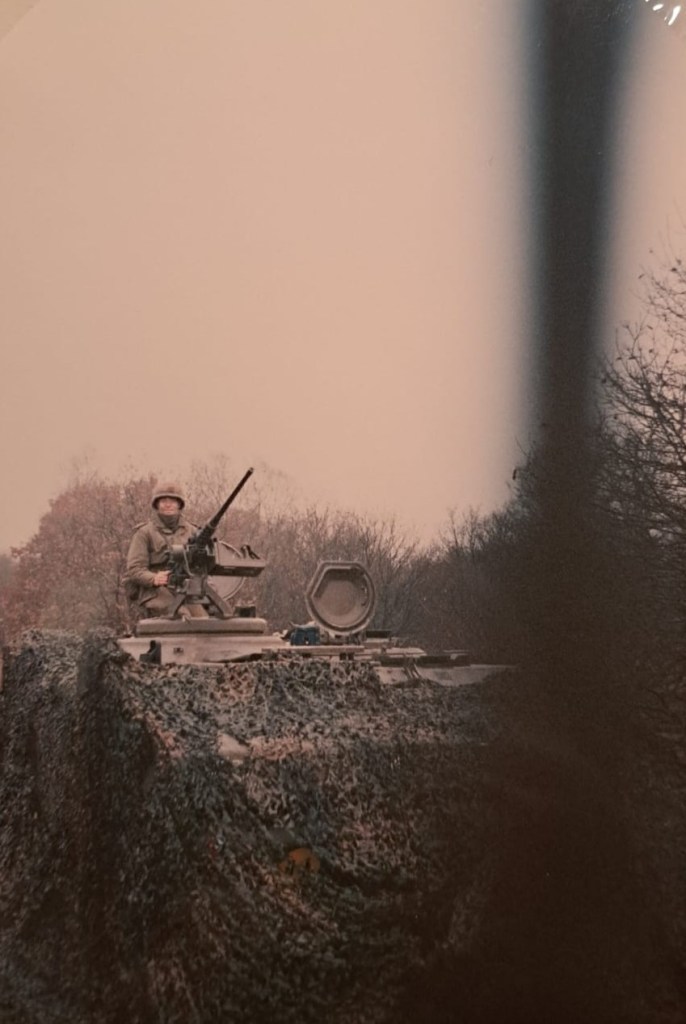
Roger on top of an armored vehicle at the machine gun.
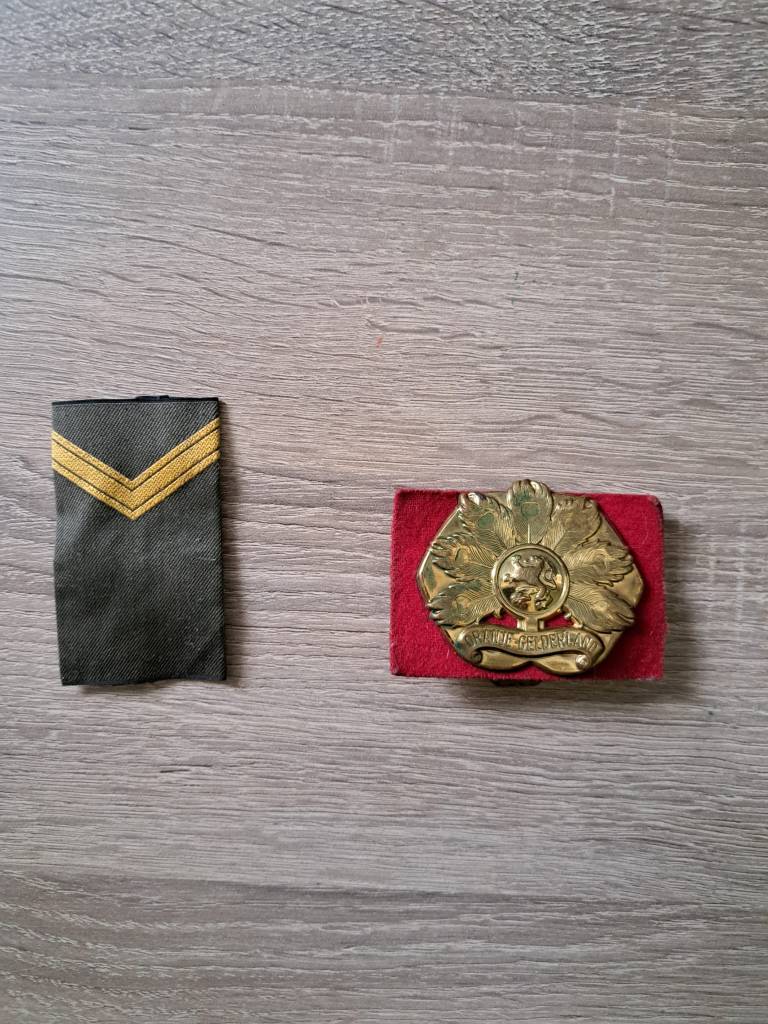
On the left, the rank of Sergeant, and on the right, the logo of the Orange Gelderland Infantry Regiment.
Me (-)
Finally, myself. Unlike my great-grandfather, grandfather, and father, I did not have to serve in the military. I was born in 1999, so conscription for my generation is something from the distant past because compulsory military service has been suspended since 1995. The American sociologist Francis Fukuyama wrote about “the end of history” after the fall of the Berlin Wall. According to Fukuyama, large-scale conflicts would belong to the past, and the international community would primarily focus on economic issues. This analysis proved not entirely accurate because tensions have increased significantly since then. The terrorist attacks on the Twin Towers (2001), the war in Afghanistan (2001), the Iraq War (2003), the Russian invasion of Georgia (2008), the Syrian civil war (2011), the Russo-Ukrainian war (2014), and the war in Gaza (2023) show that tensions have not decreased.
Due to these increased tensions, the Netherlands is considering reintroducing conscription. It also remains uncertain whether the current geopolitical situation will ultimately escalate into a large-scale war, in which the Netherlands could potentially become involved. Only time will tell whether I will eventually have to serve in the military.

A helmet without a wearer.
Sources
- Archief Defensie, Militaire gegevens van Peter (Lichting 1950).
- Interview met Roger.
- NATO Archives, Item IPT 123/344 – NATO FALL EXERCISES 1960, https://archives.nato.int/nato-fall-exercises-1960.
- NATO Archives, Item MC 0043/18-DRAFT – NATO EXERCISES 1965, https://archives.nato.int/nato-exercises-59.
- Sander Ruys, ‘PANTSER INFANTERIE BATALJONS YP 408’, DAF YP 408, https://www.dafyp408.nl/painfbats.htm.
- Sikke Hiemstra, Dagboek Sikke Hiemstra: Mobilisatie 1939-1940, https://soldaatsikkehiemstra.com/dagboek/versie-ii/.
- Vereniging Dienstplichtigen Koude Oorlog, ‘Overzicht oefeningen dienstplicht periode tijdens de Koude Oorlog van 1949 – 1 mei 1997’, https://41dko.nl/overzicht-oefeningen-dienstplicht-periode-tijdens-de-koude-oorlog-van-1949-1-mei-1997/.
 Soldaat Sikke Hiemstra