Sikke’s poems
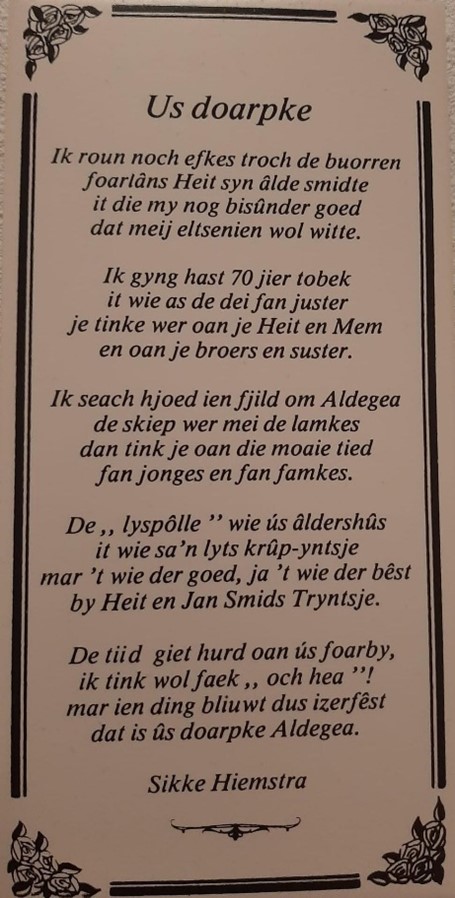
Sikke loved to write poems, and some of them have been preserved within the family. Below, I will share a few of his preserved poems. The texts are changed because they are an English translation of the original. The first poem is a Frisian poem titled Us Doarpke (Our Village). This poem is displayed on a tile at my aunt’s house, Corine de Vries. The second poem, titled Voor het Hoekje (Before the Corner), was found in his war diary. He wrote this poem for a recitation contest in 1923. Sikke came in second place during the contest and received a medal for his poem.
Us Doarpke
Translation:
Our Village
I stopped by the neighbors via my father’s old smithy; it warmed my heart that everyone still wants to know.
I went nearly 70 years back, it felt like yesterday, thinking again of my father and mother, and of my brothers and sister.
Today, I saw a field near Oudega, with the sheep and their lambs. It makes you think of those wonderful days of boys and girls.
The “Lyspôlle” was our family home; it was such a small, cozy place, but it was good there, yes, it was quite nice by father and Jan Smids’ Trijntje.
Time passes us by quickly; I often think “oh yes!” but one thing remains incredibly strong: that is our village, Oudega.
Sikke Hiemstra
Voor het hoekje // afd:huim
1.
It was on a beautiful summer morning,
When every person enjoys so much
The friendly play of sunrays
And the cheerful sound of birdsong,
That Sir Constant of Pimpelmeezen
Hung his house jacket on the coat rack,
And, dressed in his finest suit,
Went for a very calm and leisurely stroll.
No place more beautiful to wander,
Could one find in the entire area.
Than the forest path, where the dense foliage
Let one walk in the shade.
Sir Constant of Pimpelmeezen
Thus made a quick and firm decision,
And went very dignified and very proper
Toward the lovely forest path.
But Sir Ko Piet Da Leo Pompa,
Who lived on the other side of the forest,
Also decided that morning
To set out for a walk.
And in high spirits, he very lightly,
And with a cheerful mind,
Humming a merry little tune,
Also made his way to the forest path.
Sir Constant of Pimpelmeezen
Had already made his choice,
And wanted to walk pleasantly for an hour
On the right side of the forest path.
For on the right side, you see,
There was moss on the lovely path,
And he preferred moss underfoot,
As he suffered from corns.
But Sir Ko Piet Da Leo Pompa,
A bit corpulent and heavy on his feet,
Preferred to be on the other side,
So he chose the stones.
“Moss always gives slippery soles,
And slippery soles don’t hold firm,”
He said, for our stout friend
Had no trouble with corns.
2.
Thus strode Constant van Pimpelmeezen
In full dignity ever onward;
He greeted people left and right,
Very kindly, but spoke not a word.
And Sir Ko Piet Da Leo Pompa,
Less formal, but still neat,
Also calmly walked his way,
But jested with all he chanced to meet.
Yet that forest path marked the boundary
Of Kalverdijken and Pompernet,
And so a wooden fence was placed
Along the snow-covered path, well set.
A small gate offered passage to all,
To cross to the other side if they sought,
And both villages together kept
The fence and gate, as they ought.
Sir Constant van Pimpelmeezen
Arrived at last before the gate
And saw Ko Piet Da Leo Pompa
Standing just on the other side, by fate.
They knew their world well, wise as they were,
And bowed to each other with grace.
But who would pass through the gate first?
That was now the great question to face.
“After you, sir,” humbly sounded
Sir Pimpelmeezen’s courteous tone,
But Sir Ko Piet Da Leo Pompa
Thought, “No, I’ll give all honor to him alone.”
And with a graceful bow, his Noble self,
With a loose and tasteful hand gesture fair,
Spoke: “Oh no, Constant van Pimpelmeezen,
All the honor to you! Step forward, if you dare!”
“No, Sir Ko Piet Da Leo Pompa,
To me the pleasure of the honor, please!”
“Oh no, my Lord,” the other replied,
“You go ahead; I insist on this.
For you are much older in years
And your venerable lineage, so grand,
Has lived in this country and in these regions
And brought their whole lives to this land.”
3.
“I am by descent but a stranger,
My forefather was a Portuguese,
And Great-Grandma’s great-great-grandfather
Belonged to the refugées.
I am here at the gate, thus the lesser,
I feel that all too well!
And therefore, Sir of Pimpelmeezen,
You first, thus, all the honor to you.”
“No, Sir Ko Piet Da Leo Pompa,”
Thus our other one began again,
My ancestors for many centuries
Have humbly gone before each one
And therefore, you first through the gate!
By me, loyalty must wait on you.
I owe this tribute to you,
In honor of my ancestry.”
“My fathers were also very humble
And always gave honor to another,”
So spoke Ko Piet, and with a bow
Sounded again: “To you, then, the honor.”
“I won’t do it; I never will,”
Said Sir of Pimpelmeezen angrily,
You shall be the first to pass through the gate;
“I will stay here, if need be, forever!”
“Now listen, the Da Leo Pompa’s
Are famous for their steadfast will.
I do not wish to go first through this gate;
My honor, sir, is worth something too!
I will stand here until you pass,
Even if it takes an eternity,
I have the courage for it, for, you see,
The word ‘Leo’ means ‘lion’ in Dutch.”
Sir Constant of Pimpelmeezen
Now took a proud stance
And said: “Sir, Constant is my name
And I will stay constant before the gate.”
And to match deeds to words
He stood at “attention,” and muttered after:
“You first through the gate, and if you remain stubborn,
Well then, here I am, and I stand!”
4.
The sun shone brightly; the sun shone blazing,
But both men stood their ground;
For it would have been beneath their honor
To be the first to cross the gate.
But Sir Constant of Pimpelmeesen,
Turned around, angrily laughing,
And on the hard stones, he fiercely
Hurt his corns.
Also, Sir Ko Piet Da Leo Pompa
Chose, laughing, the moss path short and clear,
But due to the slickness of his soles
He twisted his right foot’s tendons.
A jester, who overheard it all,
Shouted out cheerfully in a loud voice:
“There are many fools in the world,
But these two are d.u.m.b.”
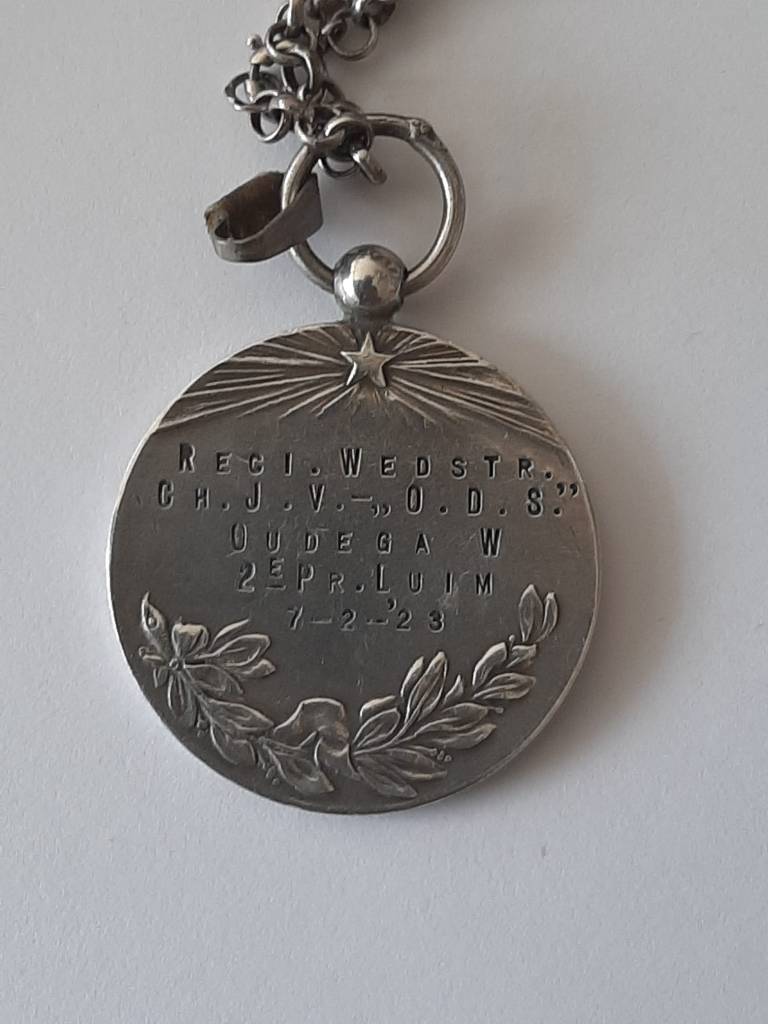
Backside of the medal.
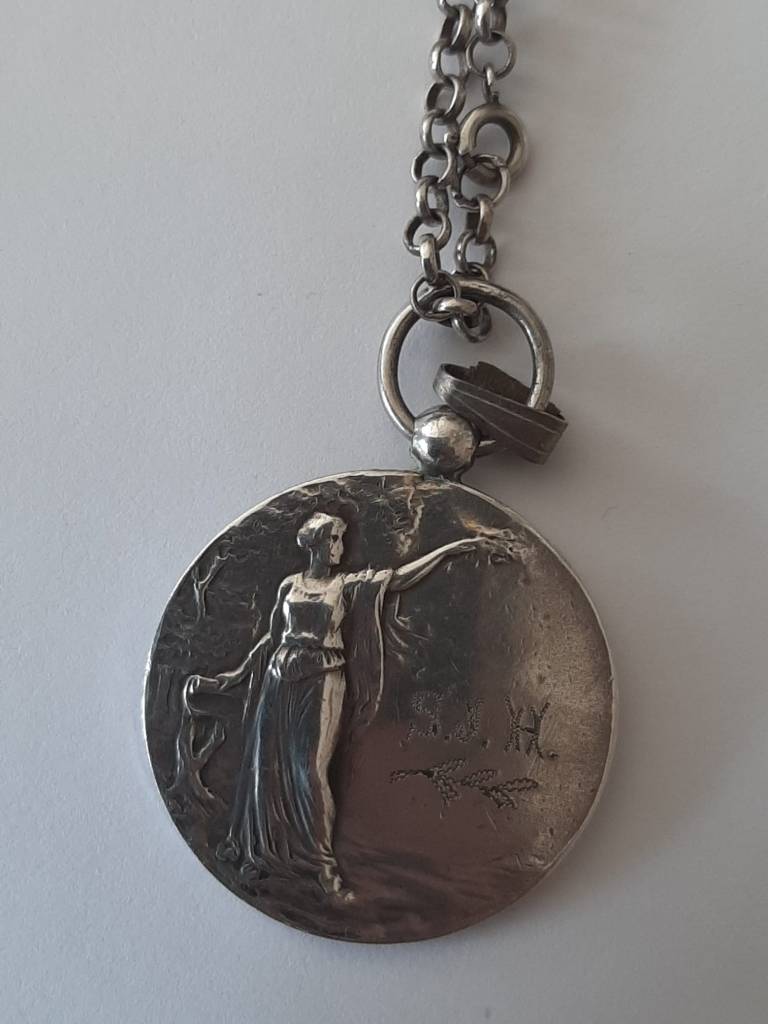
front of the medal.
 Soldaat Sikke Hiemstra