Version I
Version I presents Sikke’s diary, with some changes in order to provide better readability. In this version, language errors have been corrected, and images have been added. If you want to know the difference between Version I and Version II, please go to the section About the Diary and the subpage Versions.
August-1939
M. August 28
The radio announces that the Netherlands will mobilize completely, and 15 batches will be called up.[1] I’m picked up from work and I’m still getting everything in order. I visit family and stay home in the evening. The mood is depressed, but we are not despondent. The children ask me all kinds of things about why I have to leave. The city is busy and everyone is impressed.
Source: Netherlands Institute for Sound and Vision, Nederland Mobiliseert, Public Domain, via Openbeelden.
The Dutch mobilization began on August 28, 1939. The Polygoon newsreel also covered it in a segment.
T. August 29
At 6 o’clock, I say goodbye to the children who are still sleeping peacefully upstairs, and Ym is doing fine. At 6:30, the train departs, and it’s very busy at the station. By 8:30, I am in Schoorl and meet all my old service friends, including S. de Haas, Feake, Saap, Piet Hofstra, Braat, and so on. We are staying in the Mennonite Brotherhood house and are part of the 3rd company, 9th Regiment Depot Battalion, III Depot Infantry.[2] The weather is lovely, and the mood is good. At 6:30 in the evening, I will go on the first watch.
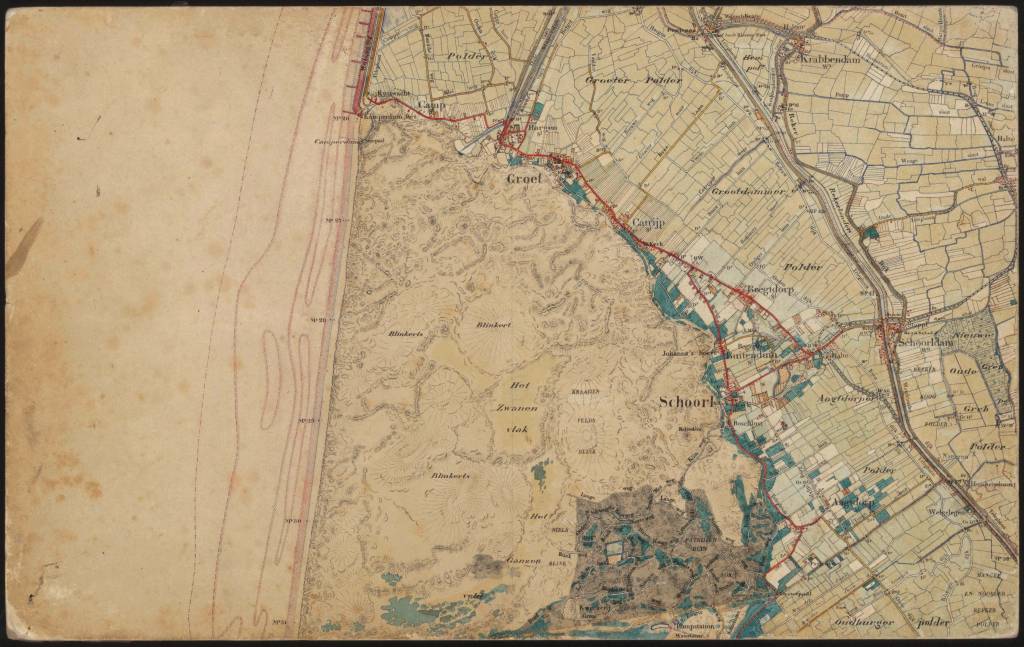
Schoorl was the first destination where Sikke was sent
as a mobilized soldier at the beginning of the mobilization.

The station was the starting point for many mobilized soldiers. For Sikke, the station in Hoorn marked the beginning of his journey by train to Schoorl. It also signified the start of his mobilization period as a soldier.
W. August 30
Last night, I was on watch and saw hundreds of cars passing by (troop transport). We’re also helping to set up the chapel for accommodation. I get my first kuch, and it tastes good. At 5 o’clock, we get a hot meal. After the service, there’s a walk to the village, where I meet even more guys with whom I served. I get to know G. de Bok and W. ten Wolde, and I write a letter home.
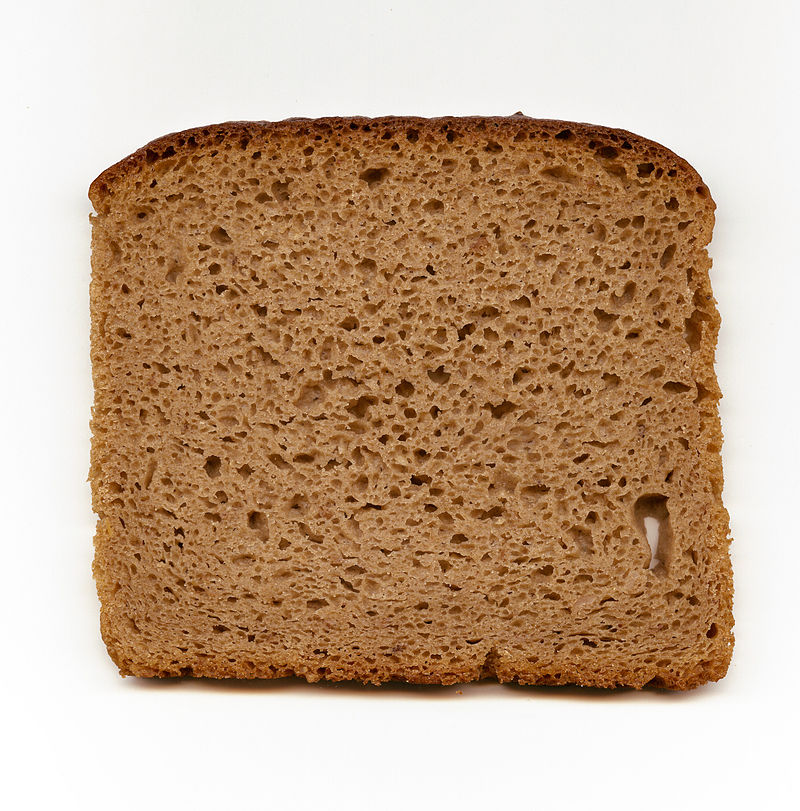
Kuch was the usual bread during the mobilization and was also known as ammunition bread.
T. August, 31
Queen’s Birthday.
At 7 o’clock we get up, and after breakfast, our new service clothes are distributed. The weather is warm, and the surroundings are explored a bit with a walk around the area. It is announced that we are not allowed to go to Schoorl, and we will remain confined within a 0.5 km radius. At 5 o’clock we have a warm meal with potatoes, green beans, and meat porridge. At 10:30 we go to bed in the straw and receive a blanket.
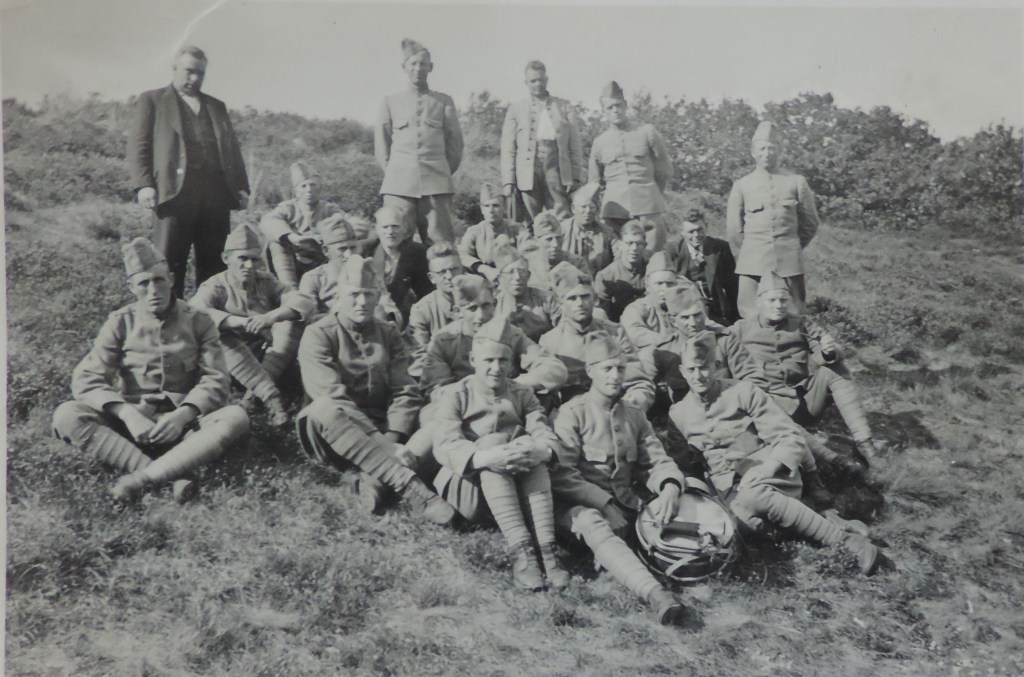
This is what the soldiers’ uniforms looked like during the Dutch mobilization. Sikke is in the middle of the group (wearing glasses and without a cap). The exact date and location of this photo are unknown.
[1] Batches are groups of soldiers that are called up together for military service.
[2] In 1939, a company consisted of about 160 men, a regiment of about 2,500 men, and a battalion of about 750 men. The depot battalion served as a training center for incoming draftees.
September-1939
F. September 1
It is beautiful weather again and at 8 o’clock I first listen to the news reports. There is no special news. Our captain introduces himself to us as Lopes de Leao. He asks for our cooperation in this difficult time and the service is not performed. I am assigned to the 1st section under commander 1st Lieutenant Hoogland, a good guy just like the captain.[1] We continue to enjoy the summer and at 11 o’clock I go to take a nap.

Throughout his life, Sikke regularly used a pocket watch to tell the time. It is likely that he also used it during the mobilization, which allowed him to accurately record the times in his diary.
S. September 2
On Saturday we receive a wash can, a towel, and shoes. We help improve the sleeping arrangements in the chapel. Meier es Hildebrand is appointed as sergeant by the section. The pay has not yet been issued and in the afternoon, there is just regular duty. Nothing of significance happens and we regularly listen to the radio for news reports. We do not receive any mail at all.
S. September 3
The first Sunday of the mobilization. In Schoorl, it is incredibly busy, with hundreds of cars from family members visiting the soldiers, causing traffic jams. Buses are coming from Frisia and Groningen, but I don’t have any visitors this Sunday. This Sunday goes by fast, and the summer weather is splendid. In the evening, everyone says goodbye to each other. The touching moments in a soldier’s life (I think of home).
M. September 4
The weather is nice again. After the kuch, the service is a walk to Camperduin by the sea.[2] There is nothing special to see at the sea, just a few airplanes flying along the coast. The state of war has not changed. It is very hot, and in the evening, there is intense thunder, though without rain. Some boys receive mail, and there is no news further.

inventory number 3509.
A photo of the beach of Camperduin. Sikke, as a soldier, was surrounded by a beautiful natural area.
T. September 5
We start this day again with great courage. The mood among us is good, and we are working on the trenches for the air protection service.[3] The 1st section begins in the pines behind the chapel. In the evening, I receive a postcard from my wife in Hoorn, everything is fine under the circumstances. The children are also doing well. At 8 o’clock, I go to Groet.
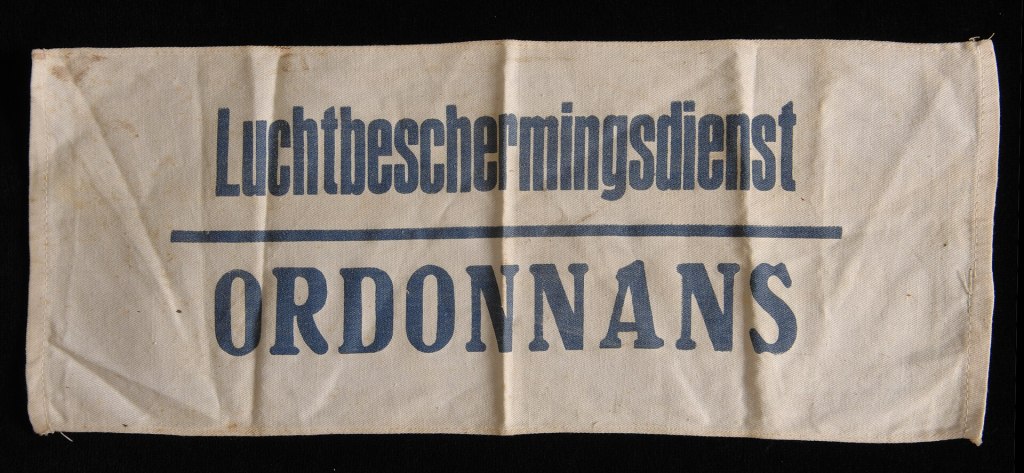
This arm band was worn by volunteers of the Air protection service. Perhaps Sikke met one of its members.
W. September 6
After breakfast, we go back to the trenches. Almost nothing is done because it is too hot. In the afternoon, we take a walk in the dunes and stay there until 4 o’clock. At 5 o’clock, the bell rings, and we eat outdoors. The food is fine, and we get fruit for dessert. In the evening, I receive a letter from father in Oudega, all is well. Manus is in service with the motor corps in Haarlem, and there is no other news.

Ultimately, Sikke’s younger brother, Andries (Manus), was also mobilized in 1939. Since 1938, he had been a member of the Vrijwillige Landstorm (Volunteer Landstorm), an organization of armed civilians supporting the regular army. This made Andries one of the Landstorm members who participated in the Dutch mobilization.
T. September 7
I get up from the straw at 7 o’clock. The weather is nice again, even warm. We receive a straw sack, and everyone fills it. I write to Hoorn and Oudega. Major Arnoldie informs us that we must salute to non-commissioned officers, and at half past 6 I must stand guard in Schoorl.
F. September 8
At two o’clock last night, I was on duty at Hotel de Roode Leeuw. There were no special events. At half past 6, I am being relieved, and my new coat is stolen from the guard room. I report this to the commander and go to bed early due to the watch. In the evening, the bell rings late in the chapel, and the captain comes to urge us to silence.
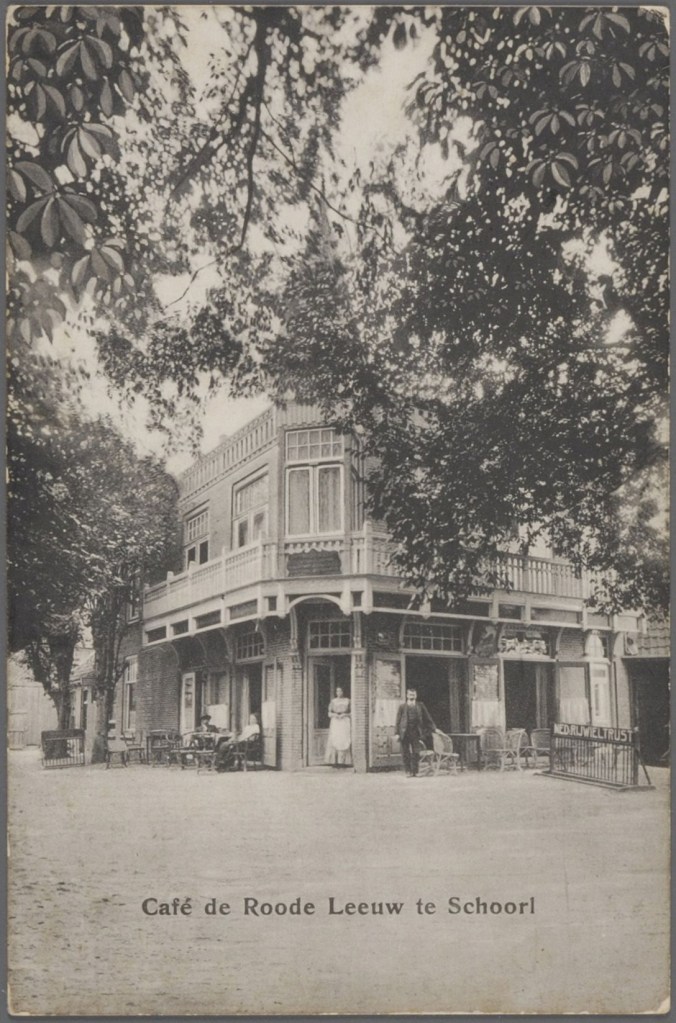
This was the place where Sikke had guard duty.
S. September 9
It is Saturday morning, and today the weather is getting warm again. To our regret, we receive a rifle and a few more pairs of socks. In the afternoon, we receive our first pay, 32 cents per day/224 per week.[4] It’s not too bad. In the evening, I go with Geert and Wiebe to the shop around the corner, and we buy postcards for the children. Nothing else to report.

The Mannlicher M.95 was used by the Dutch army during World War II. This rifle was also handed over to Sikke.
S. September 10
On Sunday morning, I go to the Dutch Reformed Church in Schoorl. A Reformed preacher is preaching, and the church is packed. At 1 o’clock, during lunch, I receive a visit from father, Ym, and the children. They have come by car from Hoorn. Little Siep is lying in a cradle in the car, and we take a trip to the sea, heading towards Camperduin. It is a beautiful day, and at 5 o’clock, they leave again for Hoorn. In Schoorl, there is a lot of hustle and bustle due to the visits and it is a lovely evening in the dunes.
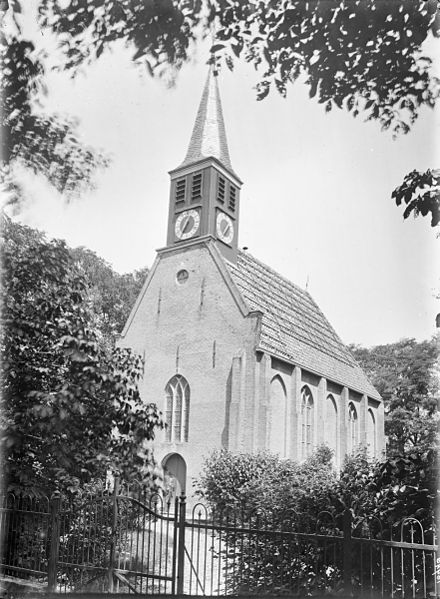
This is the church that Sikke visited during his mobilization period in Schoorl.
M. September 11
Today we are working on the trench, but not much of significance has been done. I receive a letter from Ym, everything is fine at home. We ask about the leave arrangements, but there is still no chance. This afternoon, I went to the climbing dune, and in the distance, I saw the water tower of Hoorn. No further news of importance.
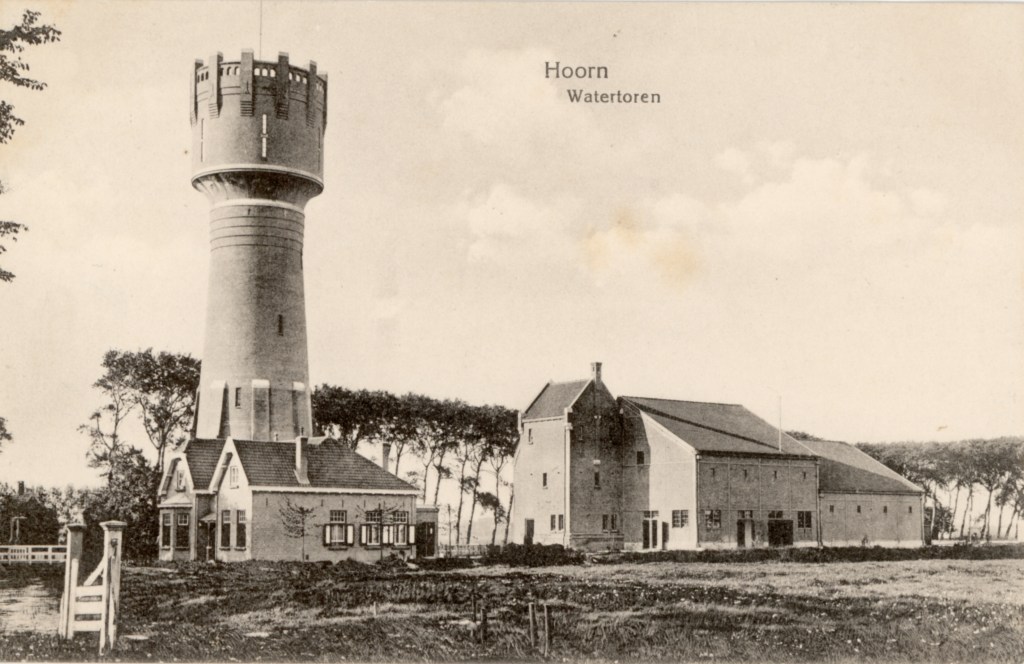
This was the water tower in Hoorn with a height of approximately 40,5 meters. Sikke could see this iconic water tower from the climbing dune of Schoorl.
T. September 12
After breakfast, we start the day with the first roll call on the korfball field. Most of the men are absent, quite a few have gone home. Work is being done on a canteen, and in the evening, I go with Geert and Wiebe for coffee to the youth hostel De Bregthoeve. Additionally, we take a walk in the area with nice weather. Nothing further to report. At 8 o’clock, the ANP has no special news.[5]
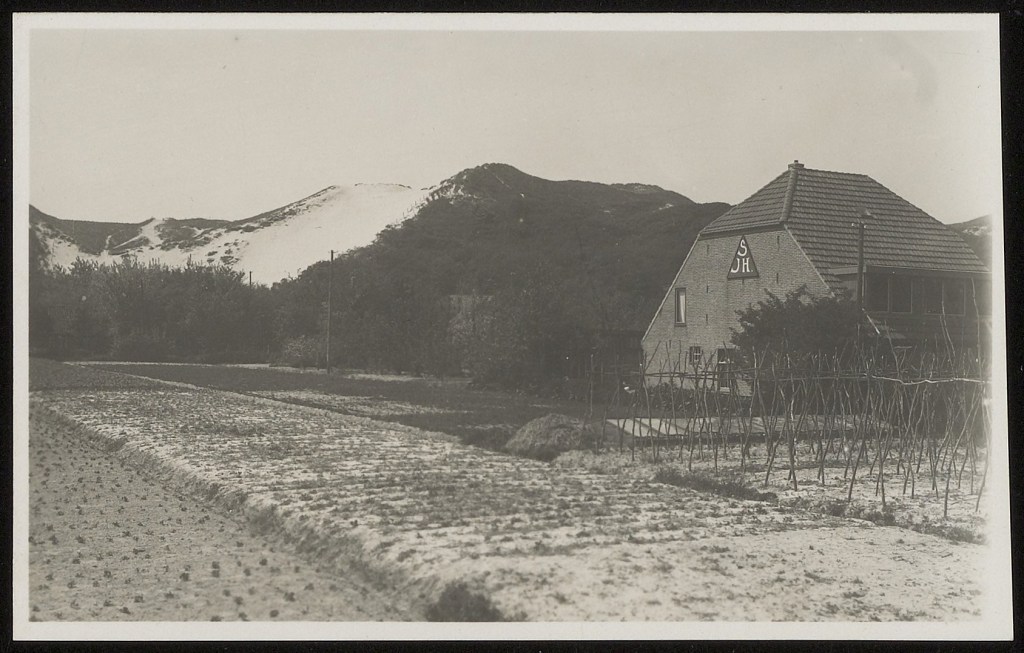
This was youth hostel De Bregthoeve. This was the place where Sikke sometimes drank his coffee.
W. September 13
At 8 o’clock, roll call begins, and afterward, we make a 15 km march to Bergen. It is very warm, and all the boys are suffering from their legs. There is grumbling that it was much too far, but I have no trouble. At 2 o’clock in the afternoon, under the leadership of Sergeant Meier, we head through the dunes to the sea. The rest stay at home, and in the evening, there is nothing to report.
T. September 14
We receive shoe polish to blacken our shoes. This is the hardest work we do today. At 5 o’clock, we eat outdoors behind the Brotherhood House, and the food is quite good. After dinner, there is a thunderstorm, without rain, it is very dry. I receive mail from Hoorn and Oudega, everything is in good order. No further news.
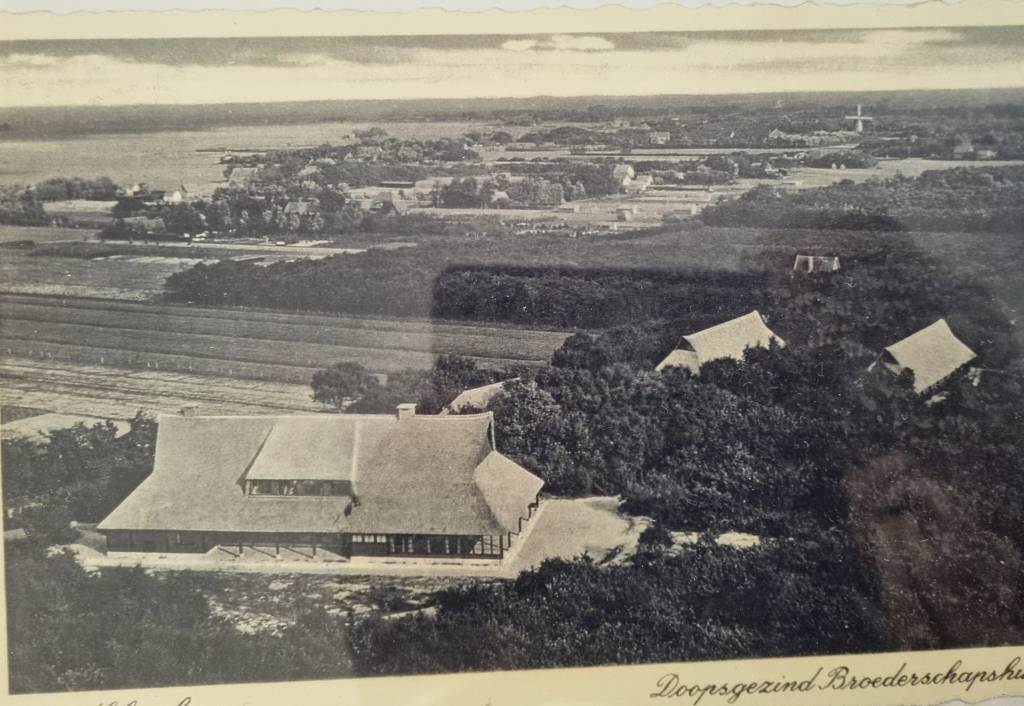
This was the mennonite Brotherhood House in Schoorl. This was the place where Sikke was stationed.
F. September 15
The day is once again spent resting. In the morning, we go into the dunes, and in the afternoon, after lunch, we take a walk to Camperduin. At sea, we see warships from our navy, and airplanes fly along the coast. Some mention a 4-day leave per month, but the date has not yet been set. The evening brings no news.
S. September 16
It’s Saturday again, and I hear myself saying, “How much longer?”. There is no news today, except that there will be a movie screening in the canteen tonight. It’s a lovely evening. The films Ons Prinsesje Loopt and One Hundred Men and a Girl are very nice. At 10 o’clock, we go to bed on the straw sack, but it’s warm in the chapel and we are greatly bothered by flies.
S. September 17
We don’t have duty, and at 10 o’clock I go to church. It’s less crowded than previous Sundays, and even the hustle of civilians and acquaintances visiting soldiers isn’t as large anymore. In the evening, there’s an evangelistic service behind the “Roode Leeuw’’, led by ds. Kruis from Alkmaar.[6] It is a beautiful service with few soldiers, around 50 (excellent speakers).
M. September 18
At 9 o’clock, we assembled for an 8 km march to Schoorldam. It was a good exercise. In the afternoon, there was no duty, so we went back to the dunes to entertain ourselves. This evening, we are doing a blackout drill, all lights must be turned off. We are sitting with Jan Vries’ music, singing along with his harmonica (“We are not afraid”). Arnoldie reprimands us to be quiet: “It is duty,” he says.
T. September 19
Work is being done on the canteen because tonight is the opening by our commander.[7] There are performances by Mr. Westra as a humorist and Schram as a magician. It is a brilliant evening with speeches, flowers, and so on, and so on. Tea and coffee are free, and the captain gives everyone a cigarette. At half past 11, everyone goes to bed, and during the night, it is still warm by the dunes.
Source: Netherlands Institute for Sound and Vision Opening van een militaire cantine, Public Domain, via Openbeelden (from Stichting Natuurbeheer).
Not only was work being done near the Mennonite Brotherhood House to set up a military canteen, but canteens for soldiers were being built all over the country.
W. September 20
Today we are marching to Bergen in good weather, but the sky is cloudy. At half past 11, we return back at our quarters. There are talks of a transfer, but Lopes de Leao calls it nonsense. Next week, leave will start, and there is general appreciation for it. Furthermore, there is no news. However, good news from Hoorn, everything is fine. No further news today.
T. September 21
Thursday morning we receive lesson in rifle drills, and Lieutenant Hoogland teaches us. This afternoon we go to the bathhouse in Schoorl, and we return feeling refreshed. Tonight, I have to stand guard at the gate at 6:30, and everything goes as usual. It’s still very much summer, and the night is beautiful. There is no news, not even on the radio. I long for leave, to see home again.
F. September 22
Got up healthy and well at 7 a.m. again. The weather is nice once more, and we haven’t had a bad day yet. We didn’t do much today, and we’re spending the day at the beach again. I received a message from Oudega, everything is fine, and Fokke might come to Schoorl by motorbike on Sunday. There’s no other significant news. It’s fine here today.
S. September 23
Today, we took a walk to Alkmaar, with a few dropouts. I’m still feeling fit and have no complaints. At 5 o’clock, I had a delicious meal: potatoes, red cabbage, and minced meat stew. This evening, I went up on the dune to admire the surroundings, with a beautiful panoramic view. After that, I went with Geert and Wiebe to Bregthoeve for coffee, and at 10:30, I’ll be heading to bed.
S. September 24
At 10 o’clock, I went to church. I was expecting my brother Fokke. But I waited until 2 o’clock, and he didn’t show up. That’s unfortunate because you’d like to hear some news from Oudega. Everything is going well in Hoorn, and Ym and the children are doing well. This Sunday we are bored, and in the evening, I take a walk to Hargen. The weather is nice, and I go to bed at half past 10.
M. September 25
This Monday begins at 9 o’clock with the distribution of the war booklet and the tag for your neck, in case you fall in the battlefield of honor. In the afternoon, there is a gas drill in the gas chamber. The exercise goes successfully, and everyone returns alive to the chapel. In the evening, we rest from the day’s duty in the dunes. There’s no further news, and I send a message home.
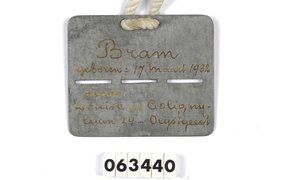
Dutch identification tag were used during the mobilization period. Thanks to these tags, the identity of soldiers could be determined in case of death. The identification tag in this photo belonged to Bram.

The war pocketbook contained information about the soldier, such as regiment, draft year, family, date of birth, vaccinations, and clothing size. Additionally, the book also included information that could be useful for soldiers in a war situation. This war pocketbook belonged to 1st class Adjutant O.O.A. Entrop.
T. September 26
Today is a day without much to do. In the morning, we go to the sea for a swim, and in the afternoon, I rest on the straw sack. Life is starting to get boring, and in the evening, we have to do an evening drill. At 9 o’clock, we have to assemble, and we drill until 11. Everything went well, and the commander is very satisfied with us. Now off to bed and sleep.
W. September 27
For the first time, we have a practice session with the light machine gun. We don’t know much about this weapon. After the afternoon break, it’s time to clean the rifle, which has never been used. That’s enough for today, and in the evening, we had a nice chat in the canteen. There’s no further news, see you tomorrow, and good night.
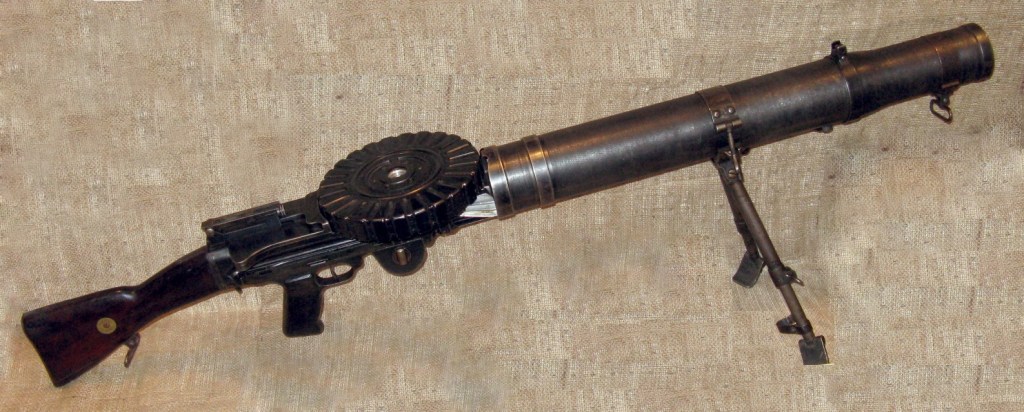
This picture shows the British Lewis Gun. During the mobilization, the Dutch army used the Lewis M.20, a variant of this weapon. The light machine gun Sikke was referring to probably looked something like this.
T. September 28
Upon waking, I tell myself: “the first month is over” and “how much longer?”. The situation doesn’t change much. In the morning, there’s no significant service, and in the afternoons, the leave lists are posted. I am scheduled for the 7th and 8th of October, but businesspeople go first. There is joy in the chapel, and beyond that, there is no news. Everything remains the same.
F. September 29[8]
It is a very important day because Prince Bernhard is visiting us. I had the great honor of speaking with him. He asked about home and a few other things.[9] It is a moment I won’t soon forget. In the afternoon, there is no service, and in the evening, I am going to Schoorl. Tomorrow, I am going on leave to go home. This has been moved up because we are being transferred to Weesp.
S. September 30
At half past 11, we receive our pay, 224 cents. At 4 o’clock, I leave via Alkmaar to Hoorn, and by 6:30, I am home. Everything is fine, including the children. During my leave, I visit a few acquaintances, like Van Putten, Van Pluo, etc. In the evening, I don’t feel like a soldier in the city. It’s cozy at home because it’s something new. I go to bed at 11 o’clock, this is definitely better than the straw sack.
This is Hoorn, the city where Sikke came from and where he lived with Ym and their children.
[1] In 1939, a section was composed of 30-34 men (approximately).
[2] Kuch was primarily eaten by soldiers, and was known as ammunition bread.
[3] The Air Protection Service was an organization of volunteers that tried to protect the Dutch population from the effects of aerial attacks. One of the ways they did this was by constructing trenches for civilians, where they could take shelter during an air raid. These trenches were known as shelter trenches.
[4] This amounts to approximately €59.13 per week (without taking the exchange rate into account) and €26.83 per week if you do take the exchange rate into account.
[5] ANP is the largest Dutch News agency.
[6] Ds. refers to preacher.
[7] The canteen was presumably built on the terrain of the Mennonite Brotherhood House.
[8] There are hardly any other sources available that confirm Prince Bernhard was present in Schoorl on September 29, 1939. The local newspapers do report on his visit to Schoorl on September 20, 1939, but not on a visit on September 29, 1939. It is possible that Prince Bernhard visited Schoorl twice or that Sikke mixed up the dates in his diary.
[9] The conversation with Prince Bernhard had made a big impression on Sikke. The prince complimented Sikke on his “flair” and his beautiful wife.
October-1939
S. October 1
Sunday is my second day of leave. In the morning, I go to the church in Oakstreet, where ds. Snoep is preaching.[1] There’s no more news on Sunday, and at half past 8 I return to Schoorl. At half past 11, I lie down in the chapel on the straw sack. Everything is quiet, and everyone is asleep. I don’t sleep well that night, and at midnight, Lt. Hoogland makes his rounds.[2]

This photo shows Eikstraat, with the church of Sikke on the left-hand side.
M. October 2
Today the weather is less nice, and it rains all day. This is the first bad day of service. There is no duty today, and in the evening during dinner, there is another downpour. In the evening, Clinge Doorenbos performs for us. It is a wonderful evening, full of healthy humor. The song “There Comes a Time When We Will Go Back to Mother” is a big hit. Thank you, Captain Lopers. At half past eleven, I go to bed, good night.
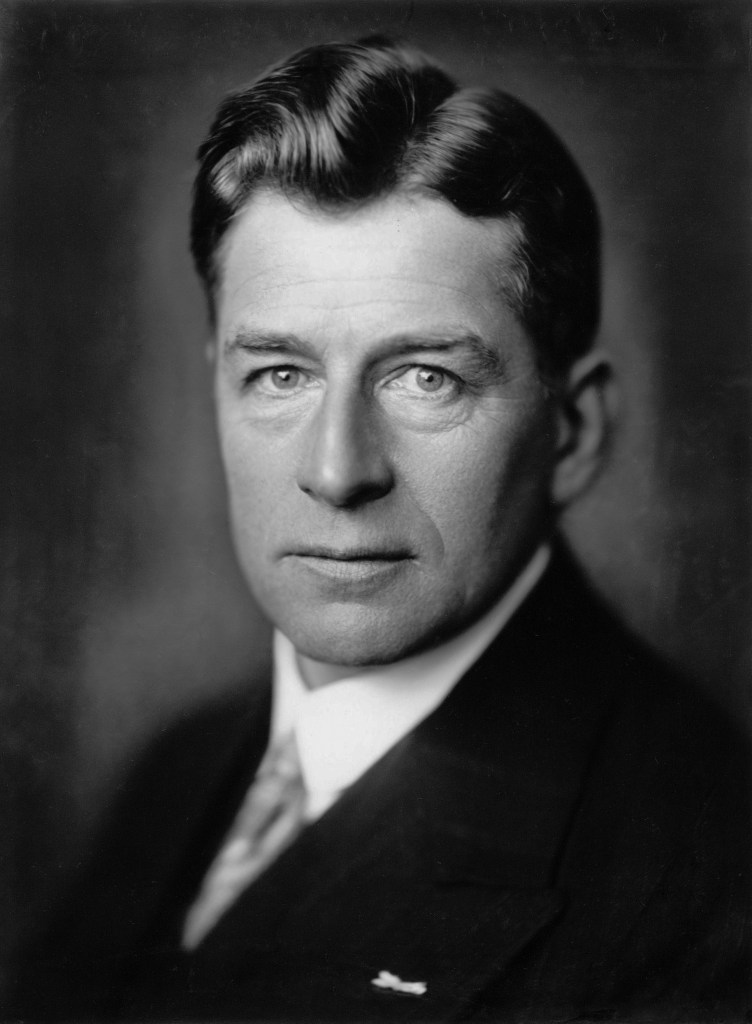
Clinge Doorenbos (1884-1978) was a songwriter, cabaret performer, and singer who performed for mobilized soldiers during the mobilization of 1914-1918. Clinge Doorenbos became increasingly popular for mobilized soldiers during WWI. During the mobilization of 1939-1940, he performed again for a new generation of mobilized soldiers, including Sikke.
T. October 3
News arrives that we will be transferred to Weesp on Saturday. Measures are already being taken in the morning. We are fully equipped, but no one is particularly enthusiastic about the transfer. We are quite comfortable here under the leadership of a distinguished commander, Captain Lopers de Leao, a man who is held in high regard by all the boys.
W. October 4
Today we are going to Schoorl to be introduced and to say goodbye to the commander of the battalion. At the sports field, we are praised with a lot of ceremony, which means nothing; this ceremony belongs to the past. In the evening, we take a walk to Groet. I receive a letter from home and from Oudega, everything is well. At 11 o’clock, it’s time to rest.
T. October 5
This day is not used for service, we prepare our belongings and fully enjoy the nature surrounding the village of Schoorl. In the evening, we discuss our further service time regarding Weesp. Some will not join us and will go to Leeuwarden instead. In the evening, we go to Schoorl one last time, and what tomorrow will bring?
F. October 6
Today is our last day at the depot in Schoorl. During the day, there is no duty, and in the evening, we bid farewell to the officers in the canteen. It is an evening filled with sincere gratitude to our captain. He is moved and wishes us all the best, as well as our families. A soldier thanks him on behalf of all of us with polite words. We say goodbye to a captain who is truly irreplaceable, and it is a wonderful evening for everyone.
S. October 7
Up at 6 o’clock, because everyone has to be at the sports field in Schoorl by 9 o’clock. We arrive in Alkmaar at 11 o’clock and in Weesp by 2 o’clock. The weather is bad, and it rains all day. At 5 o’clock, we leave Weesp for Weesperkarspel, and at half past 6, we reach Fort Uitermeer. However, due to a lack of space, we have to spend the night in the barn at Galesloot c84. At 8 o’clock, there’s a cabaret in the fort, and Cris de la Mar and Tiemmers make for a wonderful evening from a bad day. For the first time this evening, I feel homesick.
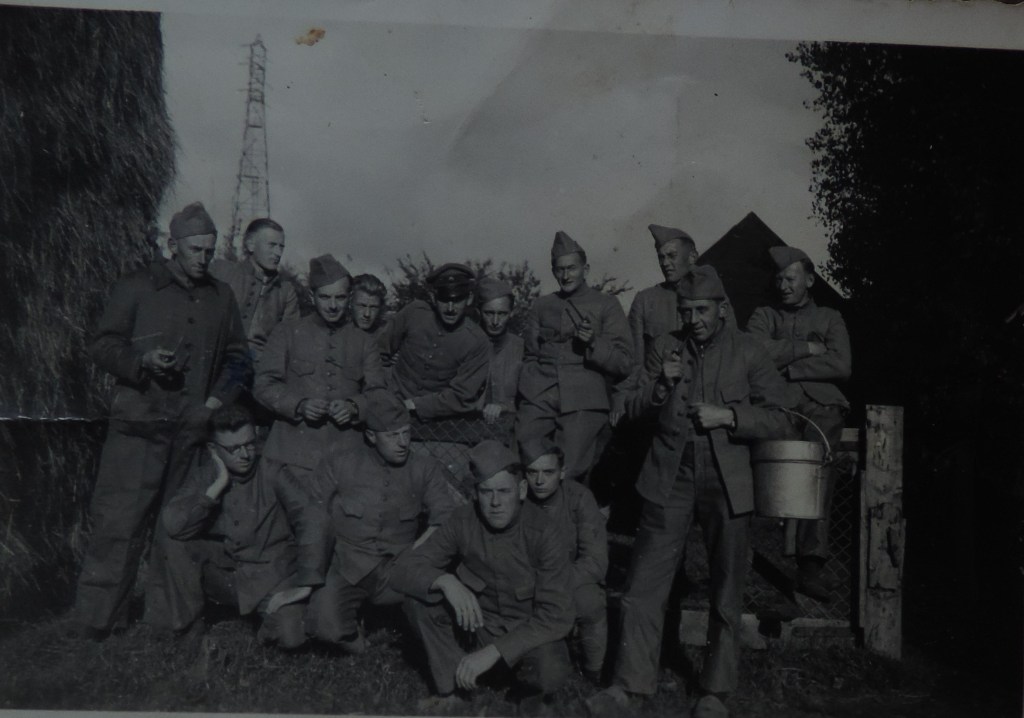
Presumably, this photo was taken at farmer Galesloot’s place. In the photo, Sikke (bottom left) can be seen together with his brothers in arms.
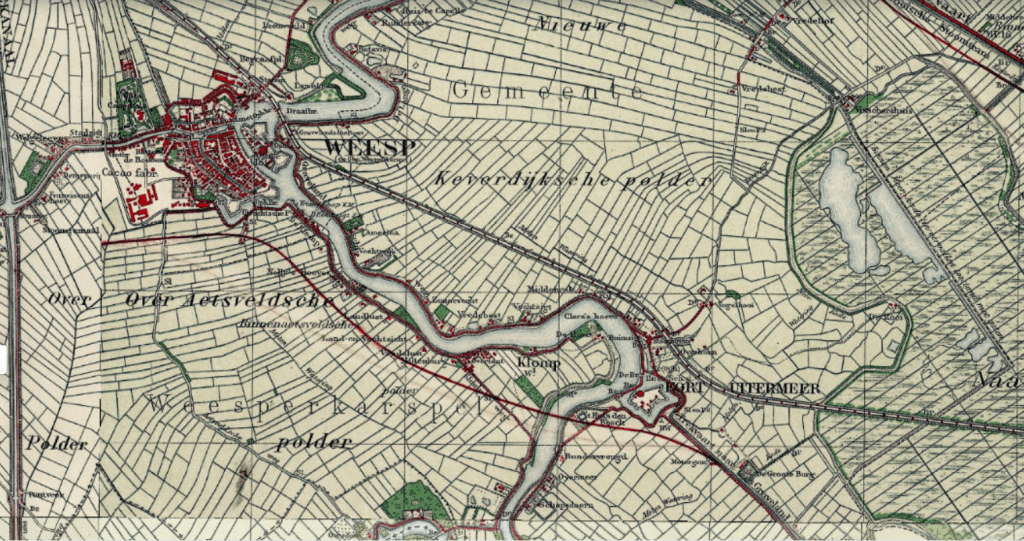
This photo shows the area where Sikke Hiemstra was stationed, with Weesp in the top left and Fort Uitermeer in the bottom right.
S. 8 October
It’s Sunday, and I didn’t sleep well. We are here with 15 people from Amsterdam, and everything feels strange. No one feels at home, and we think about Schoorl, but we are holding on. After dinner, we head to Weesp. Jo van den Akker and I visit the Dutch Reformed Church. At 9 o’clock, we’re back in the barn. I don’t feel well and have a bit of a fever. Not much is being said. It has been a Sunday I will never forget. Tomorrow might be better, goodnight.
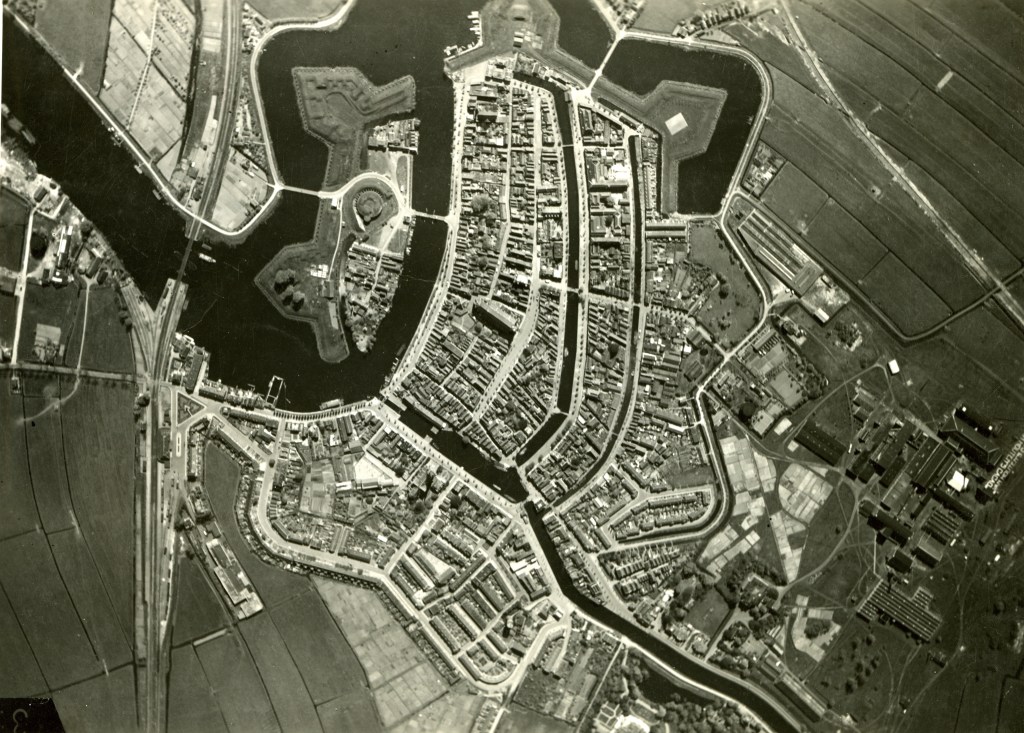
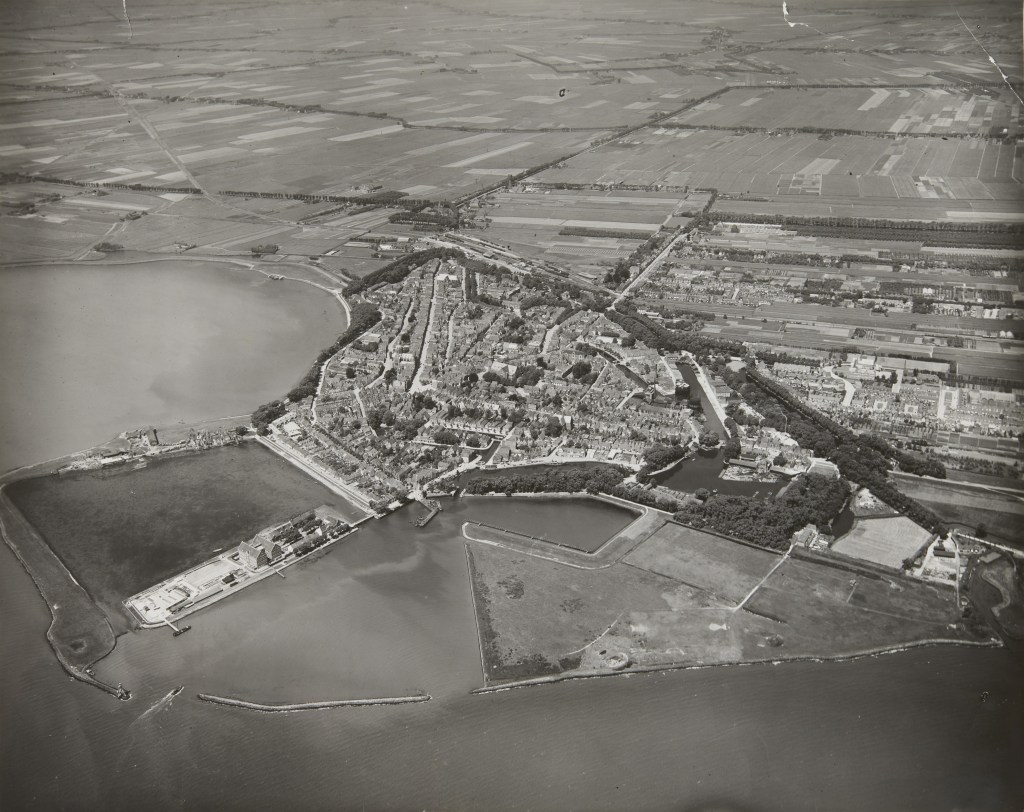
The above photo shows what Weesp looked like when Sikke arrived. Although Sikke stayed at Fort Uitermeer, located in the adjacent municipality of Weesperkarspel, he could often be found in Weesp.
M. October 9
The weather has improved, and our duty consists only of roll calls at the fort. In the afternoon, we go to Boman to request leave, which is granted against our expectation. I leave the barn at 4 o’clock and leave Weesp at 5 o’clock. I arrive in Hoorn at half past 6, everything is fine at home. The children are happy, and Siepie is growing well. There’s nothing special happening in Hoorn in the evening.
T. October 10
First day of leave, and the weather is nice. Everything is still good in Hoorn. I visit the office of the PWN and my boss.[3] Everything is also well with other acquaintances and family. In the evening, I am at home and share my experiences about Weesperkarspel. Jan asks when Daddy will be home again. It’s nice at home in the evening because tomorrow night I will leave for that famous Uitermeer again.
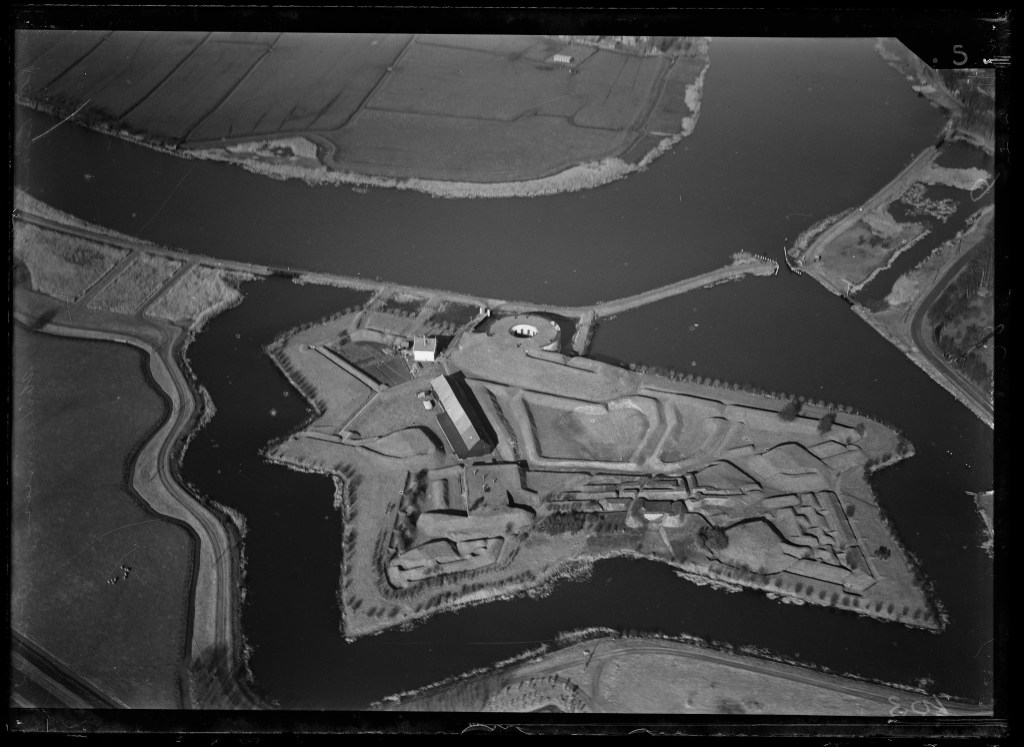
This is Fort Uitermeer from the air. The famous fort where Sikke served and often spent his time as a soldier.
W. October 11
2nd day of leave and the weather is good, although it’s getting colder. A day without much news, and before I know it, it’s evening again. At half past eight, I head back, via Amsterdam, to Weesp. By half past eleven, I’m back in the shed with the other boys. Jan Tuininga stayed home sick (got a fright). All the boys, including the ones from Amsterdam, are asleep. I don’t sleep well because it’s cold in the straw. Jo van den Akker and I are lying next to each other.
T. October 12
In the morning, after the roll call, we reinforce the support positions at the fort. Each of us gets a shovel and we dig the trenches, preparing them for the timbering. Not much is done, and by 11 o’clock we retreat to the barn. In the evening, I go looking for the other boys, who are staying in another barn further along the Vecht. They are doing well, but overall we are homesick for Schoorl. No other significant news.
F. October 13
At 8 o’clock in the morning, I stand guard for the first time along the Weesp-Bussum road. I am on watch with 6 men, and at night we sleep in a small tent. The weather is good, but at night it’s cold in the tent. The food here, although less than in Schoorl, is still quite good. I’ll be on watch at 1 o’clock tonight, and it’s busy along the road.
S. October 14
This morning, I have no duty because of the watch. After the kuch, I rest on the straw sack until 12 o’clock.[4] In the afternoon, there is no duty. At 5 o’clock, we pick up food from the fort, and it tastes good. We send a petition to the commander to get porridge after dinner. This is allowed twice a week. J. Tuininga is still sick, and in the evening, I listen to the radio.
S. October 15
It is Sunday, and for the first time, we are going to church in Weesp. We head to Weesp via the Klomp, and at 10 o’clock, the service begins with Ds. Gall, a young preacher. At half past 11, we return to the barn because the roll call is at half past 12. After lunch, we spend the rest of the Sunday in the barn. There is no further news, not even from the radio. I write to home and to Oudega. By 11 o’clock, I’m back lying in the straw.
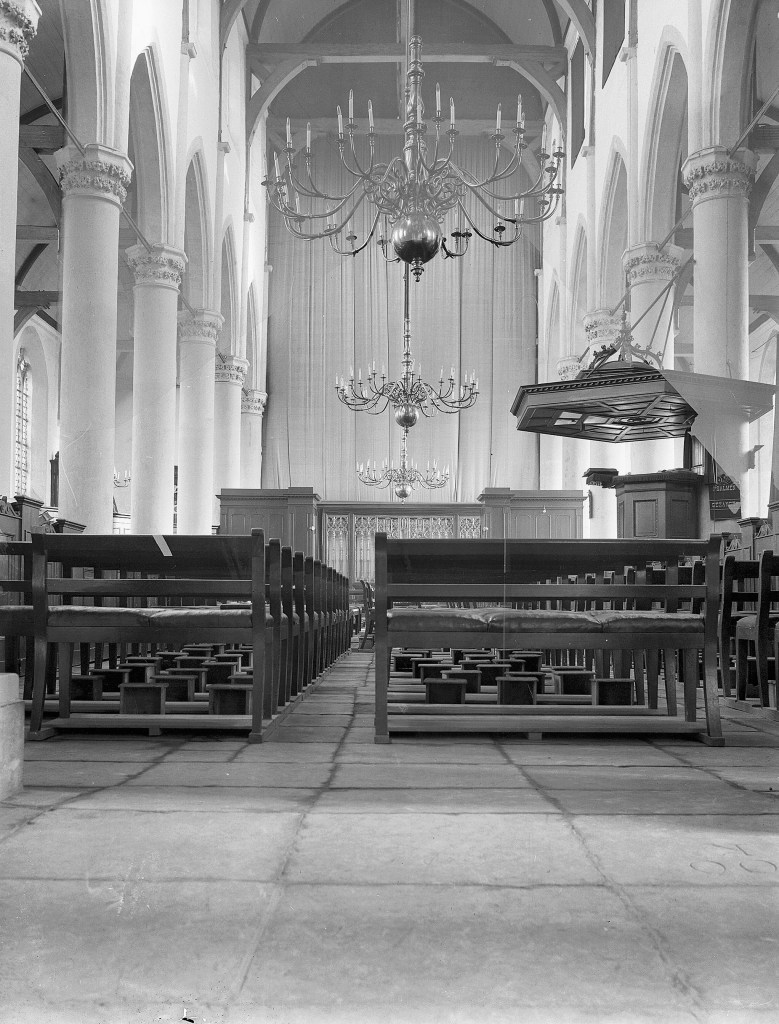
Sikke visited the Grote Kerk in Weesp during his mobilization period. It is possible that he also sat in one of these church pews.
M. October 16
We will spend another day at the fort. We’re working on the positions and filling sandbags. At half past 10, we have coffee in the canteen, and at 12 o’clock we return to the barn. At half past 1, there’s a roll call, then we fill some more bags, and at 5 o’clock I stay behind to fetch food. After 6 o’clock, I read the literature brought by someone from Amsterdam, and after the news reports, I head to the straw at 10 o’clock. It’s cold and rainy outside.
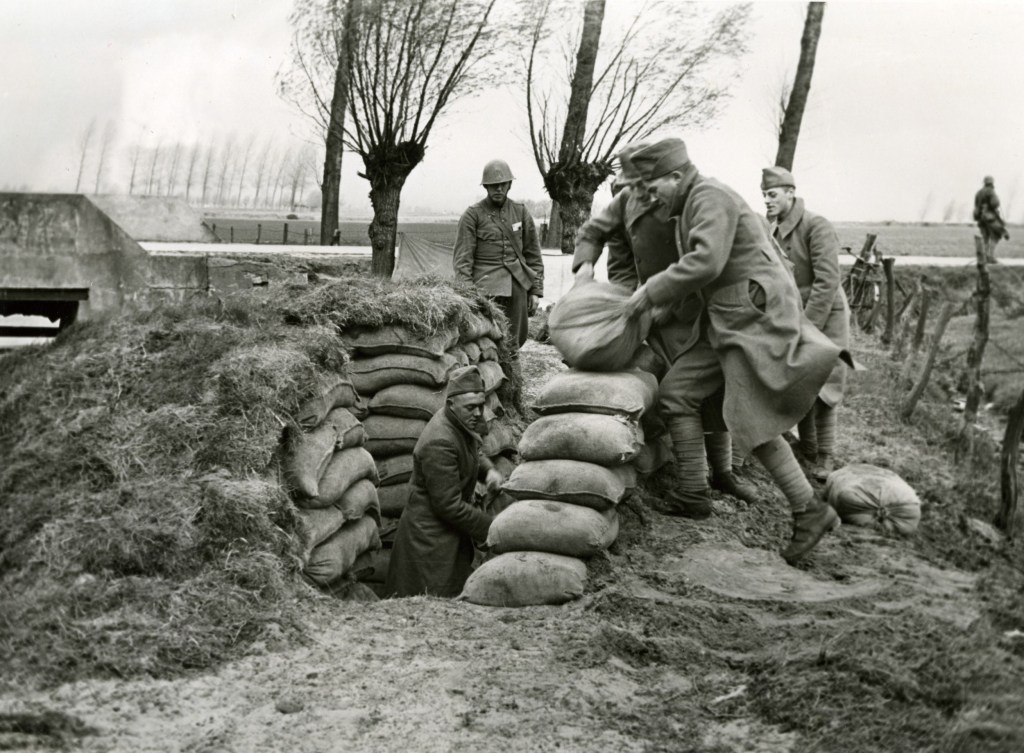
Preparing the positions and filling the sandbags would have looked like this. As the photo may show, it was not light work.
T. October 17
Today, I’m on guard duty from 8 AM until 8 PM. We receive a lot of newspapers and reading material from passing cars, as well as cigars and cigarettes. Other than that, there isn’t much news. The other guys went to bath in Weesp, and this evening I listened to ‘De Bonk’ on the AVRO Tuesday night program. At half past 10, I’m going to bed in the stable.
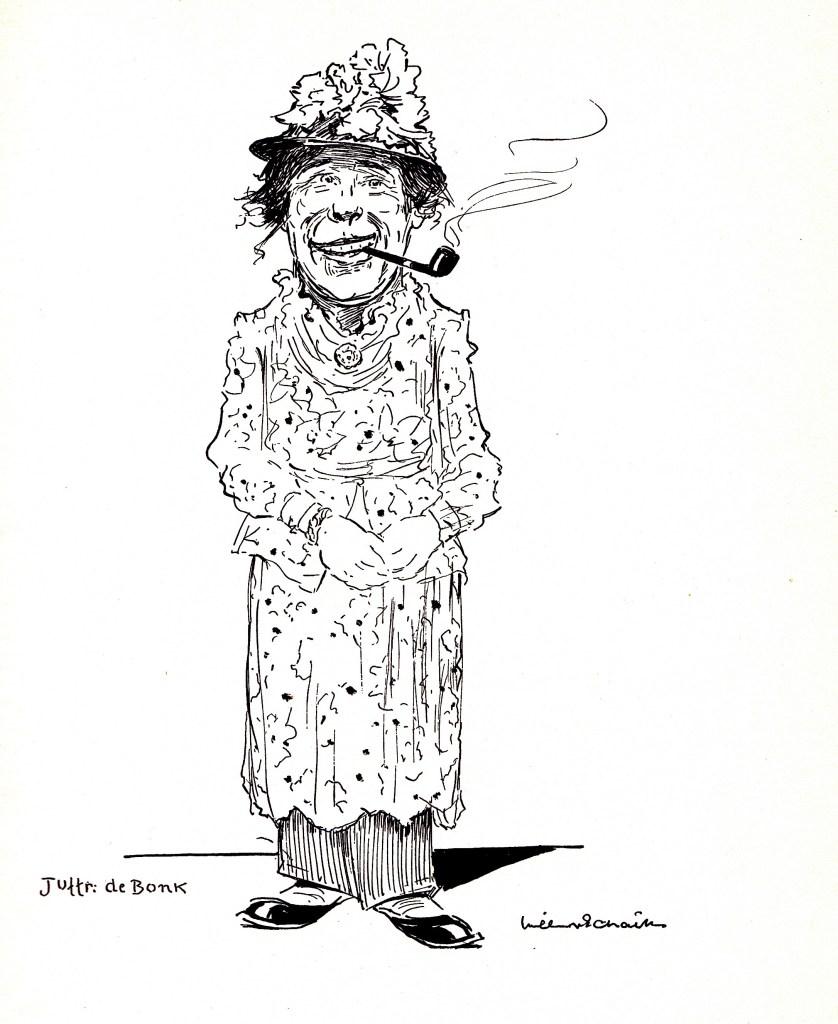
Wam Heskes (1891-1973) was a Dutch (radio play) actor who played various roles in different radio plays, including the character of Miss de Bonk.
W. October 18
At 8:30, we head to the fort to dig. The weather is bad, and most of the time we sit under the roof or in the canteen. It’s a miserable day, and it’s bitterly cold. We ask for a stove because it’s getting too cold. Gardehoek and Kooker will check with the commander about it. Korderijk will be our section commander. There’s no other news, and we’re going to bed early tonight.
T. October 19
Today, we again head to the fort to dig and fill sandbags. At 11 o’clock, a section of the wall is blown up. It’s an enormous blast, and large chunks of stone fly meters away. During the day, there is no other news. In the evening, we have a cabaret in the canteen with company from Amsterdam. It’s a great program with fun songs, an evening organized by O and O.[5] At 11 o’clock, the group heads to the barn, and by 11:30, it’s time for some well-deserved rest.
F. October 20
Today I am on room duty, a new assignment for me. But I am not busy. This evening, I went to Naarden to visit the Willeke family at Regenboogstraat 22 (everything fine). I returned at 10 o’clock, and after finishing the leftover tea, I, as the room guard, asked the men to go to bed. By 10:45, everything is quiet. I received a letter from home (everything is okay).
S. October 21
At half past 8, after the kuch, we go to the fort to once again put the positions back in order. At half past 12, we finish the rest of the kuch and return to the fort. At half past 5, we eat potatoes with red cabbage and minced meat. Tonight, there is a movie screening in the canteen, and afterward, we drive back to the shed by car. We request different quarters because it’s getting too cold. No further news.
Source: Netherlands Institute for Sound and Vision, Bakken van het soldatenkuch, Public Domain, via Openbeelden (van VPRO).
Kuch, also known as ammunition bread, was likely the most commonly eaten bread during the mobilization period. The Polygoon newsreel produced a segment on the preparation of soldiers’ kuch.
S. October 22
It’s Sunday again. Jo and I are going to church in Weesp, where Ds. Hazelager is leading the service. After the service, we briefly visit the military home.[6] At half past 12, we’re back in the barn. A few boys from Amsterdam are visited by their wives. We spend the evening in the stable, and by half past 10 we’re already lying in the straw again.
M. October 23
On Monday morning at 9 o’clock, I have to transport materials for the fortifications. A. Heringa and I receive work clothes for this, but we don’t do much. At half past 10, the learning period starts, which lasts until 12 o’clock. In the afternoon, we have the same task. In the evening, we read the newspapers in the barn, and at 10 o’clock I go to bed. We receive our third blanket, and they begin constructing the barracks. Jan Tuininga also returns.
T. October 24
At 8:30, I go to the roll call at the fort, and at 1:30, we have to assemble because we’re going to bathe in Weesp. We bathe in a new bathing vehicle, which is nicely furnished, and we return home feeling refreshed and clean.[7] In the canteen, there is a cabaret and theater performance from Weesp. It’s a pleasant evening, but the quality isn’t particularly high. After the performance, it’s time for bed at 11 o’clock. We receive straw sacks, which we will fill tomorrow.
W. October 25
Today we fill our straw sacks. This is the only work I do today. After the kuch at 2 o’clock, I start getting ready, as I’m going home on leave. At 4 o’clock, I pick up my leave pass, and by half past 6, I’m home. Ym and the children are at the station, and everything is well with all of us. At home, we talk about my time in service, and it’s cozy at home once again.
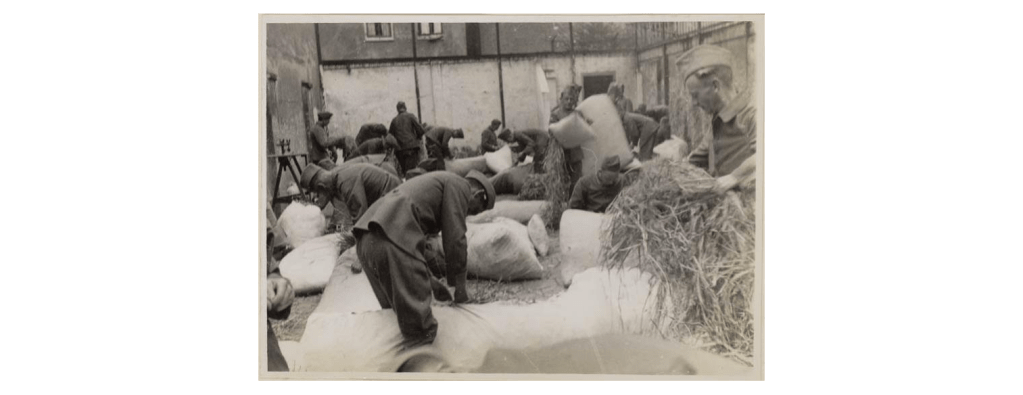
Gemobiliseerde soldaten, zoals Sikke, sliepen veelal op strozakken tijdens de mobilisatie van 1939-1940. De afbeelding hierboven toont hoe militairen hun strozakken vulden.
T. October 26
1st day of leave, and it’s cold in Hoorn. Most of the time, I’m at home with Ym and the children. In the afternoon, we go to the 3rd Boomlaan.[8] Everything is still pretty much okay there. In the evening, the radio reports that the state of war is about to intensify. People feel a bit uneasy, and there’s a crowd at the notice boards in Hoorn. I stay home in the evening.
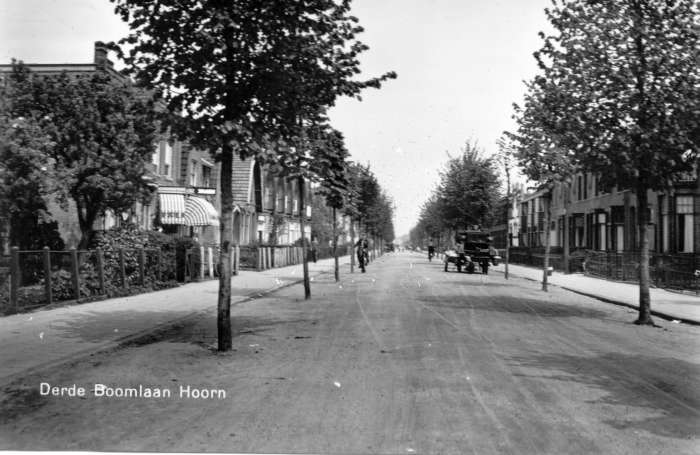
This was approximately the view of the 3rd Boomlaan when Sikke walked through this street with Ym and his children.
F. October 27
2nd day of leave. Today marks two months since mobilization began.[9] I go to the PWN office and visit Beppe Haas in the Weel. I leave for Weesp at half past 10 in the evening, and at 1 o’clock I’m back in the barn. Everything still looks fine, and at half past 1, I crawl under the blankets on the straw sack. I’ll sleep a bit because it will be soon Saturday.
S. October 28
Saturday, payday. After the roll call, we return to the barn. At half past 11, it’s time for the payment of the soldier’s salary. We receive 224 cents again and enjoy a cup of coffee with a filled cookie.[10] At half past 12, we eat brown beans with bacon, and buttermilk porridge for dessert. The duty is over, and in the evening, Jo and I go to Weesp to do some shopping. We are back by half past 8. I read for a while, and then it’s time for rest until Sunday.
S. October 29
On Sunday morning at 8 o’clock, I have to stand guard on the main road. The weather is nice, but cold. There is nothing of importance to report while on guard, and after our duty, we return to the shed at 8 o’clock in the evening. We receive unfavorable news from the ANP.[1`1] I write a message home and to my father in Oudega. Furthermore, everything is fine with all of us.
M. October 30
After the morning roll call, there is a theory lesson about the outpost service until 11 o’clock.[12] There is no further duty due to the rain, the weather is bad. In the afternoon, at 4 o’clock, I received a message from my father that Andries had been rejected. Other than that, everything is fine. At 6 o’clock, I go with D. Bunkman to the skipper with food and tea for his wife. In the evening, I am in the shed, and just after 10 o’clock, I go to bed.
T. October 31
The last day of the month, and in the morning we have to take the materials to the positions by car. At half past 1, we go for a bath in Weesp, and we return at 4 o’clock. At 5 o’clock, we pick up food from the fort, and in the evening, we listen to the Snip and Snap broadcast on the AVRO program. I sent a postcard home, and at half past 10 it’s time for the straw sack.
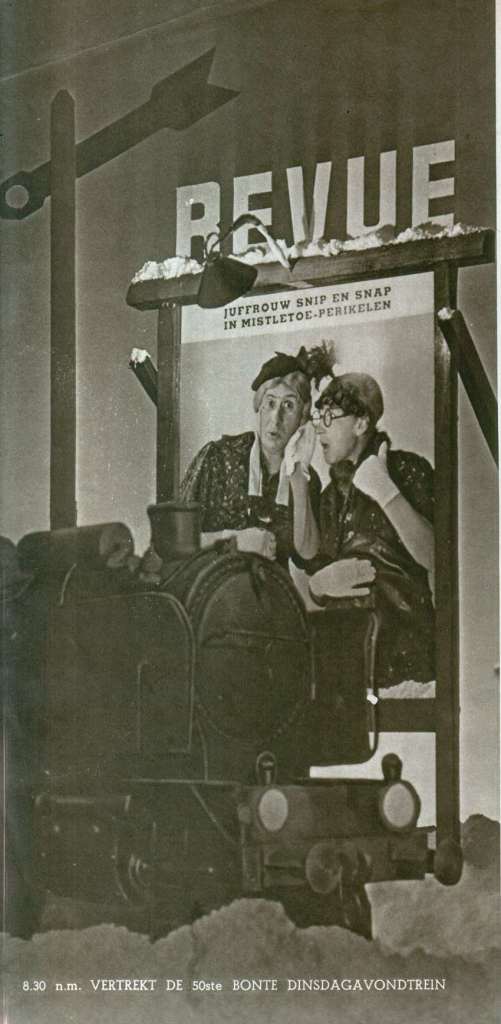
Snip and Snap was a popular show featuring Willy Walden (1905-2003) and Piet Muijselaar (1899-1978) that was broadcast by AVRO. The duo made jokes while dressed in women’s clothing.
[1] Ds. stands for preacher
[2] Lt. stands for Lieutenant.
[3] PWN stands for Provincial Water Supply Company North Holland. This is a drinking water company based in North Holland, where Sikke worked.
[4] Kuch was also known as ammunition bread.
[5] O and O (Development and Recreation) were committees that organized courses and other activities for (conscripted) soldiers.
[6] Military homes originated from Catholic and Protestant movements aiming to offer an alternative for leisure activities. These homes were intended to provide a welcoming environment where military personnel could gather outside of the barracks.
[7] A bathing car was a cramped vehicle in which the troops could shower.
[8] Ymkje had a cheese shop on 3rd Boomlaan, which was likely sold just before the war. It’s possible that they went to 3rd Boomlaan to visit the cheese shop.
[9] The Dutch mobilization officially began on August 28, 1939, but it is possible that the announcement of this had already been known among the Dutch citizens.
[10] This amounts to approximately €59.13 per week (without taking the exchange rate into account) and €26.83 per week if you do take the exchange rate into account.
[11] ANP is the largest Dutch News agency. // The exact content of the unfavorable news is unknown.
[12] The outpost service is a security service for resting troops. Soldiers on outpost duty warn resting troops of a potential attack and can temporarily hold back the enemy if necessary.
November-1939
W. November 1
It’s raining all day again, so there’s no duty performed. We check the rifle and equipment. At 12 o’clock, I fetch coffee from the fort, but the weather is bad. At 5 o’clock, it’s still raining. Ale Heringa and I go to get food, and along the way, we each devour three portions of meat that were left over. After eating, we visit Skipper Tukker with the remaining food. We drink tea with a cigar, and the evening passes by quickly. By 10 o’clock, we’re in bed under the covers.
T. November 2
The weather is slightly better than yesterday. In the morning, I help set up a new position until 11 o’clock. After lunch, there is a church service in the fort at 2 o’clock. Ds. Hooijer from Diemen, a military chaplain, gives a beautiful sermon.[1] Jo and I return to the barn, feeling satisfied. In the evening, Jo and I go to Weesp. We’re back by 10 o’clock and head off to bed again.
F. November 3
The last day in the cow stable because it’s getting too cold. The barrack isn’t ready yet, so we have to move to the milk cellar. In the morning, everything is scrubbed and tidied up there. After lunch, there’s nothing to do, and in the evening, there’s a party to celebrate Nol’s engagement. A keg of beer is tapped, and the atmosphere quickly turns festive. There’s plenty of talking, and before we know it, it’s already half-past 11, time to turn in for the night.
Source: Netherlands Institute for Sound and Vision, Een militair Huwelijk, Public Domain, via Openbeelden.
During the mobilization, ordinary life largely continued, making it not uncommon for troops to celebrate their engagements or even their weddings.
S. November 4
At 9 o’clock, the big move begins, with everyone hauling their belongings. It has been decided that the 10 Frisian boys will sleep upstairs, and the Amsterdammers downstairs. Before dinner, everything is set up. Kooker installs the lighting, and by 5 o’clock, it’s all ready. I receive a letter from home, everything is well. At half past 10, I go to bed, and this week is over. Tomorrow, the stove will be set up, and that’s that.
S. November 5
It is Sunday, and I didn’t get up on time, so I was late for church. First, the stove is set up. An opening is made in the roof, and at 11 o’clock, we light the fire. Nol is appointed as the regular room guard. At 5 o’clock, Jo van den Akker and I go to Weesp, where Ds. Gall is preaching. At 10 o’clock, we return to the cellar. It’s cozy in the little cellar. The stove is burning nicely, and the radio is playing. After listening to Kobus Kuch’s radio program, we go upstairs at 11 o’clock.
Source: Netherlands Institute for Sound and Vision, De KRO in Kantine met landmacht en Marine, Public domain, via Wikimedia Commons.
Kobus Kuch was an imaginary soldier created by the singer Louis Noiret (1896–1968). The name Kobus Kuch is a reference to kuch, the ammunition bread that soldiers ate. As Kobus Kuch, Noiret sang various mobilization songs.
M. November 6
At half past 7, I depart with six other brothers in arms for guard duty. We keep watch in the tent, but it’s too cold. There is nothing to report during the watch, and at 8 o’clock we are relieved. It’s rainy weather, and at home in the cellar, there is a letter from home, all is well. After reading the newspaper, I go to bed at 10 o’clock.
T. November 7
This Tuesday morning is reserved for rifle theory, taught by our section commander, Gardebroek. After lunch, the troop heads to Weesp for bathing. Several of us have bad colds due to guard duty. The doctor assesses the situation and requests a better guard shelter. The barracks are halfway done, and it will be another 14 days before we are transferred. No further news today.
W. November 8
Today, nothing is done other than roll calls at the fort. In the afternoon, equipment is inspected, and in the evening, we go to a performance by the Harmony from Weesp in the fort’s canteen. It’s a pleasant evening featuring a double male quartet. After the performance, we head to the Galesloot cellar. The weather is very bad, and by 11 o’clock, this day belongs to the past.
T. November 9
On this day, a 10-kilometer march is held to Weesp, and we return via the Keverdijk. In the afternoon, it seems to be enough, and nothing more is undertaken. In the evening at 6 o’clock, I leave for Naarden, returning around half past 10. After going through some reading material, I join my brothers in arms heading back to the attic, and another day is consigned to the past.
F. November 10
At 8 o’clock I get out of bed, and today’s task is to set up the new guardhouse together with Corporal Janssen. There is hammering and sawing. By half past 5 in the evening, our new guard quarters are up, furnished with British benches and a table. It’s an improvement that was absolutely necessary. At 8 o’clock, my friends take up the watch.
S. November 11
Today is another day I get to go home on leave. This morning, I went to the fort twice, and after lunch, I freshened up a bit, shaved and so on. At 4 o’clock, I set off toward Weesp, and by half past 6, I’m in Hoorn. Everything is well at home. I brought back a little something from Weesp for the children, and everyone is content. The white bread from Ym tastes great, and I’m a civilian again for two days.
S. November 12
A Sunday during leave is always a good idea. In the morning, I went to church, and everyone thinks I give such good accounts of the service. In the afternoon, I went into town with Ym and the children. Hoorn is filled with military personnel, and all the schools are packed. I ended this day with a pleasant Sunday evening at home. There’s no place like home.
M. November 13
In the morning, I briefly visit our pastor, Ds. Snoep, to ask if he could write a request allowing me to attend my son’s baptismal service. This is taken care of, and in the afternoon, I visit a few acquaintances. In the evening, I leave again for Weesp at half past 10. The war situation has worsened, and there are fears that leave will be revoked.[2] I arrive in Weesp at half past 12 and am back on the straw sack by half past 1.
T. November 14
At 8 o’clock, I wake up and the first thing I do is send a postcard home. After the kuch, we head to the fort, where we work on the defenses.[3] In the afternoon, the radio announces that all leaves have been canceled, causing widespread disappointment. Our freedom of movement is restricted, and we are not allowed to go to Weesp. At 8 p.m., I go on guard duty.
W. November 15
At 8 o’clock, I returned from the watch and am being punished for straying too far from the watch post. Jo van den Akker and I are the culprits. Attack near the roadside embankment by the guardhouse.[4] In the afternoon, we must report to the office to hear our punishment, which amounts to six days of intensified duty. During those days, we are not allowed to leave the farm after our shifts. At 8 o’clock, the ANP reports no significant news, and at 10 o’clock, we head upstairs to sleep.[5]
T. November 16
A storm is raging over our quarters. The weather is very bad. Today, we are assigned indoor duties. I write letters home and to father, asking if he will come to Hoorn on Sunday. I am not allowed to visit due to the seriousness of the situation. The mood is somber, and the radio is our only entertainment. This evening, I visited the skipper for tea and a cigar. Beyond that, there is no news to report today.
F. November 17
This morning during roll call, there was a speech by the fort commander, S. Camping. He emphasized that we must remain united and accept that others may hold less prestige. He said, “Think of the soldiers at the front, who have it so much worse.” Apart from this, there were no noteworthy events today, and the day passed with everyone chatting around the stove. After the news reports, the lights went out.
S. November 18
The weather is stormy outside. Our duty for today is to prepare the positions behind the fort, and with the shovel as our tool, we work on the Keverdijk. After tea, this remains our task. At 5 o’clock, I collect the food from the fort: potatoes with beets. After duty, I seek relaxation with the skipper since I am still punished until Monday.
S. November 19
At 8 o’clock, I go on watch. It’s Sunday morning, and there’s a storm. It feels as if everything is creaking, and our guardhouse is shaking back and forth. Jo is trying to light the stove, but it’s not working. The weather is truly terrible, and today my thoughts are in Hoorn, where Siepie is being baptized. It’s 3 o’clock, and Heit is also in Hoorn.[6] For me, this is not a good day, and I spend it lost in many thoughts. At 10 o’clock, I go to rest.
M. November 20.
The weather is slightly better outside, although it is still quite windy. Today, our duty is at the fort, and in the evening, I attend a performance in the canteen. The cabaret from The Hague provides an enjoyable evening with lots of variety and beautiful songs. The recitation, however, was (well) below standard. At 11 o’clock, I’m back in the cellar. The room guard offers me a cup of coffee, and then it’s time again. Another day of mobilization has passed.
T. November 21
I expect news from Hoorn today. For service, we are going to bath in Weesp. We’ll be back by 4 o’clock, and at 7:30 in the evening, the mail arrives with letters from Hoorn and Oudega. Everything was fine everywhere. It was a beautiful service, but Ym felt something was missing, and yes, so did I, here in this little basement. Heit had enjoyed it and, in the evening, had an encounter with horses on the railway. These letters do me good. At 10 o’clock: good night.
W. 22 November
Under favorable weather conditions, it was schottentijden today.[7] Kooker is ill with a throat infection, and Wiegman has already been at home for three weeks due to illness. This afternoon, Prince Bernhard visited the fort (I did not see him this time). During the parade, Major Smits fell into the water with his horse. Otherwise, there is no news today, and leave has still not been granted.
Source: Netherlands Institute for Sound and Vision, leger defilé, Public Domain, via Openbeelden.
During the mobilization period, military parades were regularly held, which looked something like this. This particular military parade took place in Alkmaar.
T. November 23
Today, I go to the barrack to clean. At 11 o’clock, I return, and after half past 1, I go back to the barrack. At 5 o’clock, I go to the fort to get food. In the evening, I visit the skipper with food, as he is leaving tomorrow. I also write a letter to Ym, since it’s her birthday tomorrow. At half past 10, after the news, we go upstairs.
F. November 24
Upon waking, I congratulate my wife on her birthday, as well as the children. She turns 31 today. We don’t do much of significance today, as there’s no service to perform before we head to the barrack. This evening, I head to the fort for the O and O revue.[8] It’s a splendid evening with fantastic performers. The five-person play was incredibly beautiful. Satisfied with the events of the day, I head to bed in the little cellar at half past 11.
S. November 25
At half past 11, before receiving our pay, we briefly head to Weesp with the compy.[9] Afterward, we collect our wages and bring back a pot of pea soup. This afternoon, there is no duty, so Jo and I head to Weesp to buy some cake. The skipper gives us 250 cents for food. In the evening, we celebrate from this in the cave, enjoying cigarettes, cake, and coffee from the pot. At 11 o’clock, the land defenders go to rest.
S. November 26
Today is Sunday. We are forced to stay in the cellar today. We are not allowed to go to Weesp, and everyone is waiting for the moment when leave will be reinstated. The only thing we do is fetch food from the fort. This evening, we seek comfort by the radio. By half past 10, this Sunday, with little news, has passed us by once again. The ANP broadcasts no news.[10]
M. November 27
At 9 o’clock, roll call is being held at the fort, and from that moment we move to the barracks. I fluff up the straw mattress and blankets, and like the others, I carry my belongings over to the barracks. At half past 1, Major Smits inaugurates the barracks with a speech. The flag is raised, the Wilhelmus is played, and we move into our new quarters. It’s a nice building, and each of us receives a small bottle of beer, we feel at home. I get a new bunk and lay next to Jo van den Akker.
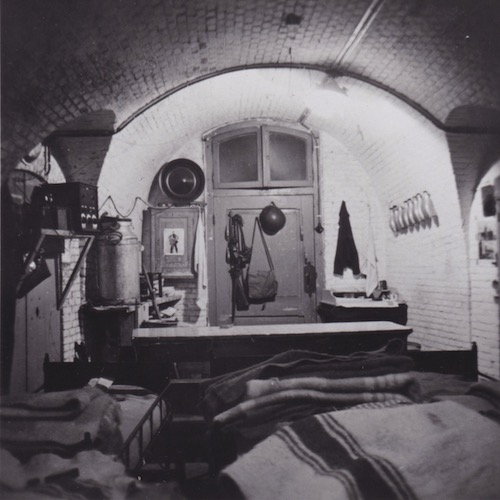
Sikke’s soldier’s quarters probably looked similar to what is shown in this photo, with the only difference being that he stayed in a wooden barrack.
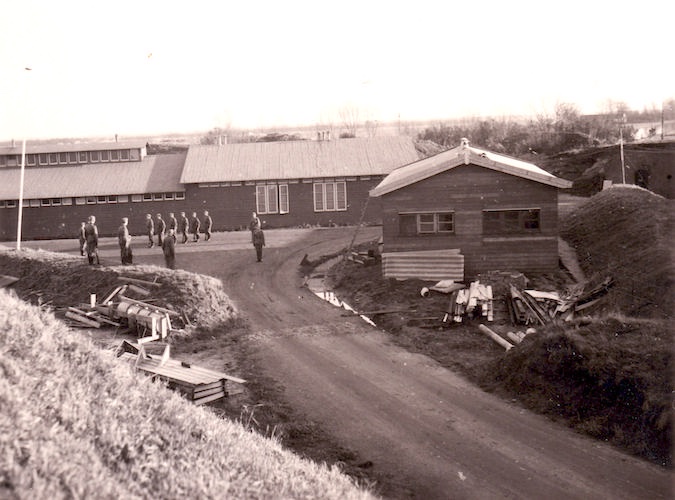
This photo was taken in November 1940, a few months after the German invasion. Although the photo was taken later, it provides a good impression of what the barracks at Fort Uitermeer looked like at the time.
T. November 28
I slept well on the bunk the first night. Our task today is to clean and hand over our old quarters at farmer Galesloot. This takes the entire day, and tonight there is entertainment at the fort. The Noordwijk Lifeboat Brigade is performing a revue. It was a pleasant evening; for amateurs, it was quite good. At 11 o’clock, I return to the barracks. It’s raining and windy outside. At half past 11, I’m back on the bunk. Leave is being granted again (Hooray). My current address is 2-1-31 RI Field Post 6.[11]
W. November 29
Our first activities in the barracks consist of rifle drill exercises and physical training. After the midday kuch, the task is to man the positions until 4 o’clock. After the hot meal, the evening is spent in the barracks, and the first leave-takers depart again. It is cold today, and at half past 10, I crawl under the covers.
T. November 30
Already more than three months in service. At 8 o’clock, I go on guard duty by the main road. There’s nothing special to report during the day. I collect food from the barracks’ kitchen, and in the afternoon, I receive a small box of cigarettes at my post from a lady. At 8 o’clock, I am relieved and receive a letter from Oudega, Andries has to go for another medical examination in Haarlem. Everything else is fine. I also receive a postcard from Ym, everything is okay.
[1] Ds. stands for preacher.
[2] On November 9, 1939, the Venlo Incident took place, in which two British secret agents and a Dutch secret agent were abducted by the German Sicherheitsdienst. The abduction occurred on Dutch territory, while the Netherlands was still neutral at that time. In the following days, some newspaper reports appeared, further escalating the threat of war. Subsequently, Prime Minister De Geer attempted to reassure the Dutch public with a radio address on November 13, 1939.
[3] Kuch is ammunition bread.
[4] It remains unknown what Sikke meant by ‘Attack near the roadside embankment by the guardhouse’.
[5] ANP is the largest Dutch News agency.
[6] Heit is dad in Frisian (minority language in the Netherlands).
[7] It is unclear what Sikke meant with ‘’Schottentijden’’.
[8] O and O is the committee for Development and Recreation.
[9] Compy stands for company.
[10] ANP is the Dutch news agency.
[11] 2-1-31 RI stands for 2nd Company (approximately 160 men), 1st Battalion (approximately 750 men), and 31st Infantry Regiment (approximately 2,500 men). // Field post handled the military mail for soldiers.
December-1939
F. December 1
The last month begins, and today we make a long march of 25 km to Hilversum via Ankeveen. We bring bread and coffee. There are a few dropouts, but I’m still doing well as I have no trouble with walking. We are home by half past 3, and at 5 o’clock we have kale with sausage for dinner. Tonight, there is a movie at the fort about the Kruger National Park. It’s a beautiful nature film. There’s no other news, and I write to Hoorn and Oudega.
S. December 2
In the morning, upon waking up, the weather is rainy. Today, we have light duties, including theory lessons about gas masks and guard duty. At half past 11, we receive our soldier’s pay. I get 220 cents, as 4 cents are deducted for the radio. In the afternoon, we scrub the floor, and the service ends at 4 o’clock. This evening, I’m going to Weesp with Jo van den Akker. The movement restriction allows us to go as far as Amsterdam. From now on, roll call will be at 10 o’clock.
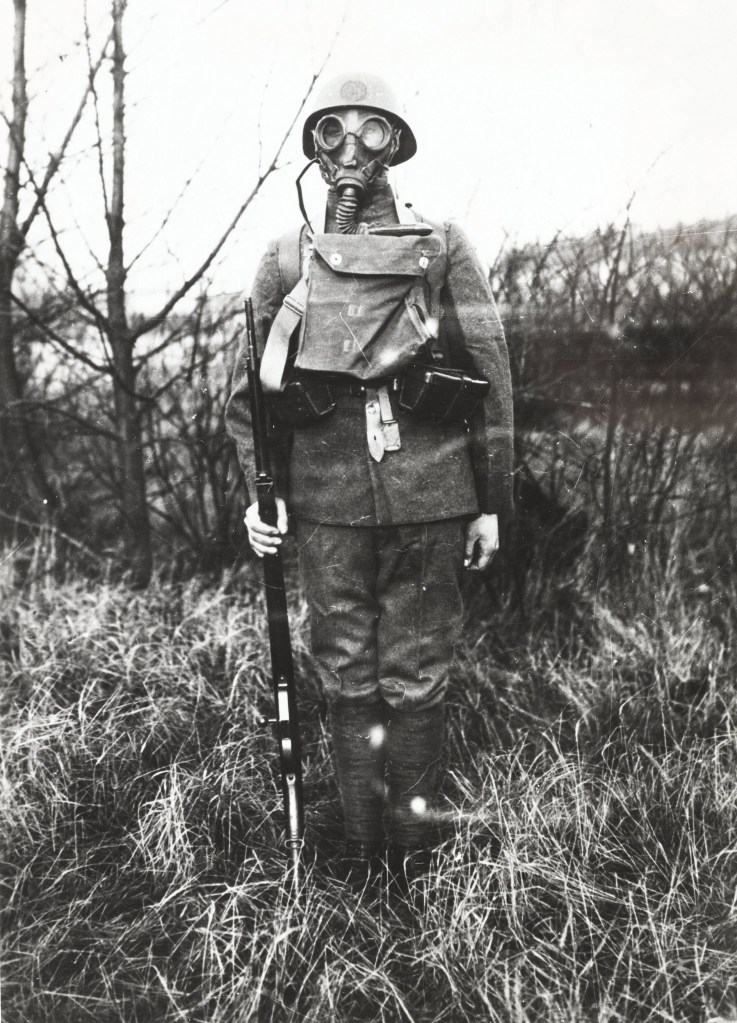
Chemical weapons were first used on a large scale during World War I (1914-1918), with agents such as chlorine gas, phosgene gas, and mustard gas. They were also used following World War I, for example, by Fascist Italy during the Second Italo-Ethiopian War (1935-1937). The Dutch army took into account that chemical weapons could be deployed in a potential war. Therefore, mobilized soldiers were trained and taught how to use gas masks because chemical weapons were considered a serious threat.
S. December 3
This morning I went to church in Weesp, where Ds. Gall preached.[1] At half past 11, I had a quick coffee at the home, and at half past 12, I was back in time for the roll call. This afternoon, I stayed in the barracks until 5 o’clock, and afterwards, I went to Weesp again. At 9 o’clock, I returned to the barracks. I played sjoelen with Jo van den Akker, and at half past 12, we went to bed. The Sunday doesn’t bring much news, except for the good weather. There was no significant news on the radio either.
M. December 4
After roll call at half past 8, we will march to the village of Nederhorst den Berg, 10 kilometers away. By half past 11, we’ll be back at the barracks. This afternoon, we’ll be doing maintenance on our weapons and equipment. This evening, there will be a major VARA radio evening in the barracks at De Klomp. Unfortunately, I have barracks duty starting at half past 6. It’s cold, and it’s freezing at -2 degrees.
T. December 5
The day of St. Nicholas.[2] I receive a package from my sister in Oudega, and many other soldiers also receive mail parcels. Today’s duty involves manning the positions. From half past five to eleven, we stay in the barracks. It is a cold St. Nicholas evening, a stark contrast to previous years. With thoughts of my wife and children, I go to bed at half past eleven. Jo is already asleep.
W. December 6
At 9 o’clock, we depart for the village of Ankeveen and return via ‘s-Graveland. At 2 o’clock, there is roll call, followed by a lecture by the doctor about TBC and its effects.[3] It is an interesting and educational lecture. This evening, there is a performance in the fort by the Muiderbergse Pleziersoldaten, a wonderful evening with beautiful music and entertaining songs. It is truly a night of relaxation. By 11 o’clock, we are back in the barracks, and not 10 minutes later, it’s lights out.
T. December 7
Today, I am on room duty for J. Tuininga, and in the morning, I worked on keeping the hall clean. This afternoon, I will attend the sermon at the fort delivered by the army chaplain, ds. Hooijer. After the service, it is my duty as room guard to keep everything clean. Beyond that, nothing of significance is happening today, and at half past 10, our day comes to an end.
F. December 8
Our Sint Nicholas Day. Today we have indoor duties, and this evening a St. Nicholas celebration awaits us at the fort. It’s a lovely evening with Cornelissen as St. Nicholas (wonderful). Everyone receives a shoebox filled with treats (it felt so real). Lieutenant Enzing is addressed and receives a women’s corset from St. Nicholas. At half past 11, feeling content and with the box under our arms, we return to the barracks.
S. December 9
Today I’m going on leave to go home. It’s about time too. This morning, I went along to the position, and in the afternoon, there is a relay race around the fort. The 5th section wins the race, and every winner receives a small box of cigarettes.[4] At 4 o’clock, feeling refreshed, I leave for Weesp. I arrived home in Hoorn at half past 6, where everything was well. The children are doing great too.
Source: Netherlands Institute for Sound and Vision, Estafetteloop voor militairen, Public Domain, via Open Beelden.
One of the activities soldiers engaged in during the mobilization was organizing a relay race.
S. December 10
In the morning, Jan and I go to church in the Eikstraat. In the afternoon, we visit the De Haas family in Het Weeltje. In the evening, we receive a visit at home from our friend Krijn Dekker and his wife. Many stories are shared about the service, and by 11 o’clock, this civilian Sunday has come to an end. The news reports bring no news.
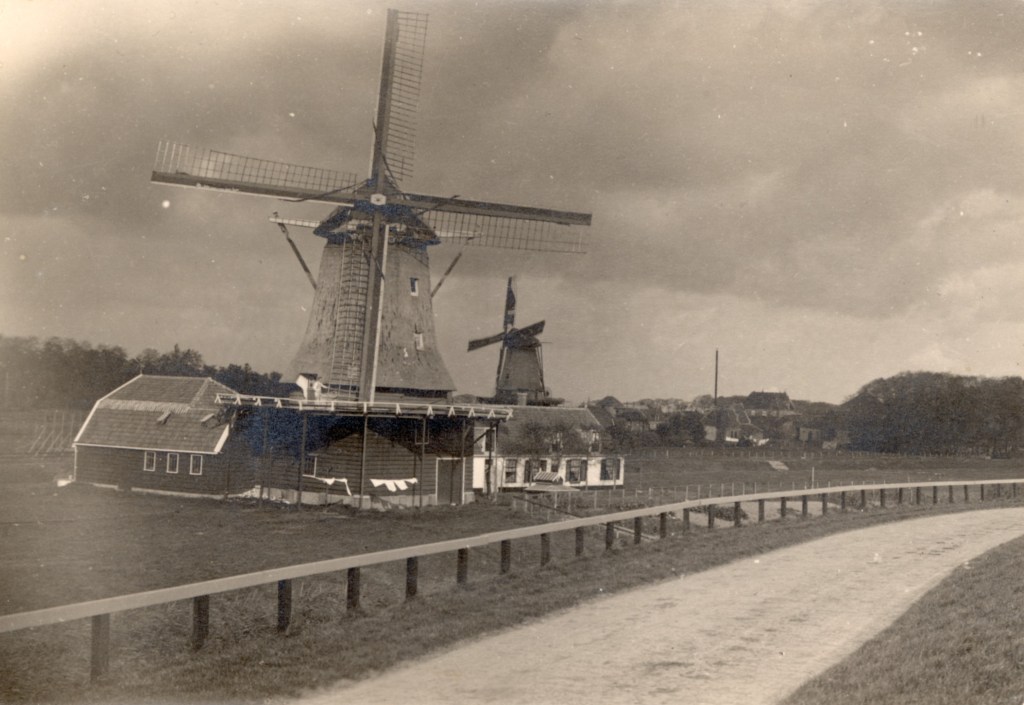
The Weeltje in Hoorn looked roughly like this at the time. It was mainly an area with many farms.
M. December 11
I spend most of this last day of leave at home, and in the afternoon, I go to the PWN office to ask about my changed position.[5] Tonight, I stay at home. Outside, it is cold, and there is a slight frost. At 10 o’clock, I leave the Pieter Floristraat 4 again. I arrive at the barracks by bus from Weesp at half past 12. My leave is over, and I am a soldier once more.
T. December 12
After the 9 o’clock roll call, I return to guard duty by the main road. The entire day passes without anything noteworthy to report. It is cold outside, so there is a stove burning in the guardhouse. Tonight, I leave my post a bit earlier because there is an event at the fort. The Dutch Hague Cabaret is performing. A wonderful evening filled with singing, music, a ventriloquist, and a magician. A splendid evening of O. and O., and by midnight, I am under the covers.[6]
W. December 13
At half past 8 there is roll call. After this, we head out for outpost duty and move to the roadblocks.[7] At 12 o’clock, we return, and at 2:00 o’clock, we man the positions. At 4 o’clock, we head back to the barracks. After dinner at 6 o’clock, I take care of my correspondence and write letters. Once it is past 10:00 o’clock, I have a quick coffee. Then I make my bed and get some rest.
T. December 14
In the morning, there is theory about the machine gun taught by Vaandrig Vugt.[8] After that, we have exercises in the form of tug-of-war and strength drills. After the midday meal, peeling potatoes for tomorrow is on the agenda. After this task, I go with Jo to the church service at the fort, where Ds. Hooijer delivers the sermon. There is no evening news, and at 10 o’clock, I rest beside Jo.
F. December 15
It is becoming winter, and it froze quite a bit last night. The duty consists of manning the positions until 11 o’clock. After lunch, we take a walk to the Polderhuis and return at 4 o’clock. In the fort, there is an American film tonight, Der Biezennen. It is a nice film. At half past 10, I go to bed after the ANP.[9]

Polderhuis, Collection 162, Inventory Number 7298.
The Polderhuis, a café-restaurant located in Ankeveen, was Sikke’s destination for the day.
S. December 16
At half past 8, roll call takes place. Afterward, we have a theory lesson about the pistol and do gymnastics exercises. At half past 11, the soldiers’ pay is distributed. After eating pea soup, at 2 o’clock, we scrub the floors and tidy up the lockers. Following the cleaning, there is an inspection by our commander, Lieutenant Boks, and everything is found to be in order. Jo and I head to Weesp and return at 10 o’clock. At 11 o’clock, we turn in for the night.
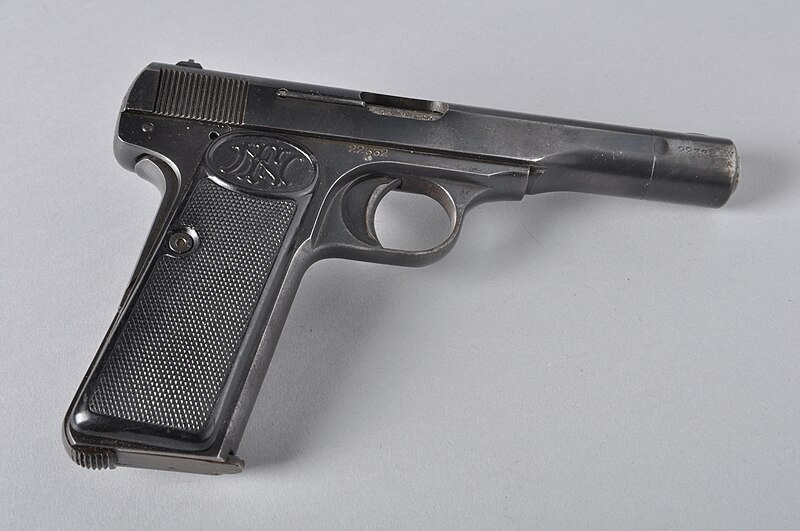
During the Dutch mobilization, the Dutch army used two types of pistols. The first type was the Browning (FN) model 1922 with a caliber of 7.65 mm, and the second type was the Browning (FN) model 1922 with a caliber of 9 mm. In the Netherlands, these models were known as the pistols M.25 No.1 and M.25 No.2. It is highly likely that Sikke received theory lessons on these types of pistols. The model in this photo is the M.25 No.2.
S. December 17
Sunday morning I go to church in Weesp, where ds. Haselager is preaching. After that, I go to the military hostel for coffee, and at 1 o’clock I return to the barracks for lunch: potatoes with apples and custard. After lunch, I go to the Willeke family in Naarden. At 10 o’clock, I head back to the barracks via the Hakkelaar. Nothing special happened after that, and I hit the sack until Monday morning.
M. December 18
We start the day with a roll call and then head to Weesp to shoot. It is very cold and freezing hard. In Weesp, I shoot very poorly the first time, scoring 31 out of 40, but the second time I score 37. I am back in the barracks at 2 o’clock and have no more duties. Tonight, I am going to the fort for an evening full of cheerfulness, including Hans Snel with his songs. It is a lovely evening, and I am home by 11 o’clock.
T. December 19
Today, we are going to the Sportfondsenbad in Amsterdam for the first time. The interior is stunning, and we had a great time in the pool. Afterward, there is a demonstration of a water polo match. At 4 o’clock, we are back in Weesp by train. After dinner, I write some letters. I regularly receive mail; everything is healthy and going well. At half past 10, I hit the hay and get some sleep.

This is roughly what the Sportfondsenbad looked like when Sikke took a dive with his fellow servicemen.
W. December 20
To start the day, the stalls in the washhouse defrost because it froze last night, with temperatures dropping to -8 degrees. It is very cold, and the roads are slippery, so we have indoor service. In the afternoon, we go ice skating near the fort, and by half past 4 we are back home. After 6 o’clock, we read the newspaper, listen to the radio, and play sjoelen. It’s half past 10 once again, time for the sack with straw.
T. December 21
It was winter again last night, and our day starts with theory about gas. After that, we have a lecture from the doctor about sexually transmitted diseases. At 2 o’clock, there is a church service at the fort conducted by Ds. Hooijer. At 4 o’clock, we’re back, and after dinner, we head to the fort again for a film about the Dutch East Indies. We’re back by 10 o’clock and have a cup of coffee with a biscuit. Afterward, Jo and I lay next to each other again. Until tomorrow.
F. December 22
The winter continues, and outside it is bitterly cold. The barrack is barely heated. Our duties consist of manning the positions, and in the afternoon, the exercises are the same as in the morning. It is too cold for this service outside, and tonight we have nothing more to do. The Christmas days are approaching nicely. It’s just past half past 10, and that’s enough for today.
S. December 23
In the morning, we receive lessons on military discipline and behavior in public.[10] At half past 11, the soldiers’ pay is distributed. After pea soup, at 2:00 o’clock, we must scrub the barracks, and at 4:00 o’clock, the duty ends. Tonight, I won’t stay up late because tomorrow morning I have to get up at 5:00 o’clock. I’m taking the first opportunity to head to Hoorn for Christmas leave.
S. December 24
At 5 o’clock, I get up, and at a quarter to 6, we leave the barracks. Outside, it is full-on winter. At half past 6, I receive a small box of cigarettes from the Weermacht at the station to give a touch of Christmas spirit.[11] By half past eight, I arrive in Hoorn, where Ym is just getting out of bed. In the evening, I go to church, and this Sunday passes without any noteworthy news. I spend a pleasant evening at home with the children.
Source: Netherlands Institute for Sound and Vision, Kerstpakketten voor onze militairen, Public Domain, via Openbeelden (from VPRO).
Not only did Sikke receive something from the armed forces for Christmas. Other soldiers even received complete Christmas packages.
M. December 25
1st Christmas Day. It’s cold outside, and it froze hard last night. In the morning, I go to church with Jan in the Eikstraat. Afterward, we visit some family, and in the evening, we stay home. We listen to the Christmas program on the radio, and at 8 o’clock, the children go to bed. Ym and I stay at home.
Source: Netherlands Institute for Sound and Vision, Winter 1939, Public Domain, via Openbeelden (from VPRO).
Not only did Sikke receive something from the armed forces for Christmas. Other soldiers even received complete Christmas packages.
T. December 26
2nd day of Christmas. In Hoorn, it is quiet, and winter is doing its best. There is a lot of ice skating on the Vest. The children go to the Christmas celebration in the chapel in the afternoon and are home in the evening. The children, Jan and Ankie, come home full of Christmas joy, and at half past 10, I leave Hoorn. By half past 12, I am back in Weesp, and by 1 o’clock, I am back in the barracks. Christmas leave is over again.
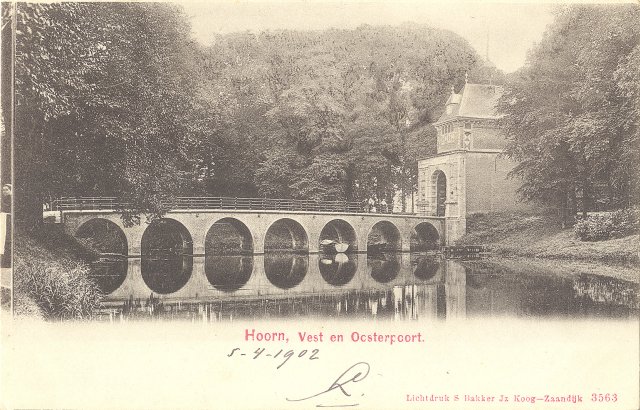
The Vest in Hoorn was a great location for ice skating in the winter of 1939.
W. December 27
After the roll call, we must peel potatoes for the 5th section in the barracks until 12 o’clock. After lunch, we will occupy positions for an hour and then receive a lecture on military discipline from the C.C.[12] After the meal at 5 o’clock, we will spend the rest of the day in the barracks, as the canteen in the barracks is now officially open. At 11 o’clock, we will rest.
T. December 28
Thursday morning begins with a march past Fort Hinderdam and through Ankeveen. At half past 11, we return, and the troop is back inside. After lunch, we have to leave the barracks to get our weapons and equipment in order. At 8 o’clock, I have guard duty by the road, but there is no news during the night while on watch. On Friday morning at 8 o’clock, I return to the barracks, after which I sleep until 12 o’clock.
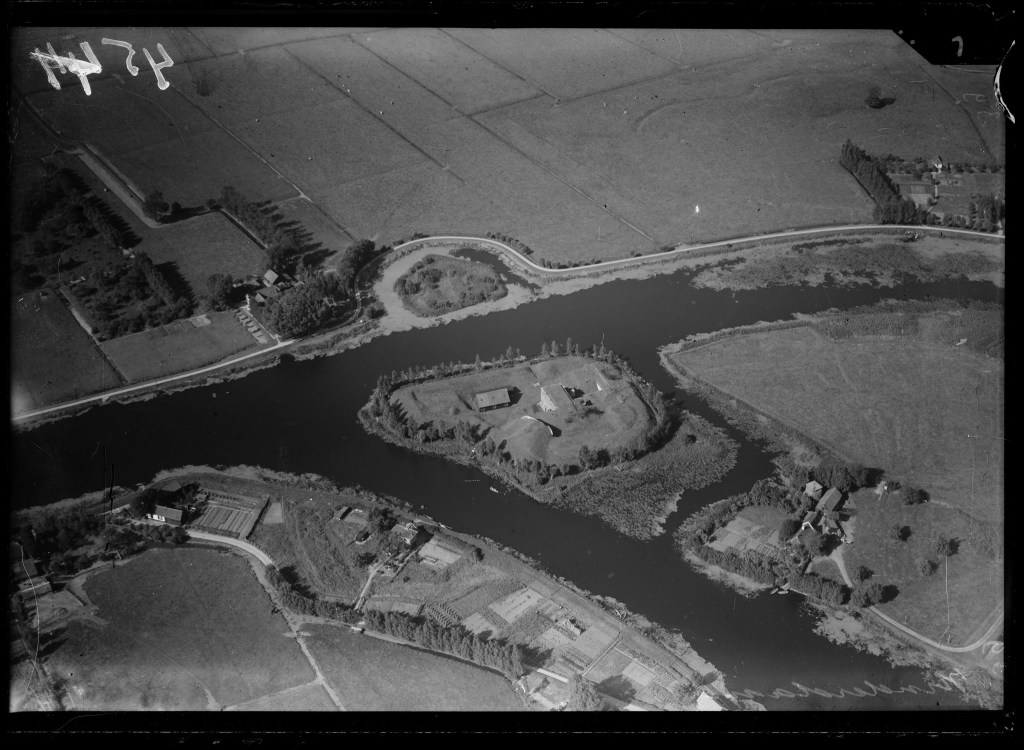
Fort Hinderdam was located approximately 3 kilometers away from Fort Uitermeer, the place where Sikke stayed.
F. December 29
This morning, I spent sleeping on the straw mattress. After eating the kuch, we are assigned to gather tube materials at the positions.[13] By 4 o’clock, we were finished with this task. After the kale with sausage, we headed to the fort at half past 7 for a performance by the theater company from Weesp. A pleasant evening, although not of very high quality. I returned at 11 o’clock and quickly got under the covers due to the cold.
S. December 30
This penultimate day of 1939 offers little to do. In the morning, we have to peel potatoes and receive our pay. After the gray peas with bacon, it’s time for cleaning up. In the evening, in the barracks we pass the time with sjoelen, and I count myself lucky when it’s 10 o’clock. After the ANP news reports, I retire to the place of rest.
S. December 31
Sunday is the last day of the year, and in the morning, I go to church. At half past 12, I am back for lunch, and at 5 o’clock, we attend the New Year’s Eve service in Weesp. At 9 o’clock, I am back, after which I write some New Year’s correspondence. At 11 o’clock, we receive a bottle of wine with oliebollen, and at midnight, we wish each other much prosperity and blessing. The year has ended, what will 1940 bring us??? At 1 o’clock, I go to bed, but by 2 o’clock there is a commotion in the barracks.
Source: Netherlands Institute for Sound and Vision, Nieuwjaarswens van Polygoon, Public Domain, via Open Images (from VPRO).
The Polygoon newsreel reflected on the year 1939 and all the important events that took place during that year.
[1] Ds stands for preacher.
[2] St. stands for Saint.
[3] TBC stands for tuberculosis.
[4] A section consisted of approximately 30-34 men.
[5] PWN stands for Provincial Water Supply Company North Holland. This is a drinking water company based in North Holland, where Sikke worked.
[6] O. and O. (Development and Recreation) were committees that organized courses and other activities for (conscripted) soldiers.
[7] The outpost service is a security service for resting troops. Soldiers on outpost duty warn resting troops of a potential attack and can temporarily hold back the enemy if necessary.
[8] Vaandrig is the lowest officer rank within the army, air force, and military police. It is normally granted to officers in training.
[9] ANP is the Dutch news agency.
[10] Military discipline refers to the internal rules of behavior within the military.
[11] Weermacht is another term for the Dutch armed forces.
[12] C.C. stands for Company Commander.
[13] Kuch was ammunition bread.
January-1940
M. January 1
In the morning, I go to church with Jo. It’s bitterly cold, and the road is very slippery, causing us to slide all the way to Weesp. After the service, we head straight back to the barracks to eat. In the barracks, I write an article for the church magazine De Wachter.[1] In the afternoon, Jo and I go ice skating on the fort canal in Weesp, and in the evening, we stay in the barracks.
Source: Netherlands Institute for Sound and Vision, Lichting 1940 komt op, Public Domain, via Open Images (from Stichting Natuurbeheer).
Also in 1940, new soldiers were called up. This video shows how the draft of that year was summoned to enter service.
T. January 2
I am on duty in the staff barracks, together with Heringa, and at 9 o’clock I head to the barracks. My work there continues in the afternoon and evening as well. The mail now delivers my New Year’s wishes from home: from Heit and others.[2] Sister Tiete’s birthday is today, and in my thoughts, I send her my congratulations. At half past 10 in the evening, Jo and I get back under the blankets.
W. January 3
It’s freezing hard with -10 degrees, and it’s a harsh winter. This morning, I have to take guard duty at 8 o’clock. On watch, it’s unbearably cold, and we can’t get warm. There’s nothing to report during the watch, and at 8 o’clock in the evening, we’re relieved. In the barracks, everyone gathers around the stove to warm up, and at 10 o’clock, I crawl under the covers with a bit of a cold.
T. January 4
After the morning roll call, I report to the doctor’s sick call. I receive some medicine for my cough and am assigned 1 day of indoor duty. I spend the day pottering around the room and occasionally lie down on the cot for a bit. The food still tastes quite good, and in the evening, I head to bed not too late. At half past 9, I settle down to rest and sweat it out further.
F. January 5
It froze -9 degrees last night, and it is still winter. The Vecht river is already solid. Today’s service is a 35-kilometer skating trip, but due to a cold, I stay behind. In the evening, we go to Weesp for the AVRO evening. It is bitterly cold, and at half past 7, we arrive in Weesp. The performance is a great disappointment, and the organization is very poor. Jo leaves even before the break, and by 12 o’clock, the rest return home stiff from the cold and dissatisfied.
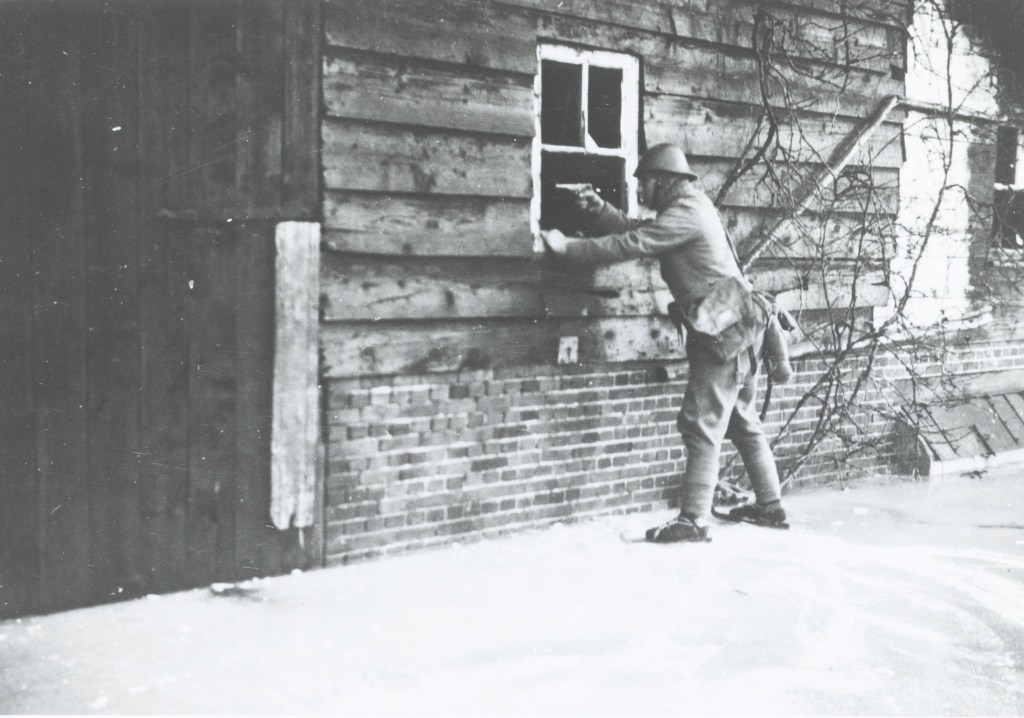
The winter of 1939-1940 was exceptionally cold, causing rivers and lakes to freeze. Even the inundations (areas of land that were intentionally flooded to hinder a potential enemy) froze due to the harsh winter. As a result, training took place on the frozen ice, including ice skating, as depicted in the photo above and described by Sikke in his diary.
S. January 6
At half past 8, roll call takes place, and afterward, we clear the snow that has blown into the position. It is still bitterly cold, and at 11 o’clock, we return, stiff from the cold. After tea, the same work is on the schedule, and at 4 o’clock, the duty can be considered finished. Korderijk bids farewell, as he is heading to the Indies.[3] This evening marks the opening of the Chr. military home in Weesp.[4] At 11 o’clock, I am back in the barracks.
S. January 7
This day starts with a theory lesson about the pistol, followed by gym exercises until 11 o’clock. After lunch, we begin clearing the remaining snow. At 5 o’clock, we are served a hot meal. At half past 6, I have barrack duty, and at 9 o’clock, I am on watch. I make rounds in the barrack during the night and tend to the stoves. The winter weather is beautiful, but it remains freezing. My watch lasts until half past 6 in the morning.
M. January 8
I have rest until half past 1 because of the night watch, and at 2 o’clock we go to the staff barracks for a vaccination against typhus. I also get an injection. In the evening, I feel a bit cold and feverish due to the injection. I go to bed early at 9 o’clock. I don’t feel very well, but I still sleep well despite a slight fever.
T. January 9
At 9 o’clock, after roll call, Jo and I go to church, where Ds. Hazelager is preaching.[5] After the service, we visit our home. It is very pleasant, and at 12 o’clock we head back to the barracks via the Klomp. The roads are icy, and in the evening, we attend church again to hear Ds. Gall. At 10 o’clock, we leave the military home for the barracks. The Sunday has passed quickly, and by 11 o’clock, the author of this text rests.[6]
W. January 10
On Monday morning, there is service in the barracks, instruction in field service, and barrier service.[7] After lunch, many take the opportunity to skate. I take over room guard duty, and at 5 o’clock we can eat. The brown beans with bacon are quite satisfying. In the evening, we pass the time reading and playing sjoelen. It’s a quarter past ten, and after the news reports, we too call it a night.
T. January 11
Today we’re going to the Sportfondsenbad in Amsterdam for a thorough refreshment. After the swim, there will be a demonstration by the Amsterdam swimming class. The performances are impressive, both in women’s swimming and in diving. At 3 o’clock, we’re back in Weesp, and by a quarter to 4, we’re back in the barracks. After dinner, there is an evening event at the fort organized by the Hague Lifeguard Brigade, focused on propaganda for lifesaving swimming. At half past 10, everyone crawls under the covers.
Source: Netherlands Institute for Sound and Vision, iedere soldaat zwemmer, Public Domain, via Open Images (from VPRO).
During the mobilization, attention was also given to swimming lessons and/or lifesaving swimming, as seen in this video and in Sikke’s diary excerpt.
F. January 12
In the promising anticipation of leave, we begin with a march from Weesp to Nigtevecht and back. After returning home, I freshen up so I can leave for Hoorn at 4 o’clock, where I arrive at half past 6. It’s terribly cold, and the frost is biting. The winter is exceptionally harsh. At home, everything is in order, and the children are doing well too.
S. January 13
1st day of leave, but there’s no sign of a thaw. I mostly stay home, but visiting regular clients remains part of my work. I quickly head to the P.W.N. office and then visit van Putten and Beppe Haas in De Weel.[8] The day flies by, and in the evening, Ym and I briefly check out the illuminated ice rink on the Vest, but due to the severe cold, we quickly return to the stove at Pieter Florisstraat 4.
S. January 14
2nd day of leave, and it’s still very cold outside. Last night, the temperature dropped below -10 degrees. I’m spending this day at home, and I’m writing a letter to Heit in Oudega.[9] At a quarter to 10, I put my things on again, and at half past 10, I leave our Hoorn. By 12 o’clock, I’m in Weesp, and by a quarter to 1, I’m already lying next to my friend van den Akker again.
M. January 15
A simple day is also worth something (though you don’t always catch it). Earning my pay is the hardest work this morning. After the pea soup, we have to clean the barracks in the afternoon, beat the blankets, and so on. By 4 o’clock, everything is in order, and I receive a letter from heit and G. de Vos. Everything is fine. G. de Vos is stationed in Maarn because he’s also in the service.
T. January 16
In the morning, Jo and I go to church as usual. After the service, we receive the news that leave has been canceled. We return downhearted to the barracks. In the evening, we go to church again. The atmosphere in the military home is pleasant, and it’s 10 o’clock when we leave. Back in the barracks, there’s a discussion about the cancellation of leave. Belgium has also canceled its leaves.[10] At half past 11, with a severe frost outside, we go to bed.
W. January 17
Monday morning after 9 o’clock, we manned our positions along the Vecht, and by 11 o’clock we were back. The duty ended at half past 1. At 2 o’clock, we went to the staff barracks for the second typhus injection. I stayed in the room and, in the afternoon, substituted for the room guard of the non-commissioned officers. Beyond that, there is no significant news for the day.
T. January 18
At 8 o’clock, I go to the main road to take up the watch, where I will be on duty for 24 hours. The other boys are going to the Sportfondsenbad in Amsterdam. There is no news on watch, except that it is bitterly cold with -14 degrees of frost. Tonight, we are not outside, but indoors we cannot heat the space. I did not sleep last night. This has been the coldest night watch so far. Outside, a snowstorm is raging, and at 8 o’clock in the morning, I am back in the barracks.
F. January 19
This morning, I slept in due to the watch. Outside, it’s still winter, and in the sun, it’s -8 degrees with frost. We’re not heading out because of the poor road conditions. It’s icy and slippery. There’s no duty today. This evening, Jo and I will head diagonally across to the Hinderdam barrack and walk back along the Vecht. By half past 8, we are back inside. No leave has been granted yet, and at 10 o’clock, we hit the straw sack.
S. January 20
The mood in the barracks was not great today. The leave situation is bothering us, and quite a few soldiers are down with throat infections, 9 in our barracks alone. Outside, there’s a bitter cold. The duty involves theory and exercises with gas masks. Apart from that, there is no other duty. This afternoon, there is a service in the fort by ds. Hooijer. Other than that, there is no more news, and the radio isn’t reporting anything unfavorable either.
S. January 21
Last night, a lot of snow fell, and this morning after roll call, we had to clear snow from the positions in -10 degrees frost. It’s bitterly cold, and we’re back by half past 11. At 2 o’clock, the snow is cleared further. Today, we’re having kale with sausage, and I quite enjoy it. At 8 o’clock, Jo and I are heading to Weesp for radio parts. I’m also stopping by the military home, and by 10 o’clock, I’m back again. At half past 10, this one’s off to bed.
M. January 22
The Saturday service begins with gym exercises, tug-of-war, and so on. At half past 11, we receive our pay. After having a cup of coffee from the canteen, I sit by the stove for a while, and then we enjoy pea soup with a bone. At 2 o’clock, we clean the floors and windows. There is no noteworthy news for the rest of the day, and the evening is quiet in the barracks. At 11 o’clock, the week comes to an end.
T. January 23
After the morning roll call, I will go to the church in Weesp because the Lord’s Supper is today. Ds. Gall is preaching, and many boys will partake, including Jo and me. After the service, we go to the military home for coffee, and at half past 12, we return to the barracks. At 5 o’clock, we go to the church in Weesp for the afterthought service and afterward to the home.[11] The radio announces that leave will begin on Wednesday. There is general approval, and at 11 o’clock, I am home.
W. January 24
This morning at 8 o’clock, I have guard duty by the main road. It is still exceptionally cold, and there is a lot of snow. While on duty, it is bitterly cold, and it’s hard to stay warm. During the posting, we go inside to warm up. Today’s meal was gray peas with bacon and porridge. There is no news today, and I return to the barracks at 7 o’clock. We close up at 10 o’clock.
T. January 25
Tuesday is the day when people go to the Sportfondsenbad in Amsterdam. The boys from the indoor service have to peel potatoes, and I am staying behind as well. It’s too cold for me, and the road is extremely slippery. At half past 3, the boys return, and the first leave-takers depart again. There’s nothing special happening tonight, and we’re fixing Jo’s pedals together. At 10 o’clock, rest.
F. January 26
After the morning roll call, the day begins with instruction on gas attacks, followed by an alarm drill at 10 o’clock. After a meal of potatoes with turnips and rice pudding, there is a march to Ankeveen in the afternoon. We return at 4 o’clock, at which point the duty ends. Jo takes watch at the barracks. There is nothing noteworthy to report this evening, and at half past 10, we go to bed. Outside, it is still winter with frost temperatures of -6 to -7 degrees.
S. January 27
Today, there is not much news, and the service does not amount too much. In the afternoon, we scrub the quarters and air out the blankets and straw sack from the barrack. Tonight, I am going to Weesp with J. Tuininga because there is a lecture with light images. It’s bitterly cold, and the lecture is canceled due to illness. At half past 9, we are back in the barrack, and there is little news on the radio.
S. January 28
Sunday, I am going to church in Weesp together with Jo van den Akker. It is still bitterly cold, and a severe frost continues to grip the area. After the service, we go to the military home for coffee, and in the afternoon at 5 o’clock, we head back to church in Weesp. Afterwards, we return to the home, where we play sjoelen and write. It’s around half past 9 when we take the mirror-smooth road through the Klomp to go home. There’s no other news, and at half past 10, it’s time to rest.
M. January 29
Upon waking, it is still winter, everything is an ice bank. Our barrack looks like an ice cave, with 1.5-meter-long icicles hanging from the roof. It is too cold for the march, so the day is spent indoors. There is not much news today, and the C.C. gives a lecture on the behavior expected of a soldier in service.[12] I receive mail from Oudega, everything is fine.
T. January 30
Today, I am on guard duty by the main road, and it is still bitterly cold. It feels as if winter will never leave us. Nothing new happens while on duty. The other boys are going to Amsterdam. Tonight at half past 8, we are at the fort for the film Jubileum from the 1940s about H.M. the Queen.[13] It is a decent film, although not extraordinary. There is no further news to report.
W. January 31
Wednesday morning, after roll call, we march to Nederhorst den Berg and return via Hinderdam. In the afternoon, there is no duty because of a snowstorm outside. It is a harsh winter, and everyone stays in the barracks by the stove. I am not feeling well and go to bed early tonight.
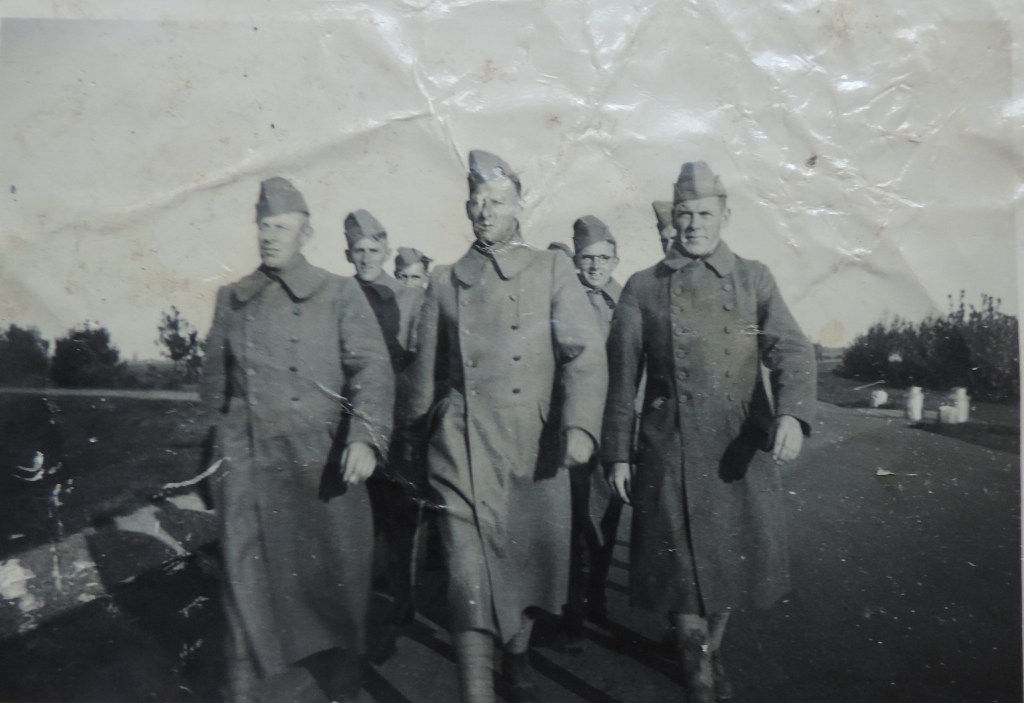
Marching was an important part for conscripted soldiers. In this photo, Sikke (the soldier with glasses) can be seen marching together with his fellow servicemen. It is unknown where and when this photo was taken.
[1] The piece was presumably not published, as the church magazine made no mention of Sikke Hiemstra anywhere.
[2] Heit is father in Frisian (a minority language in the Netherlands).
[3] Indies stands for the Dutch East Indies (Indonesia), former colony of the Netherlands.
[4] Chr. stands for Christian.
[5] Ds. stands for preaching.
[6] It is unclear why Sikke describes his Sunday, as January 9, 1940, fell on a Tuesday. It is possible that he made an error when dating his diary. At a later point in January, he corrects this error, and the diary aligns again with the actual date.
[7] Field service refers to the service performed in the field. In some cases, this term specifically refers to security service or outpost service.
[8] PWN stands for Provincial Water Supply Company North Holland. This is a drinking water company based in North Holland, where Sikke worked.
[9] Heit is father in Frisian (minority language of the Netherlands)
[10] On January 10, 1940, the Mechelen Incident occurred. A German aircraft was forced to make an emergency landing near the Belgian town of Vucht. Onboard the aircraft were plans for an attack on Belgium, the Netherlands, and Luxembourg (Fall Gelb). The Belgian authorities passed this information on to the Netherlands. Although initially skeptical, the Netherlands ultimately decided to stop granting new leaves.
[11] The afterthought is a reflective look back on the celebration of the Lord’s Supper, focusing on the question of how to continue living with God.
[12] C.C. stands for company commander.
[13] H.M. means Her Majesty.
February-1940
T. February 1
It is still a clear winter, and there is no thaw in sight. The morning duty consists of manning the positions. A request has been made to cancel this duty due to the cold. In the afternoon, work is halted because of the cold. Tonight, there is a performance in the Klomp barrack. The sis. Kerkhoven performed Tamina, a powerful play, and brilliantly executed.[1] It is very cold, and shivering, we return to our barrack at 11 o’clock. At half past 11, we crawl under the blankets.
F. February 2
I am on duty today as room watch O. and O.[2] Outside, a storm is raging, and the snow is blowing. At 1 o’clock, I hear on the radio that a train from Hoorn is snowed in. I request to leave earlier, which is granted. At 2 o’clock, I depart, and at 3 o’clock, I travel from Amsterdam via Alkmaar to Hoorn, where I arrive at 5 o’clock. It is extremely cold, and there is a lot of wind. At home, everything is in good order, and the children are doing ok.
S. February 3
Saturday morning, I’m going to Van Putten on ‘t Keern and then to De Haas in De Weel. The roads are impassable, and traffic has come to a complete standstill. The snowbanks are 1.5 meters high, and it’s impossible to keep the house warm. I spend the rest of the day at home. In the evening, I sit at home with Ym, and the newspaper reports a traffic disruption due to the winter weather.
S. February 4
Sunday morning, I am going to church with Jan. It is still cold, but the frost is not too bad at the moment. In the afternoon, it starts to rain. It is not possible to go outside due to the slippery roads. I am not feeling well and decide to consult the doctor tomorrow. In the evening, I am in bed with a slight fever and a mild throat infection. Outside, the weather is bad, and it is raining.
M. February 5
I stay in my bed and send a message to doctor Engel, who will visit me at 12 o’clock. He says it is the flu and orders me to stay in bed for a few days. I include the proof in the letter I send to C.C. 2-1-31 RI Lt. Koks.[3] There isn’t much news today, and in the afternoon, I go out for a bit. In the evening, there is no more news.
T. February 6
It is thawing quickly, and the weather is very foggy. It has been raining outside all day, making the roads incredibly dirty. There hasn’t been such wet snow in years. Train and bus services have been restored, but traveling by road remains difficult. I feel a bit better today, and my throat is better than yesterday. Tonight, I will listen to the Snip and Snap revue.
W. February 7
This morning I got out of bed again, and at 12 o’clock, I will receive a visit from the doctor. He says that I am moving too quickly and that I should go back to bed this afternoon. There is no other news, and the weather is still quite mild, but also foggy and dreary with light drizzle. I receive a postcard from J. Tuininga. Other than that, everything is fine today.
T. February 8
On Thursday morning, it is still thawing, although frost is expected again. The weather during the day is good and not cold. There is no significant news today, but in the evening, the wind picks up. Late at night, it freezes again with -4 degrees. Winter is making a strong comeback, and the newspaper reports a record compared to 100 years ago.[4] There is nothing to report on war news.
F. February 9
The winter has returned. The sky is clear, and it is freezing again at around -5 degrees. During the day, there is no news. I’m feeling good again and waiting to see what the doctor will say. In the evening, it gets cold. The sky remains clear, and by 11 o’clock in the evening, it freezes at -9 degrees. There is a strong wind coming from the northeast. There’s no more news for the day.
S. February 10
Saturday morning. It froze very hard last night with -12 degrees frost and strong winds. The weather today is otherwise beautiful winter weather. I am waiting for a visit from the doctor. The doctor came by at 5 o’clock and prescribed me a few more days of rest. He judged that I can return to my unit next week. There is no other news for today, and by the evening, there is severe frost.
S. February 11
Sunday morning, there is a severe frost of -10 to -12 degrees Celsius. I went to the church service, and in the church, 120 young soldiers stood armed for the first time in Hoorn. I also had a visit from Ale Heringa and his wife. Around 12 o’clock at noon, snow begins to fall, and in the evening, there is still frost of -6 degrees. The weather is clear and calm. Otherwise, there is no news this Sunday, and I am staying at home this evening.

In Sikke’s hometown, Hoorn, mobilized soldiers were also stationed. Sikke often came into contact with mobilized soldiers when he went home on leave.
M. February 12
From Sunday to Monday night, it was -8 degrees frost. Before the afternoon, the weather is clear, but around 4 o’clock it starts snowing again. Otherwise, I am at home all day, and this afternoon I am alone with Ankie. Ym is going to Drieboomlaan because her mother is sick. There is no other news today, and I made a drawing for my sister Niene. In the evening, there is nothing noteworthy to report, just a heavy frost with a snowstorm. At 11 o’clock, it is -6 degrees Celsius.
T. February 13
Today is my brother Andries’ birthday. Last night, it froze heavily again, with -10 to -12 degrees. The weather is good, and very little snow is falling this morning. This afternoon, I am home alone with Ankie again. The radio reports that during the night from Monday to Tuesday, temperatures dropped from -16 to -24 degrees. This is a record so far. There is no other noteworthy news to report, everything is going well with all of us.
W. February 14
Today is my brother Fokke’s birthday. Last night, there was another severe frost down to -15 degrees Celsius, but during the day, the weather is good. This morning, I obtained proof from Dr. Engel stating that I can leave again on Feb 15. This afternoon, I was visited by a military doctor who also approved my departure. This evening, I went to the music.[5] There is no other significant news. Tomorrow, I will leave for the barrack at Uitermeer in Weesperkarspel. Tonight, there will be strong winds and frost.
T. February 15
This day, I commemorate my 35th birthday. The day continued with quite a bit of frost, and at half past 4 in the afternoon, I depart again for Fort Uitermeer in Weesperkarspel. I arrive in Weesp at 6 o’clock and I am in the barracks by half past 6. Everything was in good order and disinfected again. J. van den Akker is still ill. At 11 o’clock in the evening, I went to try my straw mattress again. Besides that, there is no news today, and my birthday passed quietly and well.
F. February 16
At half past 7, this one awakens again in the barracks, and I am assigned as room guard, a duty I fulfill. In the evening, I attend a performance in the canteen of Fort Uitermeer. It is a wonderful evening. The cantonment at the coast and Lt. Jim Vogel are present.[6] The humorist and magician Mutters delivers a fantastic program, and at half past 11, I return to the barracks feeling quite satisfied. I also receive mail from my father in Oudega and from Tiete, everything fine. There is no further news.
S. February 17
Today marks 10 days of military service. In the morning, I get soup (no tea) and brown beans for sustenance. On this day, I also fulfill my duty as room guard. In the afternoon, we have a theory lesson from Lieutenant Enzing, and after dinner, we have to scrub the barracks. I leave at 4 o’clock on periodic leave and arrive in Hoorn at half past 6. At home, everything is still well with Ym and the children. I receive a congratulatory message from the office staff of the PWN.[7] Walking is done on the streets, and there is no further news.
S. February 18
Sunday morning, I am going to the morning service in the chapel at Eikstreet. The weather is beautiful, clear, and mild for winter, but the roads are very slippery. The boys are still holding speed skating races on the Vest, and twelve people are cycling across the IJsselmeer from Stavoren to Andijk. Other than that, there is no news today, and on Sunday evening, I stay home by the radio. This winter surpasses the winter of 1890 in terms of thaw, cold, and frost.
M. February 19
Monday morning, I am going to Berkhout, as well as to De Haas and Van Putten. I am also going to the PWN office, everything is in good order. In the afternoon, I leave for Weesp at half past 4 and arrive at the barracks at 7 o’clock, where the AVRO evening begins at 8 o’clock. The evening is disappointing, very disappointing. The music was beautiful, and Max Tok did great, but other than that, there wasn’t much special. At midnight, Jo van den Akker returns from sick leave. Besides that, there is a lot of noise in the barracks, but no further news of significance.
T. February 20
I got up at half past 7 and went with the compy to the Sportfondsenbad in Amsterdam.[8] It is no longer winter, and the thaw is minimal. At half past 3, we returned to the barracks. The rest of the day passed without any news. In the evening, it was quiet in the barracks, and after reading for a while, it became half past 10. We went to bed in good spirits.
W. February 21
After the morning roll call, the duty starts with physical exercise from half past 8 to half past 9, followed by a theory lesson on the heavy machine gun, given by a sergeant from the M.C.[9] After the afternoon roll call, I go on guard duty along the main road. From half past 11 to 12 o’clock, I observe signal flares in the direction of Hilversum.[10] We stop and inspect all vehicles. We stand guard with loaded revolvers, and it is a busy night with a lot of variety. No further noteworthy news to report!
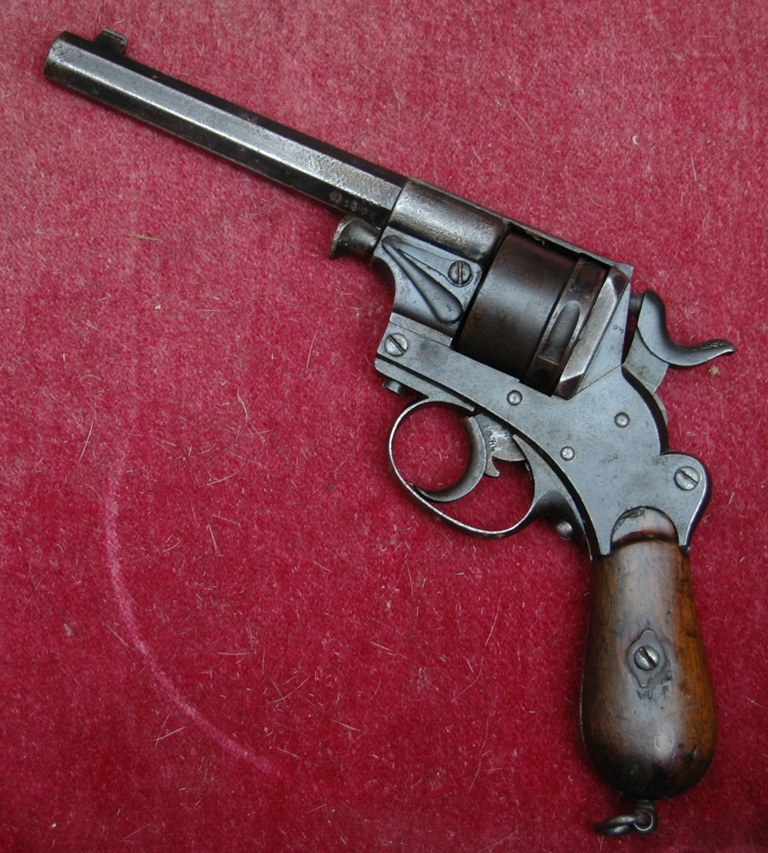
The Dutch army used two types of revolvers during the mobilization. The Revolver M.73, old model (see photo above), and the Revolver M.73, new model. It is likely that Sikke possessed one of these revolvers, because they were distributed free of charge to conscripts for some time.
T. February 22
This morning, I was still on duty, and there is no news about the signal flares. I will be relieved at 2 o’clock and freshen up. After dinner, I will go to Naarden, where everything is fine with the Wileke family. At 10 o’clock, after taking a rough road along the Keverdijk, I am back in the barracks. There is no further news, and at half past 10, I go to bed. The weather is mild.
F. February 23
After the morning roll call, we will march 20 kilometers past Nederhorst den Berg and via the Polderhuis in Ankeveen. At 1 o’clock, we will be back in the barracks. In the afternoon, after eating, the only major task is to sew our regimental number 31 onto our field cap. After a meal of potatoes, kale, and meat porridge, which we enjoyed, we spend our time in the barracks until 11 o’clock. Then, we happily settle down on our straw sack again. The weather is pleasantly mild, and the thaw is progressing quickly.
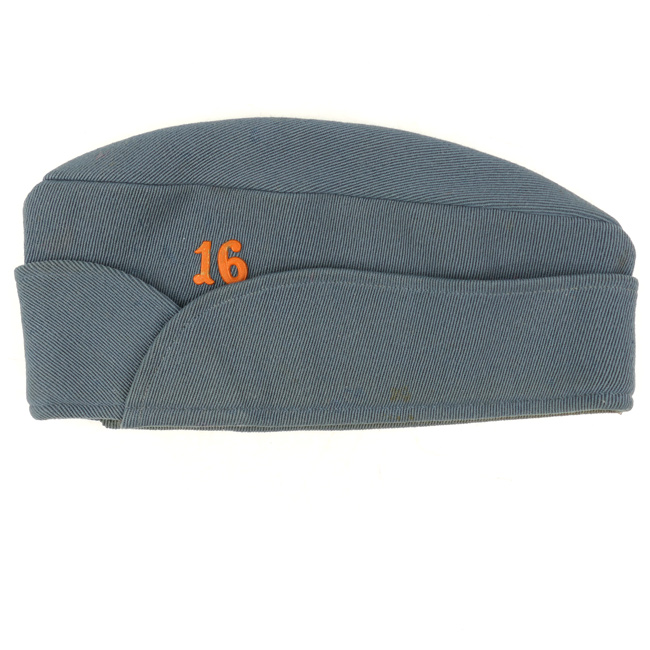
Soldiers also wore field caps during the Dutch mobilization. This is what a field cap looked like during that time. The only difference between the field cap in this photo and Sikke’s is that Sikke’s field cap had the regiment number 31.
S. February 24
Saturday morning after the morning roll call, we peel potatoes for two days. At half past 11, it is time for the payment of the wages. After lunch, I have room watch at O. and O.[11] Tonight, I went to Weesp, to our military home, where I am catching up on correspondence. I am back at 10 o’clock and in bed by half past 11.
S. February 25
Sunday morning. I first work in the room of O. and O., and then go to church in Weesp. After the service, I go to the military home for coffee and at 12 o’clock, I leave again for the barracks. After lunch, I lie down for an hour on the straw sack, and at 5 o’clock, I head to the military home in Weesp. I am back in the barracks at 10 o’clock and have seen signal flares heading toward Nederhorst den Berg. Sergeant Benhouwer was fired upon for riding through on his motorcycle.[12] I go to bed at 12 o’clock.
M. February 26
My duty today is still room watch. This morning, we are starting the summer service for the first time. I get up at 7 o’clock, and the day passes without any news. The weather is beautiful and not cold, all the snow has already disappeared. The Vecht is being pulled up again, but there is still 50 to 60 cm of ice. Other than that, there is no news, and I go to bed at half past 10.
T. February 27
Today is the day to bathe in the Sportfondsenbad in Amsterdam. At 3 o’clock, we return to the barrack, where we prepare everything for the festive evening. A cabaret group from Amsterdam is coming. It is a wonderful evening full of variety, with singing, songs, sketches, and an actor. At 11 o’clock, it comes to an end. After everyone has warmed up again, I go to bed on the straw sack at half past 12. Nothing else of significance happened today.
W. February 28
Today, I commemorate that half a year of military service has passed. In the morning, we have theory and occupy the positions. In the afternoon, we have to hand in our laundry and occupy the positions again. After eating sauerkraut with sausage, I go on barracks duty at half past 6. There is nothing to report throughout the night, except for light signals in Utrecht and the sound of anti-aircraft fire from Amsterdam.[13] Other than that, there is no news until morning, except for the evening exercise by the compy from 7 to 12.
T. February 29
I rest until 12 o’clock due to the night watch. After the midday roll call, we occupy the positions until 4 o’clock. After that, there is no more duty for the day, and at 7 o’clock, I go to the military home in Weesp. There, Ds. Van Meulen gives a lecture on Shackleton’s journey to the South Pole.[14] It is a beautiful lecture with lantern slides. At half past 10, I return to the barracks, and at 11 o’clock, I go to rest. The weather was nice today, and our barracks were christened with the name Gooi en Vechtlust.
Ernest Shackleton (1874-1922) was an Anglo-Irish explorer. He was the expedition leader of the Nimrod Expedition and attempted to be the first person to reach the South Pole. He did not succeed, but his expedition reached the southernmost point at the time (approximately 180 kilometers from the South Pole).
[1] Sis. Probably refers to sisters.
[2] O. and O. (Development and Recreation) were committees that organized courses and other activities for (conscripted) soldiers.
[3] C.C. stands for Company Commander // 2-1-31 stands for 2nd Company (approximately 160 men), 1st Battalion (approximately 750 men), 31st Regiment (approximately 2,500 men) // RI stands for Regiment Infantry // Lt. stands for Lieutenant.
[4] The winter of 1939-1940 was the coldest since the winter of 1890. The average temperature was approximately -1.9 °C (measured in De Bilt), and the cold index was around 294.0. This made it the third coldest winter in the Netherlands of the 20th century. Only the winters of 1947 and 1963 were colder. The winter of 1939-1940 is also known as the ‘mobilization winter’ since it coincided with the mobilization period.
[5] It is unknown whether this was a place or if Sikke was listening to music that evening.
[6] Cantonment is a place where troops are stationed // Lt. stands for lieutenant // This sentence was very unclearly written in the original diary. It says: ‘Cantonment to coast and lz Jim Vogel’. Therefore, part of the sentence has been interpreted when transcribing from the original diary.
[7] PWN stands for Provinciaal Waterleidingsbedrijf Noord-Holland. This is a drinking water company based in Noord-Holland, where Sikke worked.
[8] Compy stands for company.
[9] M.C. stands for Machine gun Company.
[10] Little is known about the flares that were fired prior to the German invasion of the Netherlands. Between February 17 and 29, 1940, several newspapers reported sightings of flares in various locations across the country. They were observed near Amersfoort, Doorn, Tilburg, Zeist, and Goirle, and, as Sikke described in his diary, also in the direction of Hilversum. The flares were soon linked to espionage. The German army was known for using flares to facilitate cooperation between infantry and artillery, as also occurred during the German invasion in May 1940. Nevertheless, the origin of these specific flares remains unknown to this day.
[11] O. and O. (Development and Recreation) were committees that organized courses and other activities for (conscripted) soldiers.
[12] The signal flares that were inexplicably fired across the Netherlands naturally caused tension among the military. It is likely that Sergeant Benhouwer was shot at when he ignored a stop signal from the soldiers. Little is documented about this incident, making it difficult to determine its exact nature.
[13] The flare incident, which began in mid-February, was accompanied by mysterious aircraft violating Dutch airspace. It was not entirely clear from which country or countries these aircraft originated. Nevertheless, the Dutch military took action and deployed air defense systems by opening fire.
[14] Ds. stands for preacher.
March-1940
F. March 1
After the morning roll call, we assemble for the battalion exercise.[1] We pass by the fort via the Keverdijk to Weesp, and return via the Provincial Road. The overste and colonel are very satisfied, and by half past 11, we are back.[2] In the afternoon, we march to Hinderdam and return by 3 o’clock. At 7 o’clock, I go to the fort for a film screening. It is a beautiful film, and there is a lot of interest. There is no further news today, and by 1 o’clock, everything is quiet.
S. March 2
Saturday begins with a roll call, followed by exercises on the horizontal bar. After that, we play football. At half past 11, it is time for the payment of wages. After lunch, we clean the barracks. In the evening, I go to Weesp and to the military home for a movie night.[3] At 11 o’clock, we return from Weesp, and by half past 11, we are back in the barracks. Everything is quiet in the barracks, except for a few boys who go out for the signal flares.[4] Other than that, there is no special news today.
S. March 3
At half past 7, I get up because, due to the freedom of movement, I leave for Hoorn at 10 o’clock in the morning. The weather is nice, and by half past 11, I arrive at Pieter Florisstraat 4, where everything is fine with Ym and the children. In the afternoon, I take a walk through the city, and in the evening, I visit V. Dekker. There is no news of significance this Sunday.
M. March 4
Monday morning is my first day of leave, and I am going to the PWN office.[5] There is no significant news in Hoorn. The city is busy because of the exercises by young soldiers. In the afternoon, I stay at home and finish the drawing piece for father. In the evening, there is not much to report. We stay at home and listen to a radio program. Overall, this day passes by quietly.
T. March 5
This morning, I am visiting Van Putten and De Haas in het Weeltje. In the afternoon, I stay at home until 10 o’clock. At half past 11, I leave for Weesp, where I am back in the barracks by half past 12. At 1 o’clock, I immediately head out for a night exercise that lasts until 6 o’clock. It is the first night exercise in the position, and I am in the shelter with Jo, Lanting, and Pelsma. We receive coffee and biscuits. At 6 o’clock, we return, and before resting, we are served a nice bowl of soup. At half past 6, we go to sleep.
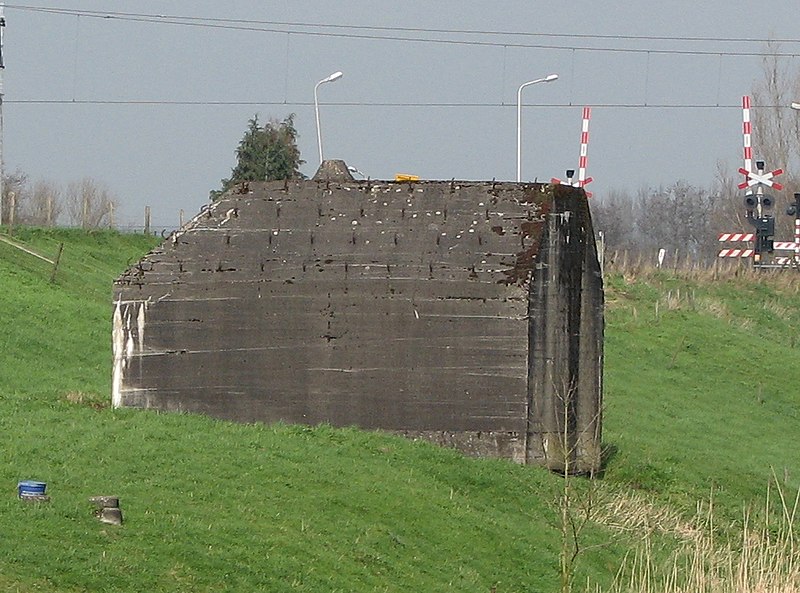
This is a group shelter (type P.), which was also called the “Pyramid” due to its shape. Group shelters were designed to protect soldiers from bombings and/or artillery fire. Sikke’s diary reveals that these shelters were also used for training exercises. Several group shelters were built in the Netherlands during the mobilization period. Some of them can still be found today, such as this one in the photo taken in Leerdam.
W. March 6
This morning, we only went to sleep at half past 6 and got up again at 12 o’clock. After the roll call at 2 o’clock, we marched with the 5th section to Fort Hinderdam.[6] After dinner, I went to the barrack Hinderdam for F. Groeneveld. Other than that, there is no news today, although there were signal flares over Muiden. At 10 o’clock, it was time to sleep, and so until tomorrow morning.
T. March 7
After the roll call, the day begins with peeling potatoes, while the rest go to play football. In the afternoon, I attend the service at the fort led by the field chaplain, Ds. Hovier.[7] At 7 o’clock, I go to Weesp, to the military home, for a radio program.[8] I speak into the microphone for the first time, and the ladies speak in Frysk for the visitors at the home.[9] At half past 11, I return to the barracks and then go to rest. Otherwise, there is no news of significance today.
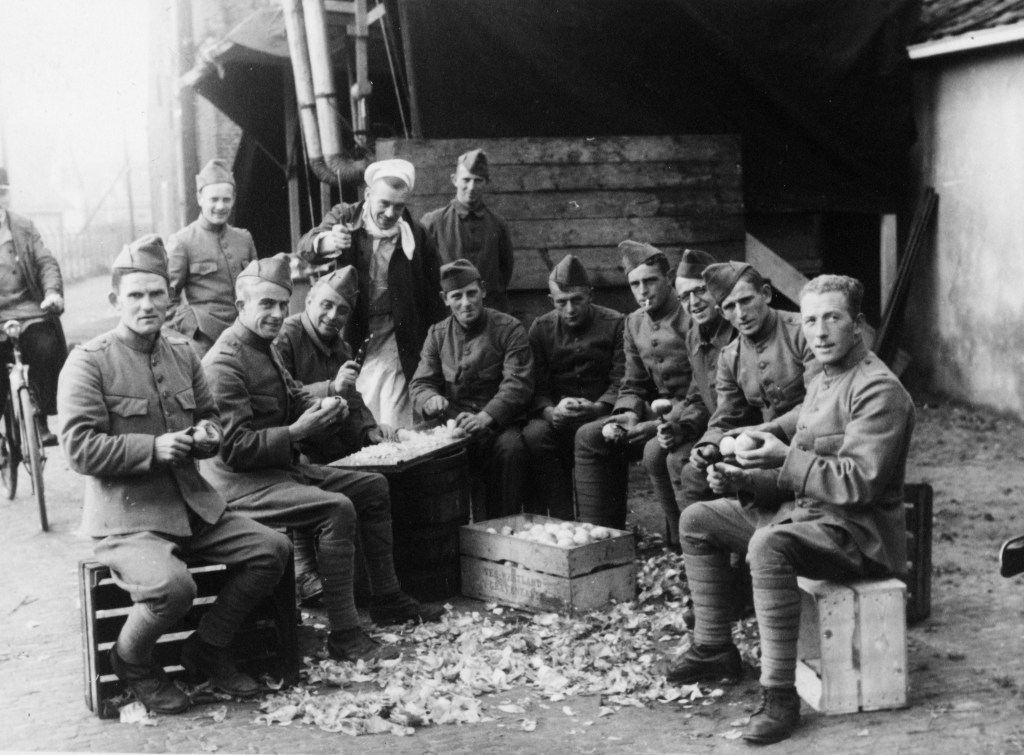
During the mobilization, it was very common for soldiers to peel potatoes. Sikke wrote multiple times in his diary that he had to peel potatoes.
F. March 8
This morning, after the roll call, we assembled for a large exercise in the Spanderswoud near Bussum. At 12 o’clock, we took a break at the French teahouse in the Spanderswoud, and around half past 3, we all returned to the barracks, still in high spirits. In the evening, I stayed in the barracks, reading my mail and newspapers. At half past 10, it was time for the straw sack, and this beautiful spring day came to an end. The weather was very nice.
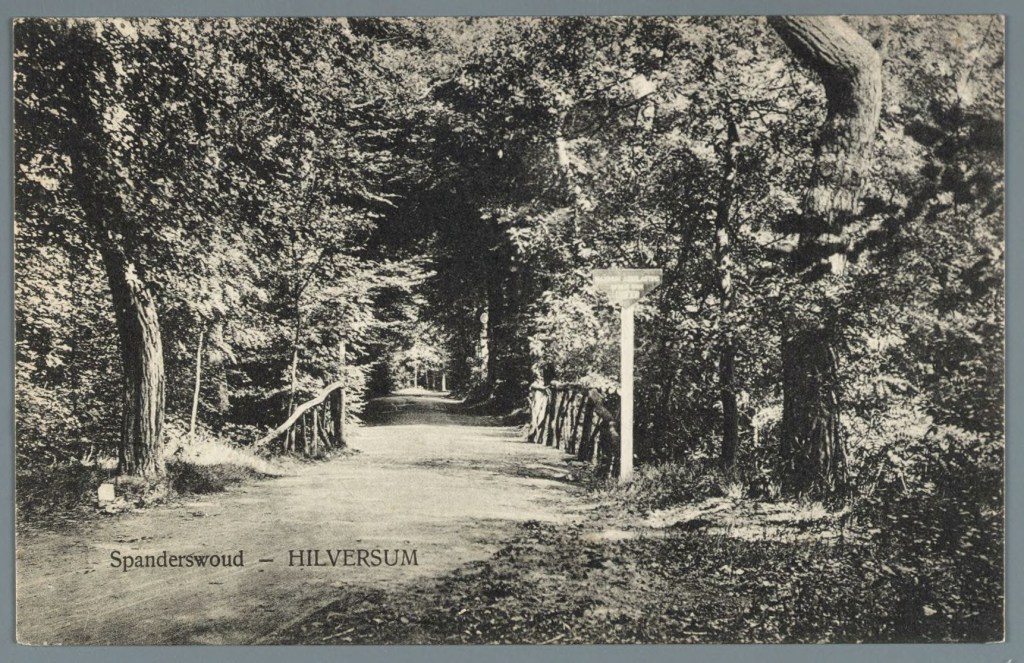
The Spanderswoud, located in Hilversum and near Bussum, was the place where Sikke conducted his military exercises on March 8, 1940.
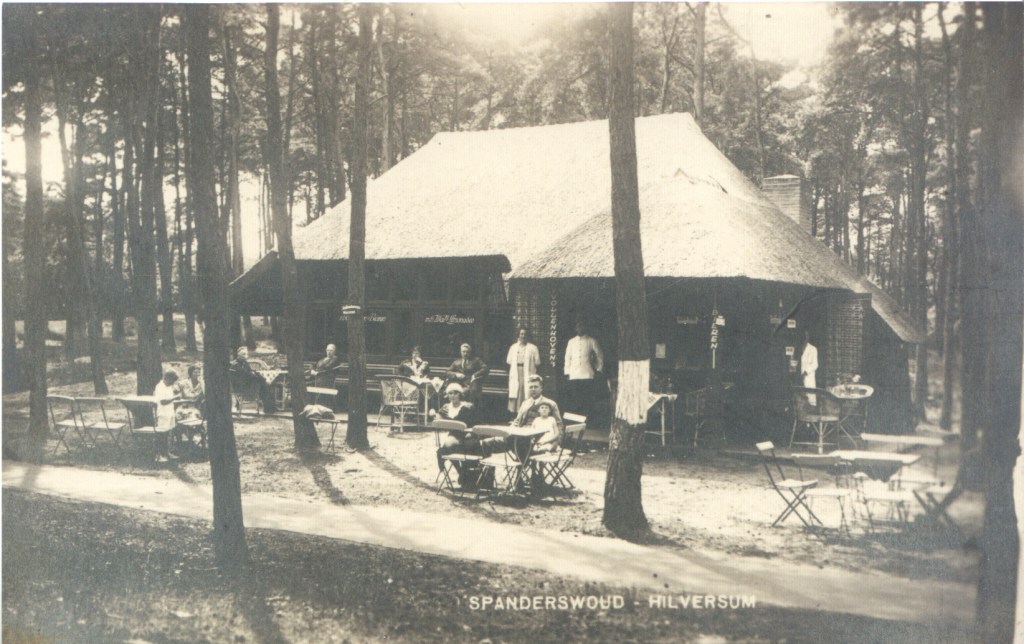
The French teahouse in the Spanderswoud was the place where the soldiers rested that day after the military exercises.
S. March 9
It is Saturday, and after the roll call, the compy sets out for an exercise in Ankeveen.[10] I stay behind to peel potatoes because I have to stand guard at the main road at 2 o’clock. During my watch, there is nothing special to report, and the weather is somewhat rainy. At 1 o’clock in the morning, I am on post, but there is nothing to report. This day has passed without any noteworthy events.
S. March 10
We will post until 2 o’clock in the afternoon. Sunday morning passes quietly and without news. After 2 o’clock, I go to the barracks and freshen up a bit for the church service in Weesp, which I am attending. Ds. Gall preaches on the words “It is finished’’.[11] It is a beautiful service, and afterward, I go to the military home, where I write a letter to my family. At 11 o’clock, I return to the barracks, and there is nothing more to report about this Sunday.
Sikke enjoyed drawing in his free time and also made a drawing during the mobilization period, which can be seen above.

On the back of the drawing it says: “Mobilization 1939–1940, Barracks Gooi en Vechtlust, Weesperkarspel near Weesp, 10 March 1940.”
M. March 11
Monday begins, after the roll call, with football and occupying the positions. I am on room duty today, and after lunch, we will scrub the barracks and clean the tables. After the meal of gray peas with bacon, I will stay in the barracks until the evening. There is no news today, and the day has passed very quietly. At half past 10, I go to bed.
T. March 12
Tuesday is cleaning day at the Sportfondsenbad in Amsterdam. I’m on room duty, so I won’t be joining. I’ll keep my room clean today, and tonight at 7 o’clock the boys head out for an evening drill. I’m exempt from this duty as well, since the room guard is not allowed to leave the room unattended. There’s no other news, and at 11 o’clock I’ll try to get some sleep.
W. March 13
Wednesday morning after 9 o’clock we start peeling potatoes. Afterwards, we clean our weapons. The ANP reports a ceasefire between Russia and Finland.[12] In the afternoon, our duties include collecting ammunition and a gymnastics exercise. At 7 in the evening, I go with Lanting to farmer Vendrig until 10 o’clock. Afterwards, there is no noteworthy news, and at 11 o’clock it’s lights out.
In the 1930s, relations between the Soviet Union and Finland deteriorated due to territorial demands made by the Soviet Union. Eventually, in November 1939, the Soviet Union decided to invade Finland. This marked the beginning of the Winter War. Finland managed to inflict significant damage to the Soviet Army (the Red Army) through guerrilla tactics, but this was not enough to completely stop the Soviet Union. On March 12, 1940, Finland and the Soviet Union signed the Moscow Peace Treaty. As a result, Finland was forced to cede territory to the Soviet Union.
T. March 14
At 8 o’clock, after the morning roll call, the day begins with peeling potatoes due to the bad weather. Outside, there is a fierce snowstorm with heavy winds. We also do gym exercises, and in the afternoon, there is a theory session from the C.C. about night exercise.[13] At 6 o’clock, I visit W. Pelsma in the hospital, and then I go to the military home for a film from Sluis Ochtendvoer. I am back in the barracks by half past 11, and by half past 11 everything is quiet.
P. Sluis was a company specialized in the production and sale of bird feed. In 1916, P. Sluis had operated a poultry and bird feed factory in the municipality of Weesperkarspel (the municipality where Sikke served at Fort Uitermeer). The company became especially well-known due to the large amount of advertising it conducted.
F. March 15
Got up at 6 o’clock, and after the roll call, we headed out for a battalion exercise towards Ankeveen and through Nederhorst den Berg. During the break, I chatted with Ds. Stengenga from the Dutch Reformed Church. It is a beautiful little church situated on a terp. After dinner, at 7 o’clock, we go to the fort for a film screening about Africa. It is an impressive film and at half past 10 we are back. I briefly lay down on the straw sack, since I have night duty at 1 o’clock in the evening with corp. Luijtens and Cupido due to the signal flares.[14] No further news.
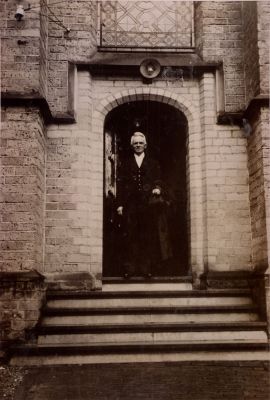
Reverend Stegenga was the minister of Nederhorst den Berg during the period 1930–1940.
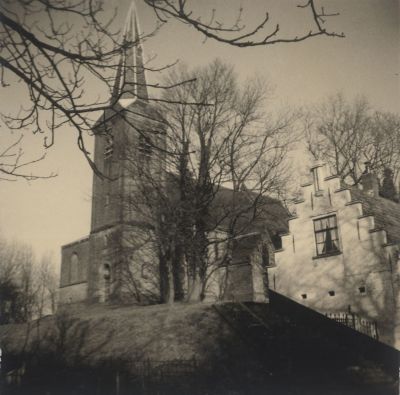
The Willibrordus Church, located in Nederhorst den Berg, is the church Sikke wrote about in his diary. This photo was taken after the war (1960), but it gives a good impression of what the church looked like at the time.
S. March 16
Last night I was on duty until 6 o’clock, and we went to Hilversum via Ankeveen and ’s-Graveland. We drove around Hilversum from 2 to 3. It was a beautiful night, with nothing noteworthy happening, and at 6 o’clock we went to sleep. In the afternoon, there was some scrubbing to be done. After that, at half past 3, I go to Utrecht, where I meet one of my best friends, Gerrit de Vos, whom I hadn’t seen in 12 years. We have a wonderful evening in U, with lots of news to catch up on. At half past 10, I leave for Weesp, where I return to the barracks at 12 o’clock.[15]
S. March 17
Sunday morning I get up at 6 o’clock. After the roll call, we go to the church service in Nederhorst den Berg, where Ds. H.P. Stegenga is preaching. It is a beautiful service. After lunch, I rest until 5 o’clock, after which I go to the service in Weesp. At half past 7 I visit W. Pelsma in the hospital. I spend the evening at the military home in Weesp, and at 11 o’clock I return to the barracks.
M. March 18
The day begins, after the roll call, with an hour of exercise on the horizontal bar. At 9 o’clock we occupy the positions until 12 o’clock. After lunch, at 2 o’clock, I freshen up, and at 4 o’clock I go on leave and travel to Hoorn. At half past 6 I arrive in Hoorn, where everything is in good order, both with Ym and the children. In the evening I am pleasantly at home with the boys. There is no news of significance today.
T. March 19
Tuesday is my 1st day of leave. In the morning, I go to the Postuma printing company at the Groote Oost and send reading materials to the military home in Weesp. In the afternoon, I go into town and visit Van Putten at the Keern. At home, I tidied up the entire backyard today and dismantled the fence. The rest of the day I stay at home, and it passes quietly without any noteworthy news.
W. March 20
Today is my 2nd day of leave. At 11 o’clock, I will visit our minister, Ds. Snoep, and Miss Hobbelman, who is still ill.[16] In the afternoon I stay at home, as well as in the evening. At 10 o’clock I leave Pieter Florisstraat 4 again, and at 1 o’clock. I return safe and sound to the barracks. The late arrival was due to missing the connection in A’dam.[17] No further news of importance.
T. March 21
The Thursday begins in the first hour with peeling potatoes. At half past 9, we do an exercise around Weesp with the battalion. We return at 1 o’clock. In the afternoon, I go to the church service at the fort, led by Ds. Hooijer. At 7 o’clock in the evening, I go to the military home in Weesp for a lecture by Prof. Dr. Barrick.[18] It is a very beautiful lecture. At 11 o’clock, I return to the barracks, and at a quarter past 11, rest begins again.
F. March 22
Today is Good Friday, and we begin the day with our correspondence, because it is Sunday service. I stay in the barracks until lunchtime. On the menu today is pikeperch. After the meal, I go on a bike ride to Hilversum, Bussum, and Naarden. At 7 o’clock, I go to church in Weesp. At half past 8, I go to our military home, where a lecture with slide projections is given by mister Boekhuis. At 11 o’clock, I returned to the barracks, and this Good Friday has passed by quietly for us.
S. March 23
Saturday, after the roll call, we start peeling potatoes. Then we beat the blankets and straw sacks outside the barracks. In the afternoon, we scrub the floors in the barracks, and after the service I stay behind in the barracks. I receive a message from home, because Ym has gone to visit father in Oudega with the children today. No further news today. The weather is pleasantly mild. At 11 o’clock we turn in for the night. It’s a quiet evening before Easter.
S. March 24
Sunday morning at half past 7, I am going with Jo and Donker to Weesp for the Easter blessing at the military home. It is a beautiful blessing prayer, led by ds. Gall. All visitors receive a New Testament, handed out by Mayor Bins of Weesperkarspel. At 10 o’clock, there is a service led by ds. Kooi from A’dam, a particularly good preacher. It is a wonderful service. At 2 o’clock, I take my watch for Van Dugteren by the main road. There is nothing else noteworthy to report. A peaceful and beautiful Easter Sunday passes us by.

Mayor Bins was the mayor of the (former) municipality of Weesperkarspel during the mobilization period. This was also the municipality where Sikke served at Fort Uitermeer. The photo shows Alderman Aard Mul placing the mayoral chain around Mayor Bins’ neck. This photo was likely taken in the 1930s.
M. March 25
On 2nd Easter Day, I stood guard by the main road until 2 o’clock in the morning. In the meantime, at 10 o’clock, I go to the church in Weesp, where ds. Hoekstra from Hilversum preaches. At 7 o’clock, I go to the military home, where I stay until 10 o’clock. At 11 o’clock, I return to the barracks. This 2nd Easter Day passed by quietly, with beautiful spring weather. Other than that, there is no significant news today.
T. March 26
Tuesday morning, after the roll call, the duty begins with the departure to the Sportfondsenbad in Amsterdam. I stay home because at 2 o’clock I have to stand guard at the main road. In the morning, I have no duty, and at 2 o’clock I take up my post after cleaning the guardhouse. Nothing special happens during the watch, and we complete our shift without any news. The weather is nice until 8 o’clock in the evening, when it starts raining and storming heavily.
W. March 27
Until 2 o’clock, I am on watch, and once again, there is no news today. After noon, I am off duty because of the watch. The other boys have exercises on the horizontal bar. At 6 o’clock, I go with Galema to our military home in Weesp, where we stay pleasantly until 10 o’clock. I receive mail from Ym from Oudega. Other than that, there is no news, and the weather is cold with hail showers.
D. 28 Maart
Deze dag wordt benut met een schietoefening in Weesp. We vertrekken om 8 uur en we zijn om half 3 weer terug in de barak. Na het avondeten van zuurkool met worst vertrek ik om 7 uur naar Weesp, naar ons militaire tehuis, waar een lezing wordt gehouden over kunst door dpl. Koperberg.[19] Om 10 uur keer ik terug in de barak. Het is erg koud weer met geweldige hagelbuien. Verder is er deze dag niets van belang te melden en om half 11 is het rust.
F. March 29
Today, there is a large exercise by the battalion along Fort Uitermeer, Naarden, Bussum, and back via Bantam. It is a heavy 25 km march, but I am fit and have little problems with my feet. We return at half past 2. In the evening, at 7 o’clock, we go to the fort for a theater night, a comedy in three acts, led by Luikie. It is a wonderful evening organized by O. and O., performed by the Nat. Theatre.[20] At 11 o’clock, we return to the barracks and turn in for the night.
S. March 30
Saturday morning, after the roll call, my work is in the kitchen and peeling potatoes. At half past 11, the pay is distributed, and at 2 o’clock in the afternoon, I leave on leave for Oudega. At half past 7, I arrive in Oudega at Ym, the children, father, brothers, and sister. Everything in Oudega is perfectly fine. Jan is with Tiete in Wijckel. In the evening, we sit at home on the Lyspôlle.[21] It is very cozy at home in the always cheerful downstairs room.
S. March 31
Sunday morning, I am going to church in Oudega for ds. Aalders. In the afternoon, Ym goes to church with the others, where Niene and Dirk are received and confirmed by ds. Aalders.[22] We receive many visitors at home. In the afternoon, we go for a walk and meet many good acquaintances from the past. In the evening, I stay at home and spend Sunday with father. It was a beautiful Sunday, feeling at home in Friesland.
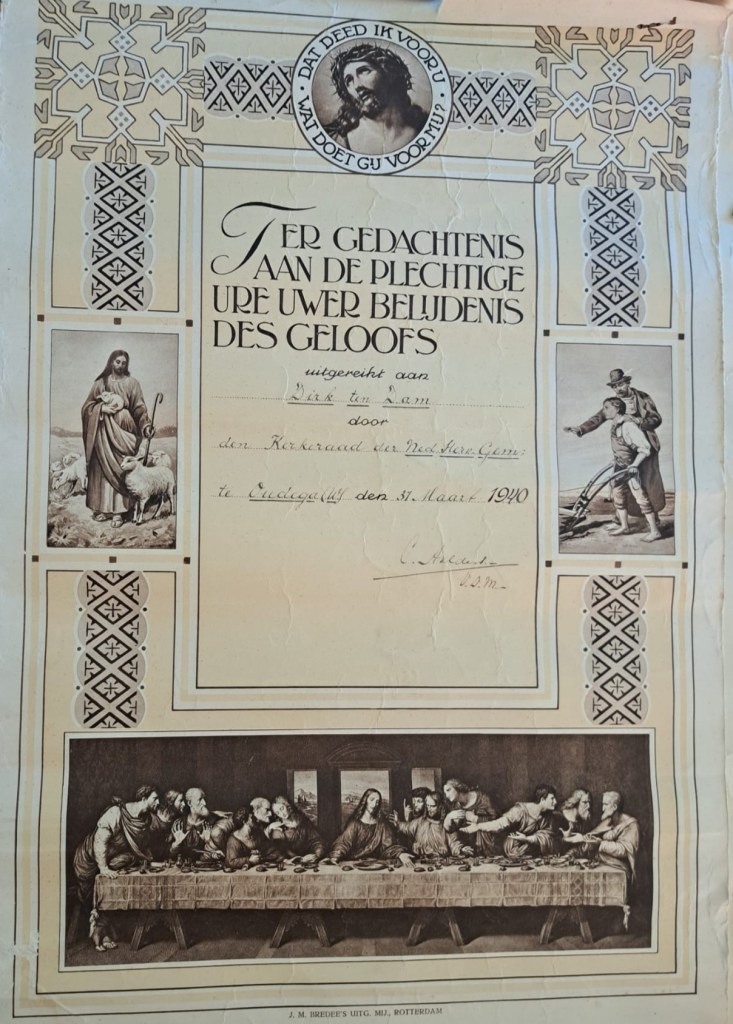
Dirk ten Dam (the future husband of Niene) received this document from the church in Oudega W after he was accepted there.

Niene Hiemstra (born as Trijntje) received this document from the church in Oudega W after being accepted there.
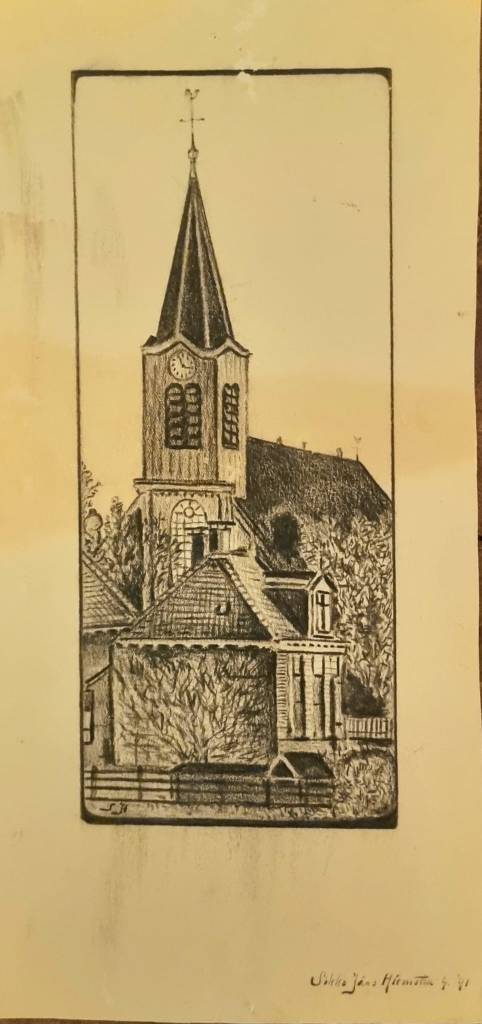
The above image is a drawing of the church in Oudega (W). The drawing shows what the church approximately looked like. This drawing was made by Sikke in 1941.
[1] In 1940 a battalion was compromised of around 750 men.
[2] Overste is the rank of Lieutenant-Colonel.
[3] Military homes originated from Catholic and Protestant movements to offer an alternative for leisure activities. These homes were intended to provide a welcoming environment where military personnel could gather outside the barracks.
[4] There is much mystery surrounding the signal flares that were fired before the German invasion of the Netherlands. In February and March, several newspapers reported that signal flares had been observed in various places in the Netherlands. These signal flares were quickly associated with espionage or sabotage. The post-war historian Loe de Jong stated in his book Het Koninkrijk der Nederlanden in de Tweede Wereldoorlog 1939-1945, part 2 that some of these signal flares could be explained, such as by pranks or cars driving up a slope with lights. Nevertheless, he also emphasized that another part cannot be explained. The ‘Signal flares affair’ gripped the entire country in February and March and caused much panic among both civilians and military personnel.
[5] PWN stands for Provinciaal Waterleidingsbedrijf Noord-Holland. This is a drinking water company based in Noord-Holland, where Sikke worked.
[6] In 1940, a section consisted of approximately 30-34 men.
[7] Ds. stands for preacher.
[8] Unfortunately, there is nothing to be found about the radio program Sikke participated in that day.
[9] Frysk is Frisian for Frisian.
[10] Compy stands for company.
[11] “It is finished” is a well-known Biblical phrase. According to the Gospel of John, these were the last words Jesus spoke on the cross (John 19:30).
[12] ANP is the largest Dutch News agency.
[13] C.C. stands for Company Commander.
[14] Corp stands for Corporal.
[15] U stands for Utrecht.
[16] Miss has been a formal title for an unmarried woman.
[17] A’dam stands for Amsterdam.
[18] Prof. Dr. stands for professor doctor.
[19] Dpl. Staat voor dienstplichtig.
[20] O. en O. (Development and Relaxation) were committees that organized courses and other activities for (conscripted) soldiers. // Nat. Toneel probably stands for the National Theatre. In 1939-1940, this was a theater company led by Rob Geraerds.
[21] Lyspôlle was a district in Oudega (W).
[22] Sikke’s sister, Niene, and her future husband, Dirk, were probably officially admitted as members of the church congregation, with their confession of faith also being confirmed by Reverend Aalders.
April-1940
M. April 1
Monday morning, I leave at 9 o’clock for Wijckel to pick up Jan. In Woudsend, I meet H. Draaier and W. ten Wolde, an old service comrade.[1] At 11 o’clock, I arrive in Wijckel at Jan and Tiete’s place. Everything is in good order here, and Jan is doing well. In the afternoon, at 4 o’clock, I leave with Jan for Oudega. In Balk, I put Jan on the bus. In the evening, I am back home with Heit, Fokke, Nien, Ym, and the children.[2] A beautiful spring day has passed us by.
T. April 2
Tuesday morning, I am at home on the Lyspôlle and take a short trip into the village to visit acquaintances, such as J. Kaspersma and others. At 4 o’clock in the afternoon, we say goodbye again to heit, brother, and sister. We travel by car to Workum. In Stavoren, Andries is waiting by the boat. After a good crossing, we arrive in Hoorn at half past 6.[3] Everything is in good order around Pieter Florisstraat 4. In the evening, I stay at home with Ym, and on the last evening, it is once again cozy at home.
W. April 3
This day, I am visiting some acquaintances in Hoorn, such as De Haas, Van Putten, and Miss Hobbelman. I will also stop by the office of the PWN, everything is in the best of the best possible condition.[4] At 6 o’clock in the evening, I will head back to Weesp, and at half past 8, I will be back at the barracks. Everything is as it was, and life in the barracks continues as usual. At half past 10, I head to the straw sack, and my Easter leave comes to an end.
T. April 4
Thursday morning, after the roll call, we have to peel potatoes until a quarter past 9. After that, we need to man the positions until 12 o’clock. In the afternoon at 2 o’clock, I will go to the Fort for a service led by Ds. Hooier.[5] I receive a booklet about Jesus of Nazareth. At 6 o’clock in the evening, I will go on guard duty at the barracks. There is nothing special to report during guard duty. I am writing a letter to Gerrit de Vos. I have watch from 8 to 10 and from 2 to 4.
F. April 5
Until 11 o’clock in the morning, I rest because of the night watch. After lunch, at 2 o’clock, we transport materials from the positions behind the fort to Weesp. There’s nothing much to report on this day. At 7 o’clock, I head into Weesp for a bit and visit our military home.[6] I spend the rest of the evening in the barracks until half past 10, after which we get ready to rest. It’s cold outside, and spring still feels far away. I have no further duties today.
S. April 6
Saturday at 8 o’clock, the compy sets out for a battalion exercise.[7] I am on duty with Kooker to transport equipment to the Van Houten factories in Weesp. At 2 o’clock, the soldiers’ pay is handed out, and at 4 o’clock I leave for Hoorn, where I arrive at half past 6. At home, everything is well with Ym and the children. No further news today, and by half past 10 the day is over. The weather was very cold and average.
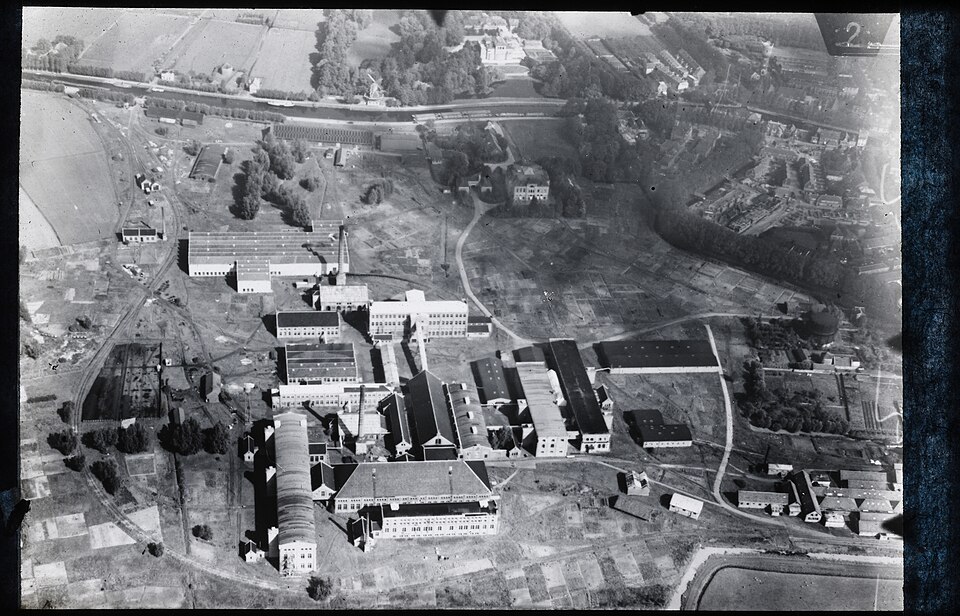
Van Houten is a producer of cocoa and chocolate. The company was founded in the nineteenth century and was very successful by the end of that century, both in the national and international markets. In addition, the company developed a new method for producing cocoa powder, known as the Dutch Method. The chocolate factory was located in Weesp, as shown in the photo above.
S. April 7
On Sunday morning, Jan and I go to church. After that, we go to the avenue. After lunch, we take a walk through and around the city. The weather is beautiful with plenty of sunshine. In the evening at 7 o’clock, Tjet Beekstra comes by for a short visit. At 8 o’clock, I leave Pieter Florisstreet and arrive back in Weesp at a quarter to 10, where I return to the military home. By 11 o’clock, I am back in the barracks. Everything went well, no punishment, and because of this day, it was a good Sunday.[8]
M. April 8
Monday morning, after the roll call, we transport equipment to Weesp. In the afternoon, we occupy the positions. At 7 o’clock, I head to Weesp, to the military home, for a movie night: SOS for the Animal, a beautiful movie in support of animal protection. At half past 10, I lie down on the straw sack, and another day has passed us by.
T. April 9
From 8 to 9 o’clock we will be peeling potatoes. After that, we are going to the Sportfondsenbad in A’dam.[9] We have heard that German troops have occupied Denmark, and as a result, the Netherlands is canceling all leave. This is confirmed by the radio at 5 o’clock. We are not allowed to leave the barracks and have to pack everything in case we are suddenly relocated. The mood is good, although people are reflective due to the situation. It remains noisy in the barracks until late at night.
Tensions rose increasingly in April 1940 when Nazi Germany decided to invade Denmark and Norway. The goal of this invasion was to secure the transport of iron from Norway and Sweden, which was crucial for German steel production. Nazi Germany wanted to prevent the British from gaining control of this vital resource. The occupation of Denmark was strategically important as it provided a base for military operations in Norway. The Battle of Denmark lasted a total of six hours, after which Denmark was forced to surrender. The German attack on Denmark and Norway also brought an end to the Phoney War in Western Europe.
W. April 10
This day we are not allowed to leave the barracks. Everyone is waiting for the message that we have to depart. This afternoon we had an inspection by the major and the overste.[10] We are hanging around in the barracks, uncertain about what will happen. The mood is good. Everything is ready: field kitchens, and so on. We do not hear much news about our country from the broadcasts. Toward the evening, we stay in the barracks and wait for further orders. I went to Weesp, to the military home, to say goodbye.
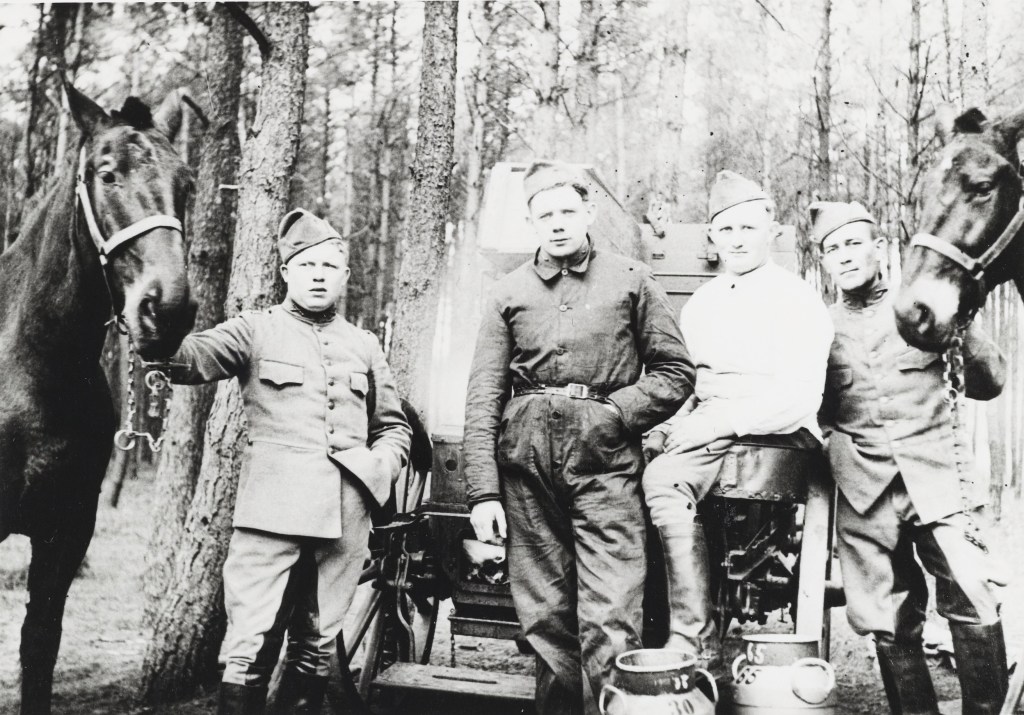
During the mobilization, it was important for soldiers to eat well. That is why field kitchens were used to distribute meals. These wagons were often pulled by horses. In the photo above, several soldiers in Amersfoort are posing in front of such a field kitchen.
T. April 11
This day begins with peeling potatoes until 9 o’clock, followed by an inspection by Major Smits. After that, we do a march around Weesp and return at 12 o’clock. In the afternoon, there is no duty. At 7 o’clock, we visit the military home in Weesp once more. We say goodbye again to our Weesper friends since we might have to leave tonight. At 10 o’clock, we are back in the barracks, and at half past 10, we are under the covers, awaiting what might happen. There are no further special events on this day.
F. April 12
After the roll call, we peel potatoes until a quarter past 8, after which we are once again inspected by Major Smits. In the afternoon, due to bad weather, there is no duty. In the evening, we go to the fort for a relaxation evening hosted by the first Dutch military cabaret group. An evening full of humor and witty moments, with wonderful performers, fun songs, and beautiful music. At half past 10, we return to the barracks, and half an hour later it’s time to sleep. The latest news is that we are not being transferred.
S. April 13
On Saturday, after the roll call, we begin yet again with an inspection by Major Smits. At 10 o’clock, we make a short march to Hinderdam. After eating pea soup at half past 1, the soldiers’ pay is handed out. Afterwards, we scrub the barracks. At 7 o’clock, I go to the military home in Weesp. At 10 o’clock, I go to bed, but at 4 o’clock in the morning, reports come in that airplanes are expected. Around 5 o’clock, these airplanes are spotted.[11] New guards have been posted during the night. Otherwise, everything remains calm.
S. April 14
Sunday morning, everything is quiet at the roll call. At 9 o’clock, I go to church. This day is considered a working day. At 2 o’clock in the afternoon, I take up the watch on the main road. Nothing noteworthy happens during the watch. Donker and I are on double guard duty.[12] During the night, there is an inspection by the duty officer.[13] It is cold, and the weather is very bad. There is nothing else to report, and there is no alarming news on the radio either.
M. April 15
Until 2 o’clock this afternoon, we stood guard at the main road. There was no significant news. The weather was bad early this morning. This afternoon we are off duty, and at 6 o’clock I am going to Weesp with Galema to visit Vermaere at Singel 21. We had an enjoyable evening, and we are back in the barracks by half past 10. From a military standpoint, this day has been quiet. It is still very cold, and there is no sign of spring yet. I received good news from Hoorn. At 11 o’clock, I am turning in for the night.
T. April 16
We start the day by peeling potatoes. At 9 o’clock, there is an inspection by Major Smits. Together with Lanting and Donkers, I clean our light machine gun, which exempts us from the planned march.[14] In the afternoon, the doctor gives a lecture on injuries in war. At 3 o’clock, everyone receives their work clothes back, as the transfer has been cancelled. I receive word from home that Sieppie is slightly unwell.[15] No other news. At 7 o’clock, I head into Weesp for a bit.
W. April 17
This day begins with peeling potatoes until half past 8, followed by an inspection by Major Smits. At half past 9, we go on a march to Ankeveen. At 12 o’clock, we have coffee, and at half past 1 we receive a lecture from the gas officer about gas and its effects during wartime. This is followed by a lecture from Lieutenant Van Bommel about general conduct. At 7 o’clock, we head to the fort for a film screening. At 10 o’clock, we return to the barracks, and by half past 10 we are tucked in. The weather today, especially this evening, was very nice.
T. April 18
Thursday from half past 7 to half past 8, peeling potatoes, and from 10 to 12, manning the positions. After the midday roll call, we have theory lessons from the C.C., Captain Koks.[16] At 2 o’clock I take up guard duty at the Vecht Bridge. But at 5 o’clock I have to return, as half the guard shift is cancelled. At 7 o’clock, I drop by the military home in Weesp, where I write to Hoorn, Oudega, and Wijckel. No other news, except that our freedom of movement has been extended to A’dam. At half past 10, I hit the sack.
F. April 19
This day begins with peeling potatoes from 8 to 9 o’clock. At 10 o’clock, we have a drill led by Sergeant Blankens. At 2 o’clock in the afternoon, I take up the main guard duty at the Vecht Bridge. On watch, there is no news, except that the weather is exceptionally bad with storm and cold. At 7 o’clock in the evening, the wind dies down and the weather improves. I stand guard every 3 hours for 1 hour each time, and during the night the weather is very nice. It is a calm night with nothing to report.
S. April 20
At half past 11 we receive our pay, and I am on guard duty until 2 o’clock. Our compy is ready to play a football match when the message comes to prepare everything for departure to Terneuzen. At 6 o’clock the entire battalion assembles, and at half past 6 we begin the march to Weesp, until a counter-order arrives: back to the barracks. There’s a great commotion in the barracks, and it is not until 1 o’clock in the night that things quiet down. The transfer appears to be postponed until further notice.
S. April 21
At 8 o’clock there is a roll call, and at 9 o’clock Lanting, Heringa, and I set off for Hoorn, hoping to get home, which we managed successfully via Amsterdam with the NACO bus.[17] By half past 11 we are home in Hoorn, everything is fine. Ym had just left. In the afternoon, we go for a walk together in the Noorderplantsoen by the sea. At half past 8 in the evening we leave again for Weesp and are back in the barracks by 11 o’clock. Everything is fine, no fuss.[18] Tomorrow we will be transferred to Muiderberg.
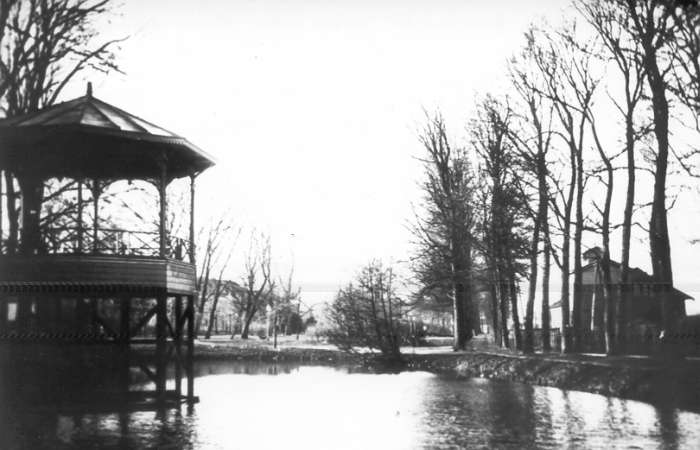
The photo above shows the Noorderplantsoen. This is the place where Sikke took a walk.
M. April 22
At 8 o’clock we started packing everything for the transfer to Muiderberg. As the 5th section, we say goodbye to the 2nd compy and are reassigned to the 1st compy.[19] At 4 o’clock we arrive in Muiderberg, a lovely village with a pleasant surrounding area near the sea. We are staying in a large warehouse, while the other companies are housed in barracks in the village. We get everything set up and at 7 o’clock we head over the village to explore the area. I send a quick message home and at 10 o’clock I crawl under the covers in my new surroundings.
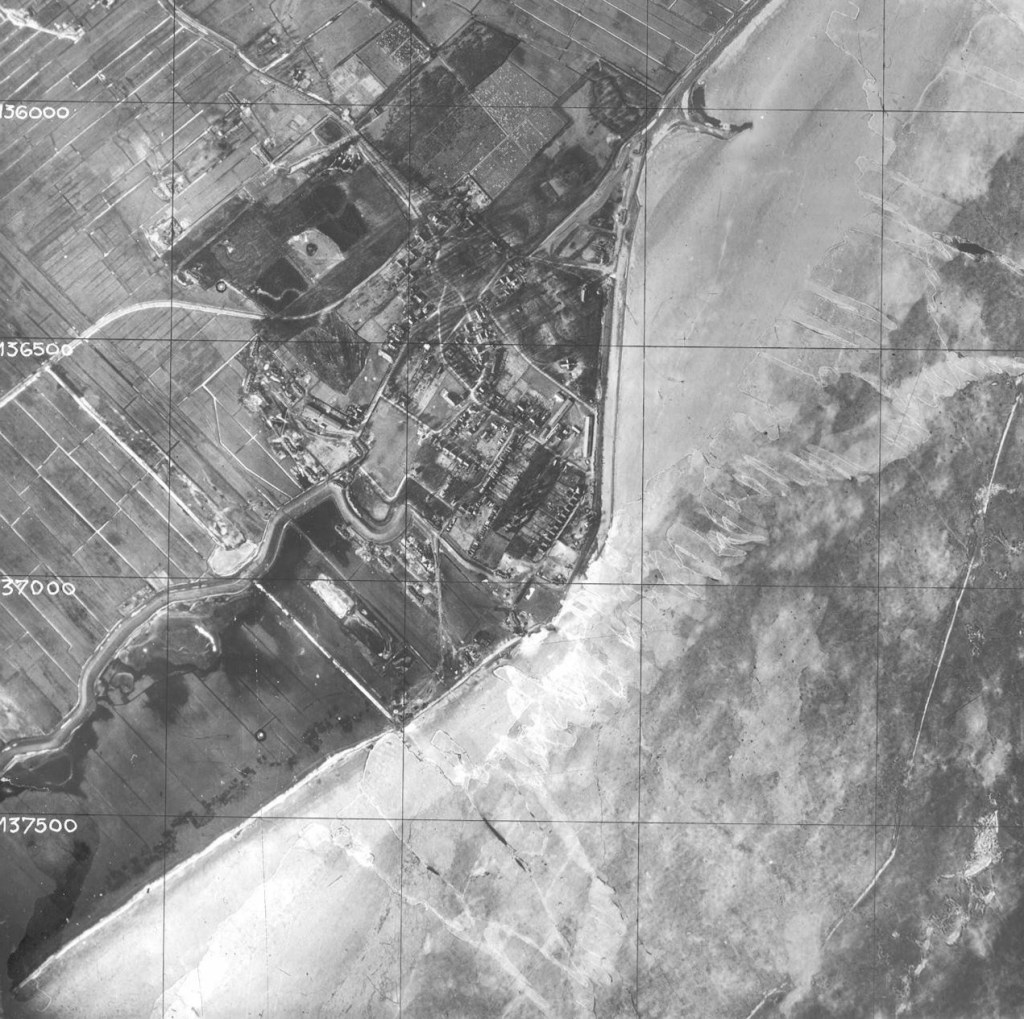
This aerial photograph of Muiderberg, taken in 1940, shows the location where Sikke was stationed as a soldier. This made Muiderberg the third place where Sikke experienced the mobilization.
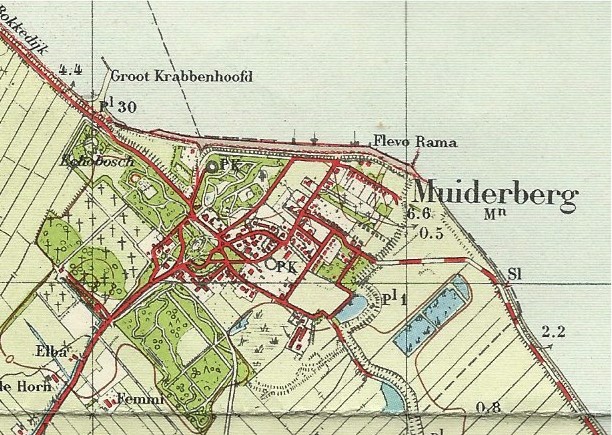
This is a map of Muiderberg after World War II, but it gives an impression of what Muiderberg looked like at that time.
T. April 23
The first new day in our new surroundings. At 8 o’clock, the duty begins: preparing and cleaning our quarters. The entire day is spent on this task. Everything is now neatly tidied up. After dinner, we explore the area and return to the warehouse by 8 o’clock. Our quarters are named ‘Coehoorn’. There is no other news today. We are quickly starting to feel at home in our new environment, and by 10 o’clock we crawl under the covers.
Fort Coehoorn was a fort near Muiderberg that was originally intended to be part of the Stelling of Amsterdam. Construction of the fort came to a halt after the First World War. Nevertheless, due to rising tensions before the Second World War, barracks and a warehouse were built on the fort grounds. Presumably the warehouse was the place where Sikke slept during his time in Muiderberg. This photo shows the barracks after the war, when they were used to house Moluccan professional soldiers of the KNIL and their families.
The image above shows the layout of the fort grounds when it was used to accommodate Moluccan professional soldiers of the KNIL and their families.
W. April 24
At half past 7 there is a drill led by Nol, and at 9 o’clock we occupy our positions. After the midday roll call, we head to the sports field in Muiderberg, where there’s a football match. At 7 o’clock, the first recreation evening takes place in our new cantonment, with a film screening.[20] The weather today was exceptionally nice, warm, even. At 8 o’clock, there was a heavy thunderstorm with lots of rain lasting late into the evening. Nothing else of significance happened today, and at 11 o’clock I crawl back under the covers.
T. April 25
At 8 o’clock, the compy gets ready to go to the swimming pool in Naarden. We return at 12 o’clock, and at 2 o’clock I take up my first watch in Muiderberg. There is nothing special to report during the watch. I stand guard at four locations in the village, each for two hours. The weather is beautiful, even warm. I receive word from home that Ankie has to be admitted to De Villa Hospital in Hoorn on Saturday. No further news today.
F. April 26
This day, I was on guard duty until 2 o’clock. The weather is beautiful. At 2 o’clock I am relieved, and at half past 2 a football match starts between the 1st and 3rd compy. The final score is 4-1 in favor of the 3rd compy. At 6 o’clock, after the afternoon roll call, I go to Naarden to visit the Wileke family. Nothing else noteworthy happened today. Our service with the new company has been going well during these first few days. Leave has started again today, the first group has already departed. The arrangement is two days of leave every three weeks.
S. April 27
On Saturday morning at 8 o’clock, we start with a gym exercise, followed by a march from 9 to 11 o’clock to the Keverdijk. Afterwards, the soldiers’ pay is distributed. At 1 o’clock, I receive a telegram from Ym saying that Ankie has been admitted to the hospital to have her tonsils removed. Because of this, I leave for Hoorn at 2 o’clock. Everything at home is fine and Ankie is also doing well. At 8 o’clock, I visited the hospital briefly.
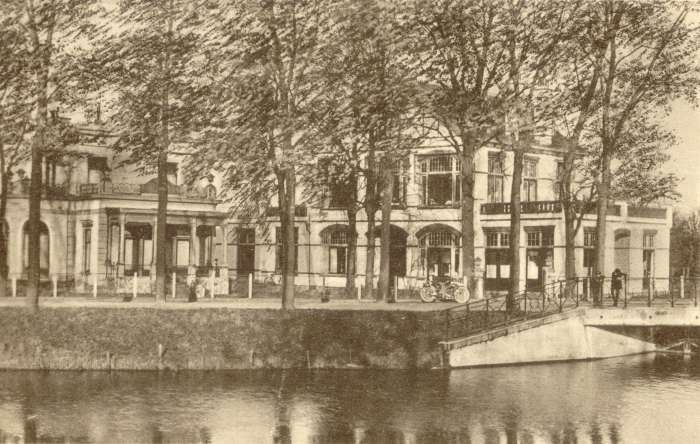
This was the hospital (Hospital De Villa) where Ank was admitted to have her tonsils removed.
S. April 28
On Sunday morning, I went to church at 10 o’clock and briefly visited the Villa. Ankie is doing well. In the afternoon at 3 o’clock, I made my first visit to Ankie, and at 7 o’clock, I visited her again. Her condition remains good, although she is now starting to develop chickenpox. Otherwise, I stay at home in the evening. The other children are doing well, and Jan has already recovered from his chickenpox. There is no other significant news for the day.
M. April 29
Today I’m paying a visit to Van Putten and De Haas in the Weel. At 10 o’clock, I pick up a certificate from Dr. Engel and the military doctor.[21] At 11 o’clock I visited Ankie in the Villa, she is doing well. In the afternoon at 3 o’clock, Ym will visit her again. I will leave at half past 4 via Amsterdam for Muiderberg. At half past 6, I am in the warehouse, and at 7 o’clock we watch the film Marijntje Gijzen’s Youth, a beautiful movie. At 10 o’clock I lie down on the straw sack.
Merijntje Gijzen is the main character in a series of novels by author A.M. de Jong (1888–1943). The story is inspired by De Jong’s own childhood. The series consists of eight volumes and was adapted into films in 1936 . Above, you can see the film when Sikke saw it in April 1940.
T. April 30-1940
Birthday of H.R.H. Juliana.[22]
Today, for the afternoon sport, we played football. The 1st compy against the 2nd compy (1–2), and the 3rd compy against the M. compy (1–7).[23] In the afternoon, I went on a bike ride with J. Lanting through Naarden, Huizen, Blaricum, Laren, Hilversum, ‘s-Graveland, Ankeveen, Weesp, Muiden, and Muiderberg. We were back in the barracks by half past 8. I received a message that Ankie is back home. No other noteworthy news. The weather was beautiful today. At half past 10, I went to bed after cycling 60 km.
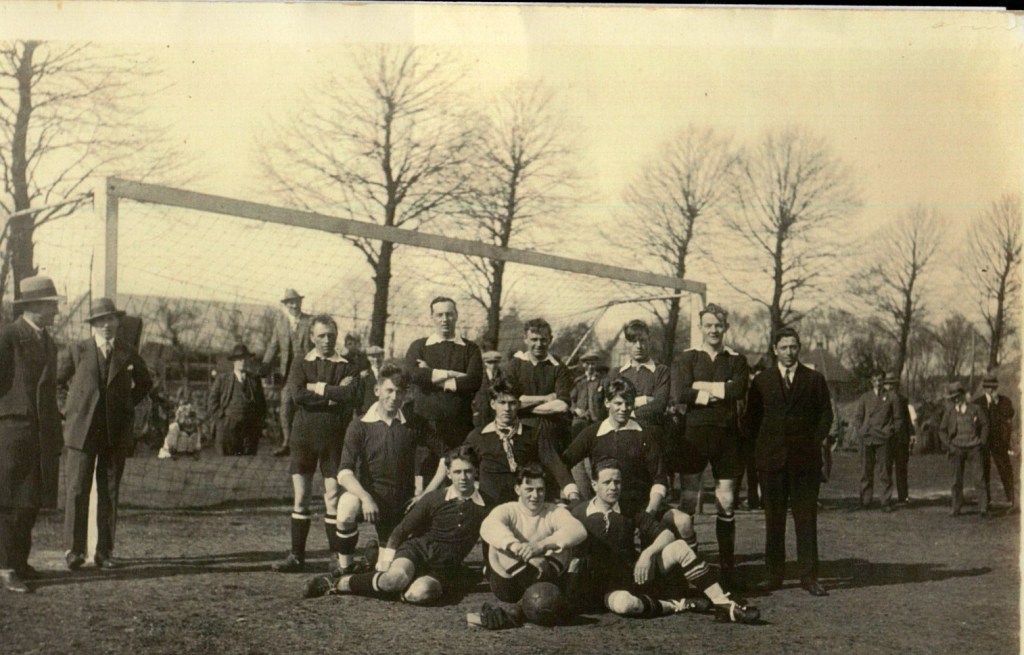
The field where the soldiers presumably played football was the Dorpswei. Sportclub Muiderberg also trained here, as shown above. In the photo, the goalpost on one side of the field is visible.
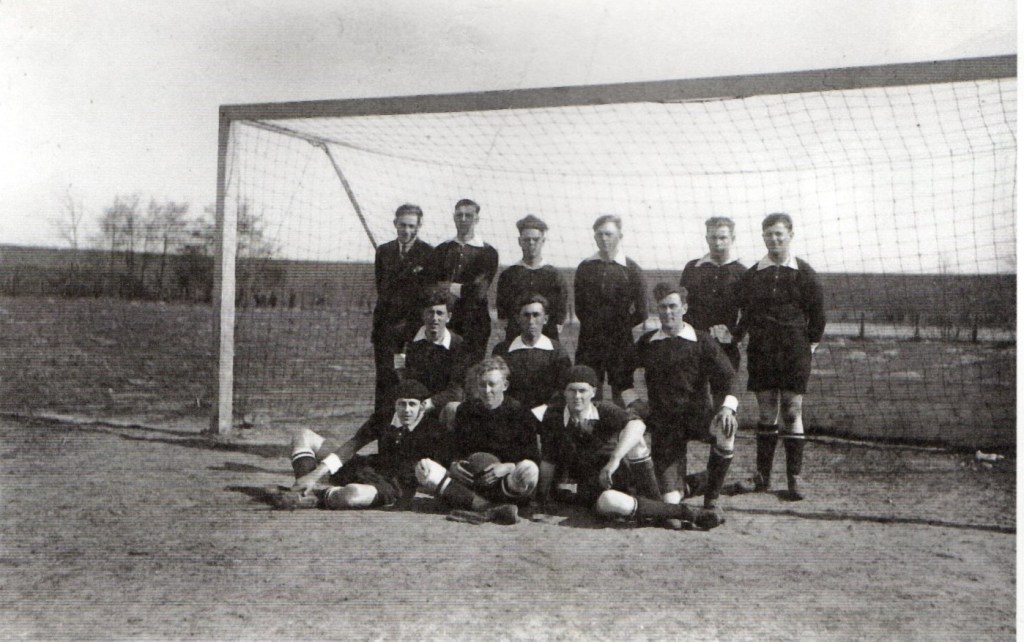
The field where the soldiers presumably played football was the Dorpswei. Sportclub Muiderberg also trained here, as seen above. In the photo, the goal on the opposite side of the field is visible.
[1] Both Sikke and W. ten Wolde served together in Schoorl from August 1939 to October 1939.
[2] Nien stands for Niene (The younger sister of Sikke), and Heit means father in Frisian.
[3] Since 1886, a ferry service has been operating between Stavoren and Enkhuizen.
[4] PWN stands for Provincial Water Supply Company North Holland. This is a drinking water company based in North Holland, where Sikke worked.
[5] Ds. stands for preacher or reverend.
[6] Military homes originated from Catholic and Protestant movements as an alternative form of leisure. These homes were intended to provide a pleasant environment where soldiers could come together outside the barracks.
[7] Compy stands for Company (Company consisted of approximately 160 men) // A battalion consisted of approximately 750 men.
[8] Most likely, Sikke left for Hoorn without leave or permission. However, since no one noticed, he was not punished for it.
[9] A’dam stands for Amsterdam.
[10] Overste is a luitenant colonel.
[11] During the mobilization period, it was not uncommon for foreign airplanes to violate Dutch airspace, as this occurred frequently. This violation was presumably related to the Battle of Norway, which involved the deployment of many airplanes. During this time, newspapers reported on German, British, and French airplanes entering Dutch airspace.
[12] Double post refers to a post that is manned by two soldiers at the same time.
[13] The duty officer is a non-commissioned officer who was responsible for the watch.
[14] The light machine gun used by the Dutch army during the 1939–1940 period was the Lewis M.20, the Dutch variant of the Lewis Gun.
[15] In the Dutch version it says ‘slightly ongesteld’, which in refers to being slightly unwell.
[16] C.C. stands for Company Commander.
[17] NACO stands for Nederlandsche Auto Car Onderneming. NACO was a Dutch public transport company.
[18] Presumably, Sikke had once again gone to Hoorn without permission to leave.
[19] A section consisted of approximately 30-34 soldiers.
[20] Cantonment is a place where troops are stationed.
[21] Dr. stands for doctor.
[22] H.R.H. stands for Her Royal Highness.
[23] M. compy stands for machine gun company.
May-1940
W. May 1
Wednesday morning we start with a running exercise on the football field of M.V.V.[1] From 9 to 12 o’clock, we make a march to Naarden and back. In the afternoon, at two o’clock, I take up guard duty at hotel Het Rechthuis together with the other boys. The summer weather is beautiful, and it’s almost warm. There is nothing to report while on guard. The eve of Ascension Day is calm and brings a very pleasant spring atmosphere. The weather remains beautiful throughout the night as well.
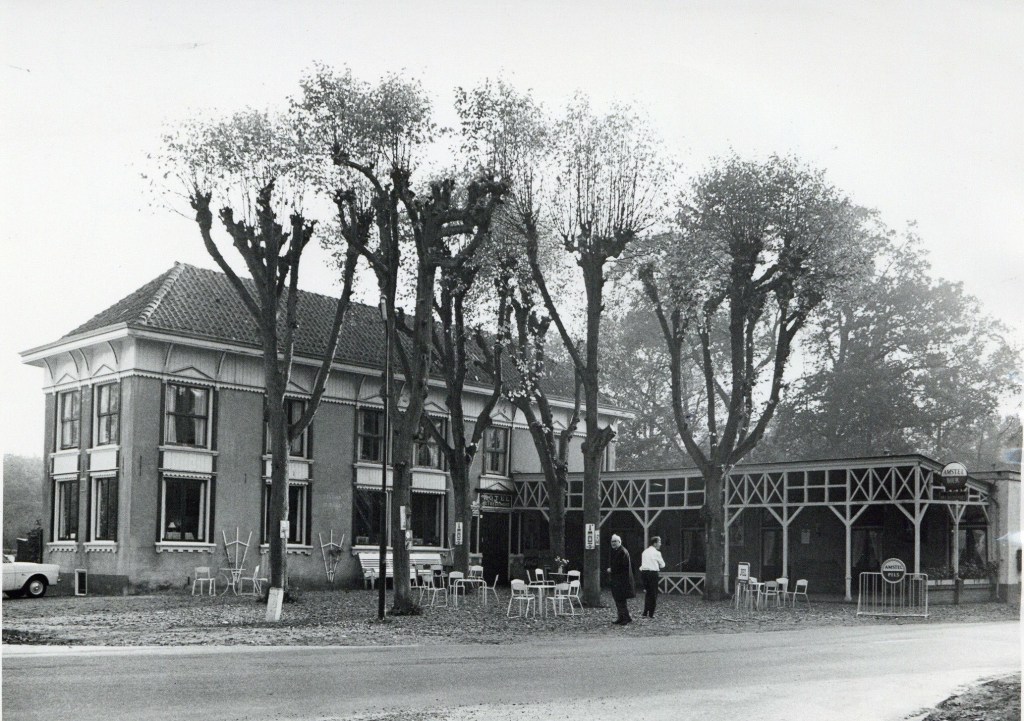
This is a post-war photo of Hotel Het Rechthuis, the place where Sikke stood guard.
T. May 2
Ascension Day.
In the morning, the weather is calm and pleasant. The village is a bit busier than usual, with some beach visitors. I’m on watch until 2 o’clock, but there’s nothing to report. I rest until 4 o’clock and write a letter to father for his birthday. At 6 o’clock, I go to barracks Flevo to meet Jo van den Akker. We take a walk along the sea. Nothing else noteworthy happens this day, and by half past 9 we go to bed.
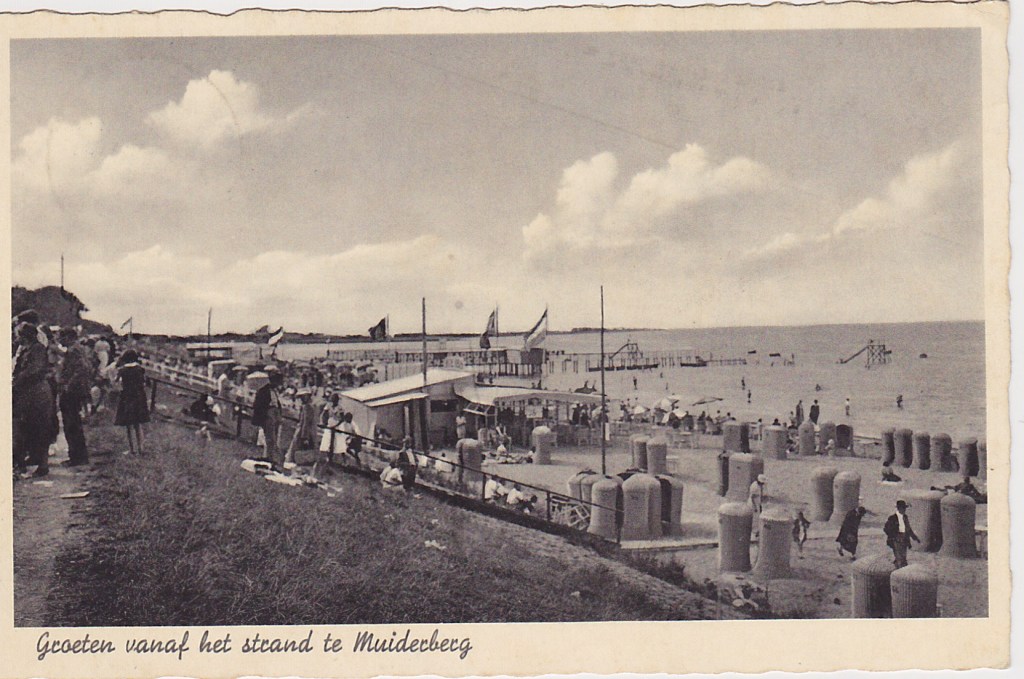
This photo shows the beach of Muiderberg around 1939. Presumably Sikke walked along the beach by the sea of Muiderberg together with Jo on May 2, 1940.
F. May 3
Friday morning from 8 to 9 o’clock we have a theory lesson about the light machine gun, and from 9 to 12 a security exercise march along the sea to Muiden.[2] At 12 o’clock we return, and after lunch we have a drill with the major involving aiming and similar exercises. At 4 o’clock we have to clean our weapons and clothing. At half past 7 we attend a film screening in the canteen of the 2nd compy.[3] The film is called Chinese Gold.[4] There is no other news today. The weather was exceptionally beautiful. At 10 o’clock we go to bed. Today was father’s birthday.
S. May 4
This day begins with physical exercises from half past 7 to half past 8, after which the positions are manned from 9 to 11. At half past 11 it is time for the pay. After the afternoon roll call at half past 1, we clean the barracks, and the duty ends at 4 o’clock. At 7 o’clock, Feake and I take a walk by the sea, and we spend the evening in the barracks until 10 o’clock. At half past 10, it’s time for the night’s rest.
S. May 5
Sunday starts at 8 o’clock with a roll call and again at 9 o’clock. At 10 o’clock I go with Feake and Pelsma to the church in Muiderberg, where pastor ds. Hoorper, the army chaplain of the Weesp cantonment, preaches.[5] After the afternoon roll call, I go to see Jo and we cycle to Naarden, where we attend a church service in the Evangelization with Ds. Th. Hoen from Bussum as pastor.[6] At half past eight I am back in the barracks, where I stay and at half past ten I go to bed. It was beautiful summer weather today.

This is a photo, taken from the beach, of the church that Sikke visited in Muiderberg on May 5, 1940.
M. May 6
Monday, after the morning roll call, the first hour is reserved for a sports exercise on the football field. This morning, I have been assigned as room guard. At 2 o’clock in the afternoon, I join other boys on guard duty at hotel Het Rechthuis. While on guard, there is nothing of significance to report until the evening. The weather is exceptionally beautiful, and nature is unfolding in rare splendor. There is no further news today.
T. May 7
I stayed on watch duty throughout the night, but there was nothing to report. At 2 o’clock in the afternoon, I am relieved of the watch duty. I freshened up a bit, as I am scheduled to go on leave at 10 to 4. On the way to the bus, the word came that all leaves have been cancelled.[7] I returned to the barracks. The mood is still good. At 7 o’clock there is a film screening. There is little news from the radio, except that the navy is being mobilized. At 10 o’clock I go to rest.
W. May 8
At 8 o’clock, the day begins with a javelin-throwing exercise, after which the company departs for a field post duty drill.[8] After the afternoon roll call, there is a gas mask exercise and theory session, followed by maintenance of the rifle and equipment. Roll calls take place at 5 o’clock and again at half past 7, a measure related to the suspension of leave. The mood is good. Otherwise, there is not much news today, not even from the A.N.P.[9] At 10 o’clock, the author turns in for the night.
T. May 9
This day begins with a running sport on the field of the M.V.V. After that, from 9 to 10, the troops gather for a theory lesson on military discipline, given by the C.C.[10] At 10 o’clock, the positions are manned. After the afternoon roll call, the focus of the service is on assault exercises. After eating potatoes with spinach, there is rest, with a roll call at half past 7. Afterwards, I take a walk through the village with Feake and others. At 10 o’clock, I rest after this calm day.
F. May 10
At 5 o’clock in the morning, we are startled by the message from our C.C. that a German attack has been launched on our country. We immediately prepare ourselves and receive ammunition and hand grenades. We take up our positions behind Barrack Coehoorn. Strange aircraft fly over our country. One plane is fired upon by us and returns fire.[11] The tension rises, although everyone remains calmly at their post, awaiting further orders.
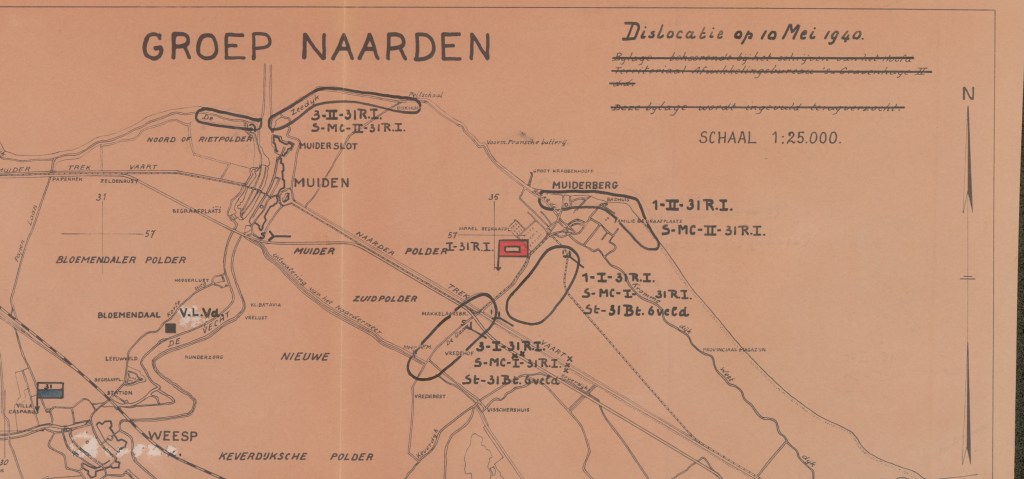
This is a military map of the situation on May 10, 1940, in the area around Muiderberg. The map also shows the positions occupied by Sikke’s company (1-I-31 R.I.).

The military map above shows the fire plan around Muiderberg. It clearly indicates the direction in which the soldiers were facing during the German invasion.
S. May 11
At 3 o’clock in the morning, the order is given to move our unit to Amsterdam. Everything is packed up, and we depart from Muiderberg, traveling via Muiden by bus to Amstelveen. At 6 o’clock, many unfamiliar aircraft are spotted, and the sirens wail. There is tremendous tension as we drive through the municipality of Amstelveen. We proceed along Kalfjeslaan to the ferry at Ouderkerk aan de Amstel. Here, we are positioned and everything is concealed, awaiting the arrival of the paratroopers.
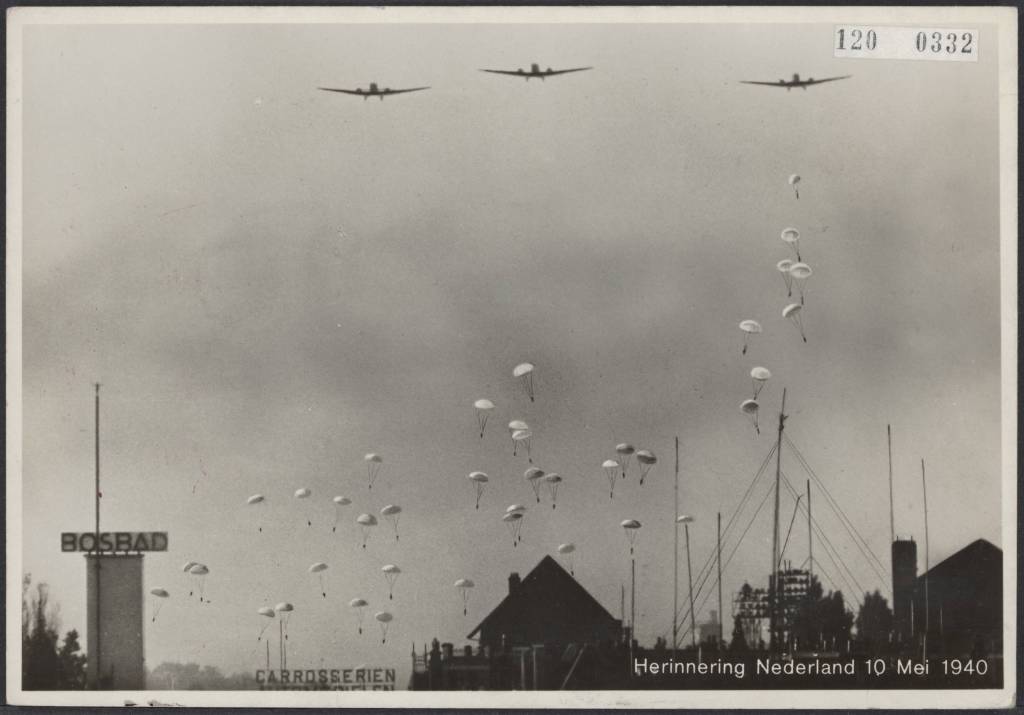
One day earlier, the Battle of The Hague took place (as seen in the photo above). Around 3,000 German paratroopers were deployed to seize the airfields around the city and to capture the government, military leadership, and the Queen. Nevertheless, Dutch soldiers put up fierce resistance, resulting in a tactical victory for the Netherlands. It was taken into account that German paratroopers might be deployed in and around Amsterdam. However, this did not happen, although the possibility was taken into account. This is also evident from Sikke’s diary.
S. May 12
Last night at 12 o’clock, we arrived from Kalfjeslaan to the Stadswallen in Amsterdam (North).[12] We are sleeping on top of each other in a room on a small boat, in a barn. Posts are being set up, and every 4 hours, 4 men go on guard. The mood is good, but tense. Sleep doesn’t come easily, but everyone is exhausted. There is heavy gunfire on the Prussians, and also bringing in suspicious people was a lot.[13] This Sunday will not be quickly forgotten. We are heading into the night.
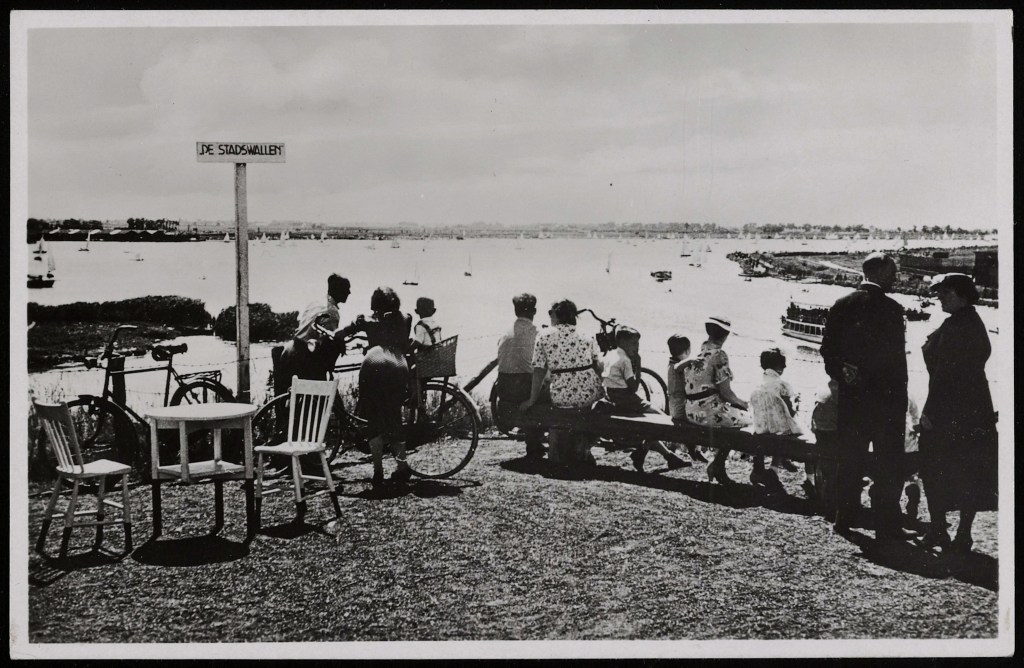
The image shows the city walls, located next to the Nieuwe Meer. It is presumed that Sikke was stationed somewhere here on May 12, 1940.
M. May 13
Just like other mornings, there are once again airplanes coming under fire from anti-aircraft guns. Bombardments only took place in the Heerengracht on Saturday, May 11, during which 40 people lost their lives. Tension hangs over the city. The police and military are working hard, arresting many individuals who appear suspicious. More than I can write, we are living through this day.[14] We are very tired, but we do our duty. Hundreds are being detained by us.
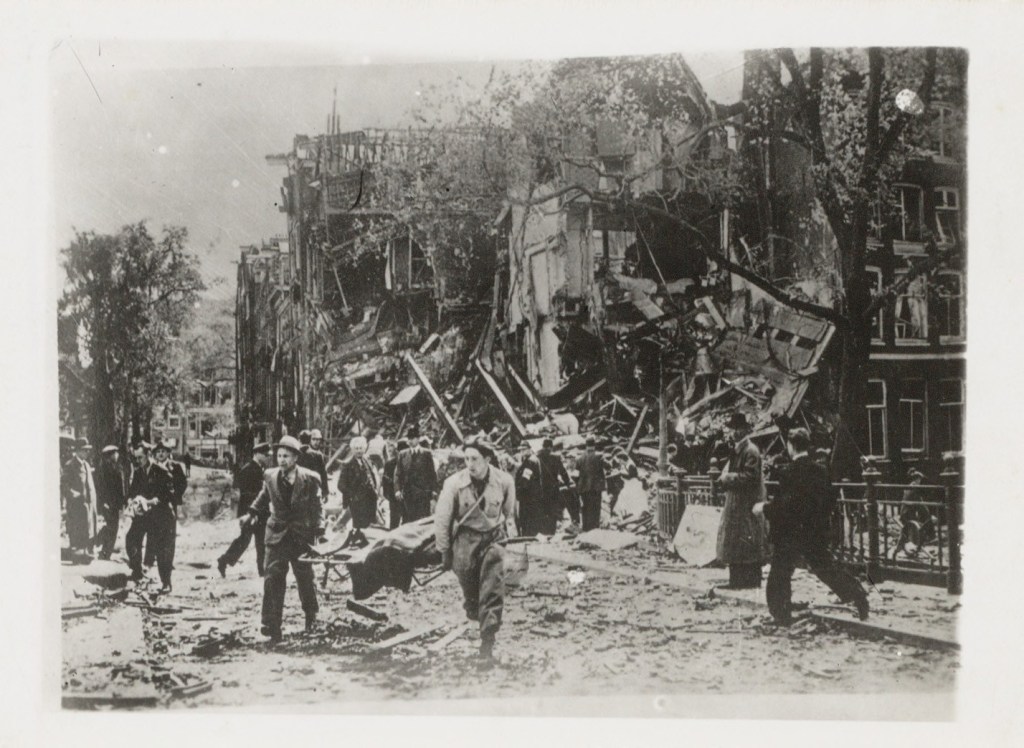
On May 11, 1940, a bombing took place in Amsterdam a the Blauwburgwal and the corner of Herengracht. The attack resulted in 44 deaths and 79 injuries. In addition, 14 buildings were destroyed. There are two explanations for this bombing. According to the first explanation, a German bomber was targeting Schiphol Airport. However, the aircraft was hit by Dutch anti-aircraft fire, causing it to drop its bombs over Amsterdam to reduce weight. Another explanation is that the old post office behind the Royal Palace on Dam Square was the intended target, as it housed the communication center of the Dutch army.
T. May 14
At 4 o’clock we are startled by the sound of the immediate alert alarm. We are ready at once and transferred to the opposite side of the IJ in connection with preparing positions to repel the enemy.[15] It is a day of great tension. The people of Amsterdam are extremely kind to us, everything is offered, food, drinks, fruit, etcetera, etcetera. At 2 o’clock in the afternoon, I am transferred to the Willemsluis for guard duty.
Ceasefire.[16]
This is a photo of the Willemsluis. This was the place where Sikke heard that the Netherlands had surrendered.

On May 15, 1940, the formal surrender of the Netherlands took place. During this event, the terms of the capitulation were discussed. Zeeland was excluded from the surrender because French troops were still active in the area. The French forces were given the opportunity to withdraw from Zeeland. Furthermore, only the Dutch armed forces (the army, air force, and navy) surrendered. The Dutch state itself did not surrender, which allowed the colonies and Dutch units in Allied territory to continue the fight. The photo above shows General Henri Winkelman (1876–1952) leaving the building after signing the capitulation.
W. May 15
Yesterday afternoon, the news arrived that the Netherlands had surrendered. We are transferred to the Beatrixschool, where we spend the night and hand in our weapons. At 2 o’clock, we have to go to the stadium, from where we are moved to the school at Frans Halsstraat 16. There, we are considered prisoners of war.[17] The tension has eased slightly, but there is still mourning due to the losses in our army.[18] At 8 o’clock, we go to bed without our uniforms for the first time again. We are exhausted.
The Beatrix School (see photo above) was the place where Sikke’s company spent the night and handed in their weapons.
This is a photo from 1890 of the schoolyard of the Frans Hals School. Sikke spent his time in this school as a prisoner of war.
T. May 16
At 8 o’clock I got up. The mood is good, especially among the Amsterdammers who are receiving frequent visitors these days. I know nothing about home, but I’m not worried. We are not allowed to leave the gate and remain under the control of the German military command. At 5 o’clock it is announced that we are allowed to be in the city until 10 o’clock. I go to D. Brinckman, Von Zesenstraat 27, 1 floor, Amsterdam-East, and to the skipper. At 10 o’clock, German troops pass through the city.
This is a photo taken after the war. On the left, you can see the gate of the Frans Hals School. As Sikke mentioned in his diary, they were not allowed to leave the gate.
Source: Netherlands Institute for Sound and Vision, Intocht van Duitse gemotoriseerde troepen, Public Domain, via Openbeelden.
On May 16, 1940, the German motorized troops entered Amsterdam, as can also be seen in the footage.
F. May 17
On Friday morning, we get up and start with sports practice until 12 o’clock. At a quarter past 12, I meet my wife, who has been looking for me for two days.[19] She and the children are doing well. At 6 o’clock in the evening, I take them across the IJ, and at 8 o’clock the bus to Hoorn departs. The rest of the day passes quietly. There are many German troops in the city. At 10 o’clock, we go to bed in the Frans Hals School. There is no significant news today.
Source: Netherlands Institute for Sound and Vision, Een tocht door de gevechtszone, Public Domain, via Openbeelden.
A group of journalists, under the supervision of the German military authorities, toured the battlefields. The footage shows the damage caused by the German invasion, such as destroyed buildings and bridges.
S. May 18
Saturday morning at 9 o’clock, just like on other days, there is a strict roll call. We take a walk through the city and rest in the Vondelpark. After the afternoon roll call at 2 o’clock, we do gymnastics exercises and play football. At 6 o’clock in the evening, I go home with J. Schuit to the Spaarndammerbuurt, where I am warmly welcomed. At 10 o’clock, I go to sleep peacefully again, awaiting whatever else may lie ahead.
S. May 19
Sunday, the day of rest. At 10 o’clock, I go to church for the first time, the Old Church, where pastor ds. Dijkstra preaches on the text: “Jesus Christ is the same yesterday and today and forever.”[19] After the midday roll call, we visited Artis. At 6 o’clock, I go to the Muiderkerk, where pastor ds. Donselman preaches on the text: “As the mountains surround Jerusalem, so the Lord surrounds His people, from this time forth and forevermore.”[20] These two services, reflecting on them afterward, left an impression on me and gave me peace. At 10 o’clock, it is quiet again, and Sunday comes to a close.
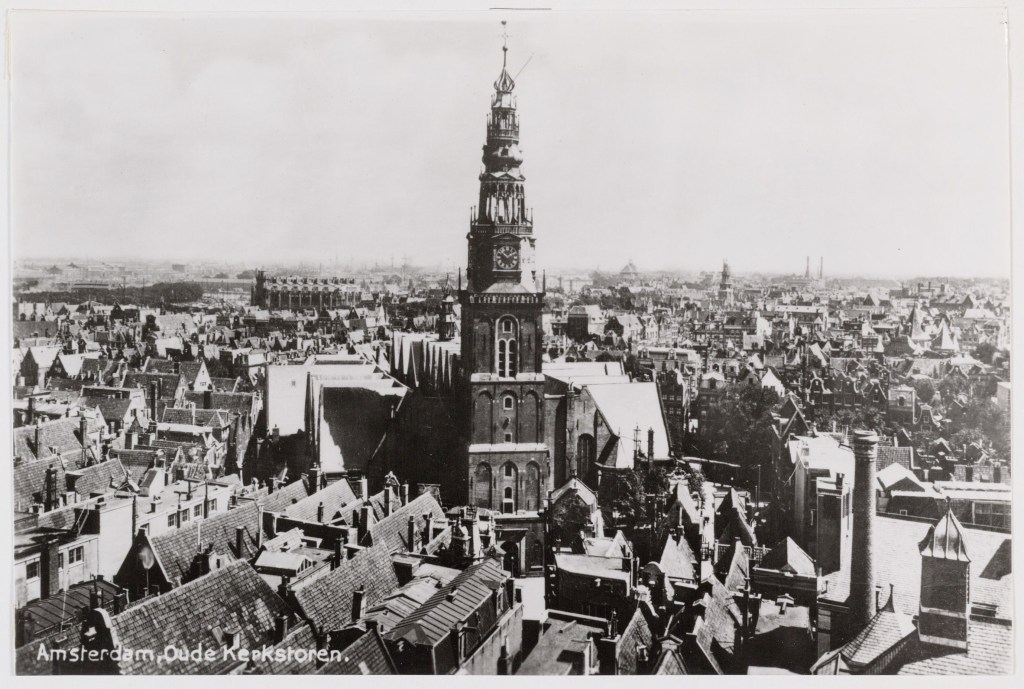
This is a photo of the Oude Kerk, the first church Sikke visited as a prisoner of war.

This photo shows the interior of the Old Church.
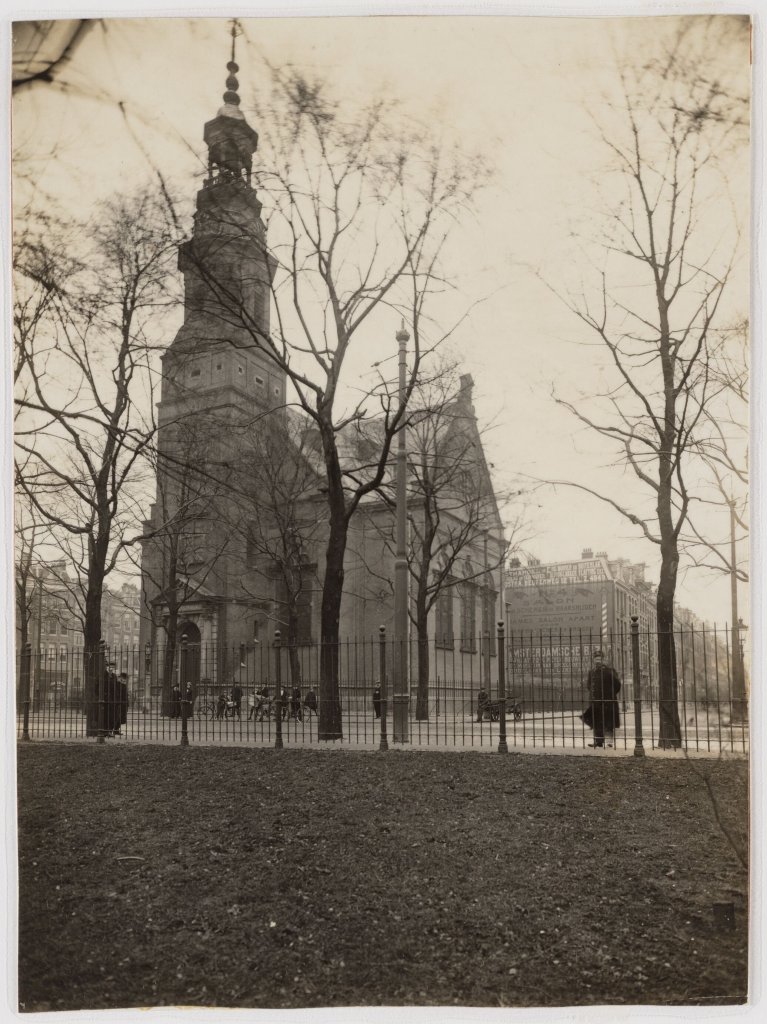
This photo shows the Muiderkerk, the second church that Sikke visited.

This image shows the interior of the Muiderkerk. The pulpit is prominently featured in the scene.
M. May 20
At 8 o’clock, the day starts with a theory lesson on military discipline. After that, we head to the Sportfondsenbad in the city. Following the midday roll call, we go to the sports field by the ice rink, followed by a march through the city. After dinner, at half past 6, I visit Sperts with R. Hogestop. He is the head of the school at Westzaanstraat 3. At 10 o’clock, we lie down in the straw again, and this day, despite these tense times, has quietly passed us by. A.V. Koningsveld sends greetings from Oudega, where everything is going well.
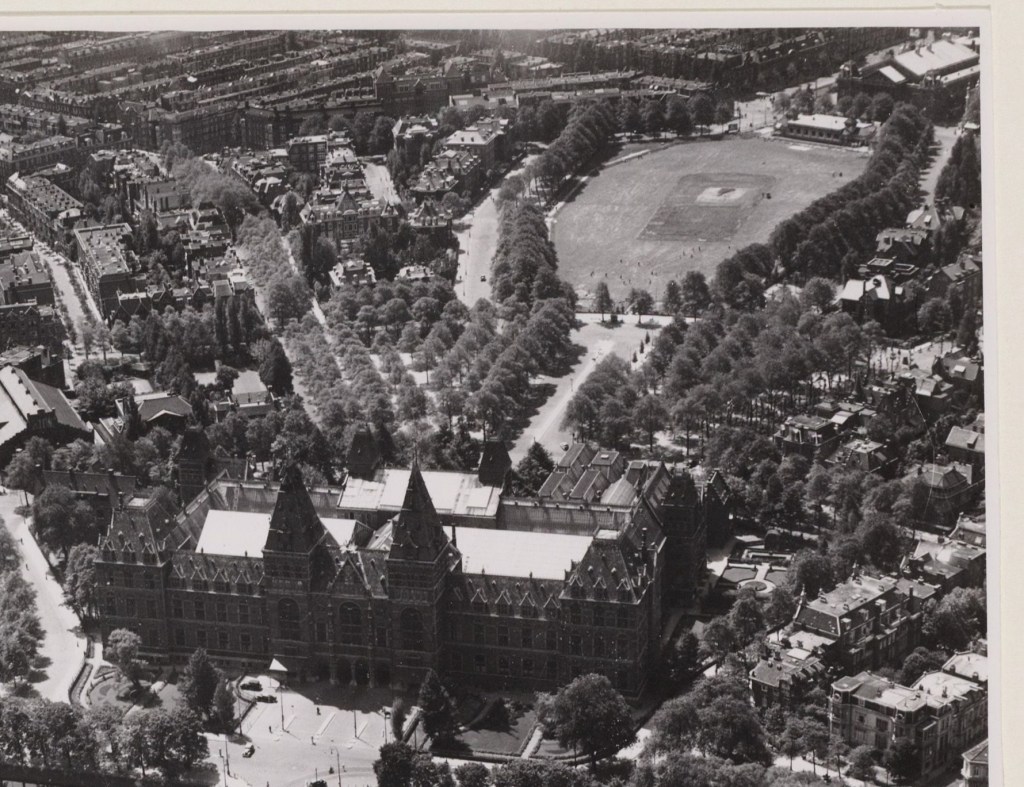
Sikke most likely referred to the sports field at the museum square.
T. May 21
We get up at 7 o’clock, and the duty starts at 9 o’clock. At 9 o’clock, 18 of us leave for Spaarndam, located between Zaandam and Velsen, where we take up guard duty at the gunpowder ships. We claim a cockpit with a machine gun from a crashed Dutch airplane. Besides that, there is no news on guard duty.[21] At half past 6, we are back in A’dam.[22] At 8 o’clock, I briefly go with A.V. Koningsveld to J. van den Akker. No further news, and at 10 o’clock we hit the sack.
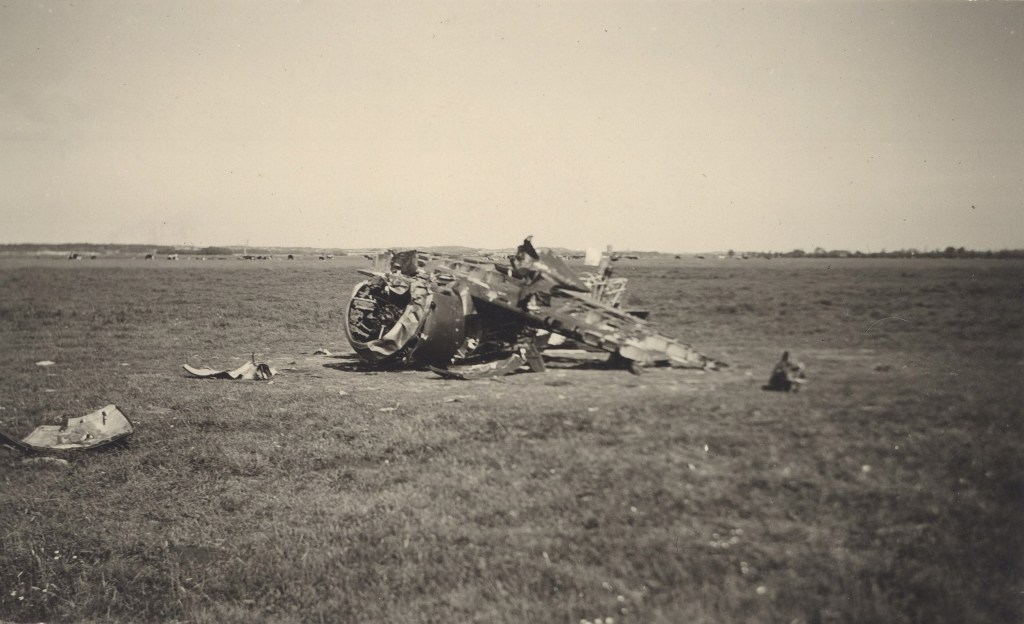
During the May Days, fierce fighting also took place in the air between German and Dutch aircraft. As a result, after the Dutch surrender, various Dutch and German aircraft wrecks were scattered across the Netherlands. In this photo, a Dutch aircraft wreck of the Fokker D.21 can be seen near Kijkduin.
W. May 22
At 9 o’clock, our work consists of a walk through the city. At 2 o’clock, we go with the entire compy to the Artis Zoo. At half past 5, we return to the barracks. After the evening meal at 6 o’clock, we head into the city for a bit, and I send several postcards to acquaintances. Nothing is yet known about our return home, everyone longs for home. The mood among us is good, and the food has not been bad so far. No further news, and at 10 o’clock it’s time to rest again.
This is the entrance of Artis around 1920. This was the zoo that Sikke’s company visited.
T. May 23
After the morning roll call, we begin with our duties and hand in part of our equipment, such as the grey clothing and the cartridge pouches.[23] After this, we do sports at the ice club grounds. In the afternoon, there is an inventory check of all the goods still in our possession and those that are missing. After the half past 5 meal, we stay near the school or take a walk into the city. There is no other news of significance. Everything is quiet in the city, with nothing noteworthy to report.
F. May 24
At 9 o’clock we begin evacuating the school due to the relocation of furniture to other schools. This will take up the entire day. At 2 o’clock we get some rest, because at 5 o’clock we have dinner and then leave by car with 18 people for the Hembrug (outside) to stand guard for the evening. Nothing of significance occurred during the watch. Ander and I took our post from 8 to 9.
This is the Hembrug (photo from 1928), the place where Sikke stood guard on May 24, 1940.
S. May 25
The night passed quietly under a beautiful bright moon. A few aircraft flew over us and dropped flares. Searchlights scanned the sky, but there is nothing to report. Furthermore, there is nothing to report during the day until 6 o’clock. We are relieved and by 7 o’clock we are back at the school. According to rumors, 50 of the soldiers are going home. This Saturday passed quietly and calmly, and at 10 o’clock we tried to get some sleep.
S. May 26
At 10 o’clock I went to Central Station to pick up Ym. We meet each other at 11 o’clock. Everything is fine in Hoorn, also with the children. Today we walked around Amsterdam and explored the city. Everything was quiet and calm. At 8 o’clock we are back to Central Station and Ym left again. There’s not much more news, and the day has been peaceful. At 10 o’clock, under the covers at the school.
M. May 27
At 9 o’clock, the day begins with exercises on the ice rink field until 11. After the afternoon roll call, the C.C. announces that 15% of the troops will be going home, namely 22 men, including our friends Pelsma and Tuininga. At 3 o’clock, the departing soldiers leave. After dinner, Lanting and I go into the city for a while. We also briefly visited the 2nd company. At 10 o’clock, we go to bed. There wasn’t much news today.
Source: Netherlands Institute for Sound and Vision, Het Nederlandse leger demobiliseert, Public Domain, via Openbeelden.
After the capitulation of the Dutch army on May 15, 1940, the demobilization began. The army was disbanded, weapons were surrendered, and prisoners of war were released. Non-professional soldiers, such as reserve officers and conscripts, were soon granted extended leave so they could return to their professions. However, professional soldiers remained longer in captivity because they were first required to sign a declaration. The demobilization of the Dutch army lasted until July 15, 1940.
T. May 28
After the morning roll call, we are taken to the Sportfondsenbad for a swim. At 12 o’clock, we return to the school for the afternoon roll call, during which it is announced that ten men will be granted extended leave, including G.W. van der Beek and Cupido. Nothing further is known yet about any other transfers. Dinner is at 5 o’clock, and afterwards we prepare for guard duty in Velsen. We pass the Hembrug. There is nothing noteworthy to report while on duty. It rains heavily in the evening, and there are no aircraft. The thunderstorm continued into the night.
W. May 29
This morning I posted until 8 o’clock and there is nothing special to report. The weather is rainy. Today I called Hoorn and Oudega, everything is fine. At 6 o’clock there was another air raid alarm over IJmuiden and Velsen, and anti-aircraft fire could be observed. Today, Lanting, Donker, and Draaier departed. It has been said that I will go tomorrow. Nothing further to report, and hoping to be home tomorrow, we go to rest.
T. May 30
The long-awaited day has arrived. Lanting and I slept alone in the straw last night. At 9 o’clock, I received my pass.[24] I say goodbye to the boys, and at half past 11 I am home, where everything was in fairly good order. This afternoon, I fix up some things and tidy up my little garden. Everything else is going well, and tomorrow I am going to the company. My mobilization period is over, and I hope it will never again be necessary for me to wear my uniform.
F. May 31
Today I met acquaintances and family, and spoke with many of them. Tomorrow I will return to work at the PWN.[25] I have experienced a great deal during the time in which this book was written. I sincerely hope that war will never again come upon us. Thank God that all those dear to me have been spared. On this day, Friday, May 31st at 8:30 in the evening, I close my diary, and may I remember this longing with gratitude for a long time to come.
[1] M.V.V. stands for Muider Football Association.
[2] The light machine gun used by the Dutch army during the 1939–1940 period was the Lewis M.20, the Dutch variant of the Lewis Gun.
[3] Compy stands for company.
[4] The light machine gun used by the Dutch army during the 1939–1940 period was the Lewis M.20, the Dutch variant of the Lewis Gun.
[5] A cantonment is a place where troops are stationed.
[6] Ds. stands for preacher and Th. stands for theologian.
[7] The reason the Dutch government revoked all leaves was related to the military attaché in Berlin, Bert Sas (1892–1948). Sas was in close contact with the German officer Hans Oster (1887–1945), who repeatedly passed him information about a possible German invasion. Sas passed this information to the Dutch authorities. On May 6, he reported that Germany would launch an attack on the Netherlands on May 8. In response, the Dutch government decided on May 7, 1940, to revoke almost all military leaves. Only special leave (for example, due to illness or the death of family members) remained permitted. To prevent panic, the government emphasized that this was merely a precautionary measure. However, the expected German invasion on May 8, 1940, was postponed due to unfavorable weather conditions. The actual invasion took place a few days later, on May 10, 1940.
[8] The outpost service is a security detail for resting troops. Soldiers on outpost duty alert the resting troops in case of a potential attack and can, if necessary, temporarily hold off the enemy.
[9] ANP is the largest Dutch News agency.
[10] C.C. stands for Compagny Commander.
[11] The German aircraft flying over Muiderberg were presumably targeting Schiphol. After all, Schiphol had a strategic location from a military standpoint and was therefore bombed as early as May 10, 1940. However, it is also possible that some strategic positions in Muiderberg itself were attacked by the German air force. After all, Muiderberg was filled with bunkers, as it was part of the New Dutch Waterline.
[12] Sikke was located farther north than the day before, but not in Amsterdam North.
[13] It is not entirely clear whether Sikke actually referred to ‘Prussians’ in his diary, as this part is difficult to read. Nevertheless, people from Limburg and Twente used a variant of the word ‘Pruus(j)’ to refer to Germans. Perhaps Sikke drew inspiration from this for his wording.
[14] In Amsterdam, there was widespread panic. The capital was gripped by what became known as “paratrooper fever.” Many residents of Amsterdam believed they had seen German paratroopers, even though there were none. People were also afraid of the so-called Fifth Column. This group consisted of members of the NSB (the Dutch National Socialist Movement), Nazi sympathizers, and Germans living in the Netherlands. There were fears that the Fifth Column would carry out acts of sabotage to support the advance of the German army. A rumor even circulated that this group was handing out poisoned chocolate.
The Dutch army, the police, the Air Protection Service, and the Voluntary Civil Guard checked everyone, and each other, which in some cases led to dangerous situations. Lastly, during the German invasion, there were suicide attempts, many of them in Amsterdam. Many these were committed by Jews who were afraid of living under a Nazi regime. In Amsterdam, it is estimated that around 400 people took their own lives during the German invasion.
[15] Signals came in among the military and civilians that the Afsluitdijk had been forced and that German troops arrived in North Holland via boats across the Zuiderzee (now IJsselmeer). These messages were not verifiable, but they do provide a possible explanation why Sikke was stationed in North Amsterdam.
[16] After the bombing of Rotterdam and the German threat to bomb several cities, the Netherlands surrendered on 14 May 1940. An armistice followed immediately. The formal capitulation, in which all conditions were recorded in writing, was signed on 15 May 1940. This marked the end of the Battle of the Netherlands. However, Zeeland was not included in the capitulation, which meant that Dutch units continued to fight there until 17 May 1940.
[17] The capitulation of the Netherlands marked the beginning of the demobilization of the army. Between August 1939 and May 1940, the country experienced mobilization and the German invasion (the May Days). After the Dutch surrender, the demobilization of the Dutch army began, with soldiers returning to civilian life. This demobilization would continue for the entire army until July 1940.
[18] The German invasion would claim the lives of approximately 2,000 Dutch soldiers. In addition, around 6,000 Dutch soldiers were wounded during the German invasion.
[19] A day later, newspapers such as Algemeen Dagblad and de Volkskrant published where the army units were located in the country. This information was, of course, useful for the families of soldiers, so they knew where the soldiers were stationed. Sikke’s regiment was also mentioned in these newspapers.
[19] This passage appears in the New Testament in Hebrews 13:8.
[20] This passage appears in the Old Testament in Psalm 125:2.
[21] It is unknown why Sikke continued to perform military duties while he was a prisoner of war.
[22] A’dam stands for Amsterdam.
[23] cartridge pouches were bags used to store ammunition.
[24] Sikke probably received his leave pass, which allowed him to go home on extended leave.
[25] PWN stands for Provincial Water Supply Company North Holland. This is a drinking water company based in North Holland, where Sikke worked.
Citation instructions for version I
If you wish to refer to version I, please do so as follows: Soldier Sikke Hiemstra, “Diary: Version I”, https://soldaatsikkehiemstra.com/english/diary/version-i/.
Sources
This section refers to external sources used for this webpage.
- Algemeen Dagblad, ‘Mededeling over legeronderdelen’, May 18, 1940, 3, https://resolver.kb.nl/resolve?urn=KBNRC01:000088084:mpeg21:p003 (May 17, 2025).
- Bert Booden, ‘Geldelozeweg-Keern’, https://www.watertorens.eu/torens/Hoorn/index.html (11 September 2024).
- Bianca Stigter, ‘Atlas van het bezette Amsterdam (1940-1945)’, (version march 29, 2024) https://historiek.net/atlas-van-het-bezette-amsterdam-1940-1945/127560/ (may 13, 2025).
- Centraal Bureau voor de Statistiek, ‘Prijzen toen en nu,’ (version March 21, 2013) https://www.cbs.nl/nl-nl/onze-diensten/leren-met-het-cbs/gereedschappen/prijzen-toen-en-nu (September 9, 2024).
- City Archive Amsterdam, ‘Zelfmoordpoging’, (version April 23, 2019) https://www.amsterdam.nl/stadsarchief/stukken/dood/zelfmoordpoging/#:~:text=Vierhonderd%20zelfmoorden,voor%20vervolging%20onder%20het%20naziregime (May 13, 2025).
- D. Hans, ‘Britsche Verkenningsvluchten’, Het Ochtendblad, April 14, 1940, 1, https://resolver.kb.nl/resolve?urn=MMKB27:048366024:mpeg21:p00001 (April 13, 2025).
- Delpher, ‘Venlo-Incident’, https://www.delpher.nl/thema/geschiedenis/venlo-incident#:~:text=De%20Telegraaf%2C%2013%20november%201939&text=Wat%20De%20Geer%20zich%20dan,inval%20in%20Nederland%20te%20rechtvaardigen (November 13, 2024).
- De Slag om de Grebbeberg en de Betuwestelling in mei 1940, ‘Geijkte misvatingen en mythes’, https://www.grebbeberg.nl/index.php?page=geijkte-misvattingen-en-mythes (February 21, 2025).
- De Slag om de Grebbeberg en de Betuwestelling in mei 1940, ‘Geweer en Karabijn M.95’, https://www.grebbeberg.nl/index.php?page=geweer-en-karabijn-m-95 (September 9, 2024).
- De Slag om de Grebbeberg en de Betuwestelling in mei 1940, ‘Lichte mitrailleur Lewis M.20’, https://www.grebbeberg.nl/index.php?page=lichte-mitrailleur-lewis-m-20 (September 27, 2024).
- De Slag om de Grebbeberg en de Betuwestelling in mei 1940, ‘Vuistvuurwapens’, https://www.grebbeberg.nl/index.php?page=vuistvuurwapens (16 December 2024).
- De strijd om Westervoort, ‘Infanterie’, https://www.westervoort1940.nl/nl_troepen_infanterie.html (August 29, 2024).
- De strijd om Westervoort, ‘Infanterie Depotbataljons’, https://www.westervoort1940.nl/infanterie_depot_bataljons.html#opkomstdata (August 29, 2024).
- De Telegraaf, ‘Nieuwe raid op vliegveld van Stavanger’, April 14, 1940, 1, https://resolver.kb.nl/resolve?urn=ddd:110578196:mpeg21:p001 (April 13, 2025).
- De Telegraaf, ‘Lichtkogels gezien in Brabant. Bij Goirle afgeschoten?’, February 22, 1940, 8, https://resolver.kb.nl/resolve?urn=ddd:110578612:mpeg21:p008 (February 21, 2025).
- De Volkskrant, ‘Granaat van luchtafweergeschut ingeslagen’, February 28, 1940, 2, https://resolver.kb.nl/resolve?urn=ABCDDD:010845225:mpeg21:p002 (February 28, 2025).
- Ds. A.TH. (Anne) van Olst, ‘Het is volbracht’, geloofstoerusting.nl, https://www.geloofstoerusting.nl/videos/het-is-volbracht/(March 10, 2025).
- Eindhovensche en Meierijsche courant, ‘Landverraders in onze provincie? Lichtkogels bij Goirle afgeschoten, February 23, 1940, 9, https://resolver.kb.nl/resolve?urn=KBDDD02:000199760:mpeg21:p009 (February 21, 2025).
- Eindhovensche en Meierijsche courant, ‘Weer lichtkogels nabij Zeist’, February 23, 1940, 5, https://resolver.kb.nl/resolve?urn=KBDDD02:000199760:mpeg21:p005 (February 21, 2025).
- Eric van der most en Johan van Hoppe, ‘1940: verklaring op Erewoord’, https://krijgsgevangen.nl/verklaring-op-erewoord/ (August, 19, 2024).
- Fedor de Vries, ‘Groepsschuilplaats Type P Griftenstein’, Traces of War, https://www.tracesofwar.nl/sights/4984/Groepsschuilplaats-Type-P-Griftenstein.htm (March 5, 2025).
- Fred Poppen, ‘Bommen op Amsterdam’, Dood in Amsterdam (2022), 1-7
- Hervormd Brandwijk, ‘Dankzegging en Nabetrachting’, (Version December 1, 2023) https://www.hervormdbrandwijk.nl/heilig-avondmaal/dankzegging-en-nabetrachting/ (January 23, 2024).
- Historiek, ‘Geallieerd bombardement op Schiphol (1943)’, (version January 8, 2025), https://historiek.net/geallieerd-bombardement-op-schiphol-1943/161022/ (May 10, 2025).
- Historisch Muiderberg, ‘Geschiedenis van een brinkdorp ‘aan zee’’, https://historischmuiderberg.nl/brinkdorp-aan-zee/ (May 10, 2025).
- Historische Vereniging Buitenplaats Ypenburg, ‘B04 – Gebouw inwendige dienst en Officier van piket’, https://historischypenburg.nl/b04-gebouw-inwendige-dienst/ (April 14, 2025).
- Jephta Dullaart, ‘Fort Coehoorn’, (versie 15 mei 2024), https://onh.nl/verhaal/fort-coehoorn-gedroomd-fort-luidt-einde-van-de-stelling-van-amsterdam-in (23 april 2025).
- L. de Jong, Het koninkrijk der Nederlanden in de Tweede Wereldoorlog II, Neutraal (Den Haag 1969) 282-284, 447-448, 451-453, 460-461.
- Leestekens van het Landschap, ‘Groepsschuilplaats’, https://www.leestekensvanhetlandschap.nl/groepsschuilplaats (March 5, 2025).
- Leeuwarder Courant, ‘Nederland en de Oorlog’, May 7, 1940, 1, https://resolver.kb.nl/resolve?urn=ddd:010607960:mpeg21:p001 (May 7, 2025).
- Liza Koppenrade, ‘180 jaar verwennerij: Van Houten’s Cacao en Chocolade’, Oneindig Noord-Holland (Version October 7, 2015), https://onh.nl/verhaal/180-jaar-verwennerij (April 6, 2025).
- Marcus van der Heide, ‘Clinge Doorenbos (1884-1978)- rijmend door het leven’, Contactblad Historische Kring Bussum 16 (2000) 42-67, https://www.historischekringbussum.nl/bussums-historisch-tijdschrift/1020-bht-16-2-pag-42-67.
- Ministerie van Defensie, ‘Verhalen uit de meidagen van 1940’, https://www.defensie.nl/onderwerpen/militaire-geschiedenis/verhalen-uit-de-meidagen-van-1940 (May 15, 2025).
- Netherlands Institute for Military History, Den Hague, Gevechtsverslagen en -rapporten mei 1940, access 409, inventory number 480022.
- Netherlands Institute for Military History, Den Hague, Gevechtsverslagen en -rapporten mei 1940, access 409, inventory number 489019.
- Nieuwe Haarlemsche courant, ‘Evenwichtige Neutraliteitspolitiek’, April 13, 1940, 2, https://resolver.kb.nl/resolve?urn=MMNHA03:179205022:mpeg21:p00002 (April 13, 2025).
- NOS, ‘Slachtoffers ‘onbekend’ Amsterdams bombardement krijgen een naam’ (version may 1, 2017), https://nos.nl/artikel/2170971-slachtoffers-onbekend-amsterdams-bombardement-krijgen-een-naam (May 13, 2025).
- Provinciale Noordbrabantsche en ’s Hertogenbossche courant, ‘Geheimzinnige Signalen? Geval Spionage?’, February 19, 1940, 6, https://resolver.kb.nl/resolve?urn=MMSADB01:000016900:mpeg21:p006 (21 February, 2025).
- Provinciale Noordbrabantsche en ’s Hertogenbossche courant, ‘Vreemde vliegtuigen boven ons gebied’, April 15, 1940, 3, https://resolver.kb.nl/resolve?urn=MMSADB01:000017753:mpeg21:p003 (April 13, 2025).
- Sander Steenbakker, ‘De Luchtbeschermingsdienst’, https://oorlogsleven.jimdofree.com/geschiedenis/luchtbeschermingsdienst/ (September 5, 2024).
- Theater Encyclopedie, ‘Het Nationaal Toneel’, https://theaterencyclopedie.nl/wiki/Het_Nationaal_Toneel (March 29, 2025).
- Volskrant, ‘Mededeeling over legeronderdelen’, May 18, 1940, 2, https://resolver.kb.nl/resolve?urn=ABCDDD:010845288:mpeg21:p002 (May 17, 2025).
- Willem Kruf, ‘Verdwenen muurreclame terug in Bergen op Zoom : P. Sluis ochtendvoeder’, Brabants Historisch Informatie Centrum, (Version October 28, 2024) https://bhic.nl/ontdekken/verhalen/verdwenen-muurreclame-terug-in-bergen-op-zoom-p-sluis-ochtendvoeder (March 14, 2025).
 Soldaat Sikke Hiemstra