
May Days
Tensions escalated in April 1940 when Nazi Germany decided to invade Denmark and Norway. The aim of this invasion was to secure the transport of iron from Norway and Sweden, which was crucial for the German steel production. Nazi Germany wanted to prevent the British from gaining control of this raw material. On May 10, the Netherlands, Belgium, and Luxembourg were invaded when the Germans launched Operation Fall Gelb (Case Yellow). Shortly thereafter, Fall Rot (Case Red), the invasion of France, began. The main reason for Nazi Germany to invade neutral Netherlands was to defeat France more quickly and to prevent the Netherlands from becoming a base of operations for Great Britain. The Dutch armed forces were quickly overwhelmed by the new German method of warfare, Blitzkrieg (lightning war).
| Troops: | |
| Netherlands (approximately) | Germany (approximately) |
| 280.000 Soldiers | 150.000 Soldiers |
| 1 tank | 200 tanks |
| 700 artillery guns | 1.400 artillery guns |
| 145 planes | 1.150 planes |
| 30 armored cars |
The Dutch army achieved some successes in certain areas, such as the Battle of The Hague and the Battle of the Afsluitdijk. However, other battles were less successful, such as the Battle of Maastricht, the Battle of Mill, the Battle for the Maas Bridges in Rotterdam, and the Battle of the Grebbeberg. The Dutch army held out for four days before the Germans bombarded Rotterdam. About 800 people died in this bombing, and around 80,000 Rotterdammers became homeless. Fearing further bombings of other cities, the Netherlands capitulated. However, the Dutch forces in Zeeland did not surrender because French troops were stationed there. These troops withdrew, leading to continued fighting in Zeeland. The city of Middelburg (in Zeeland) was destroyed, and on May 17, 1940, the province of Zeeland also capitulated. The southernmost part of Zeeland, Zeeuws-Vlaanderen, fell into German hands on May 27, 1940, due to the presence of French and Belgian troops.
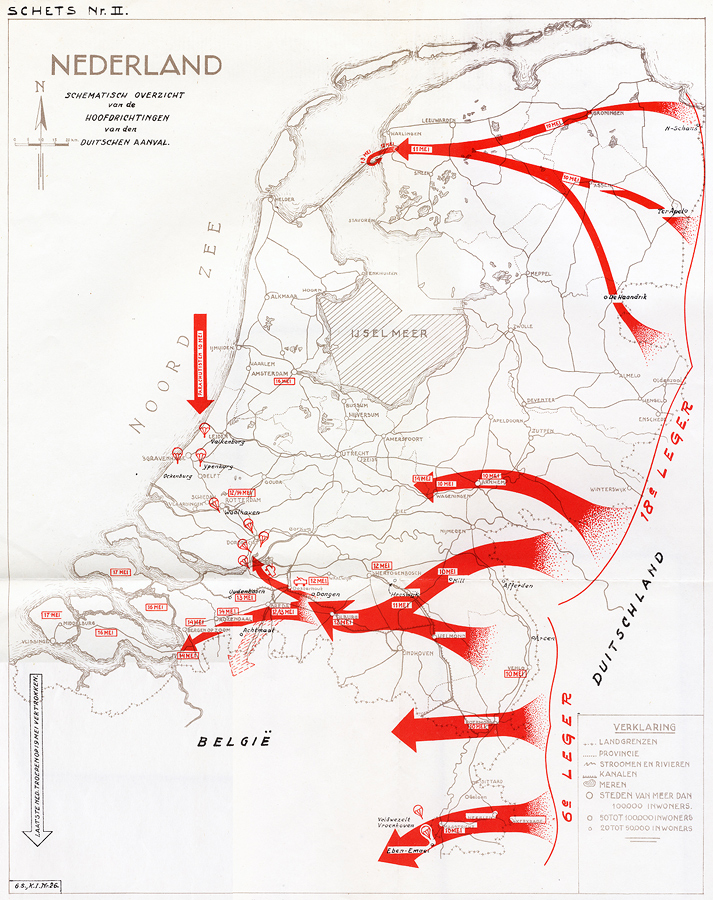
The above illustration shows the German attack on the Netherlands.
The May Days were hectic for the Dutch soldiers due to the rapidly unfolding events. Fighting occurred not only at the front lines but also behind the lines, where Dutch soldiers fought with paratroopers and German aircrafts. There were air battles between Dutch and German planes, and German bombers carried out several bombings. Futhermore, there was fear of a fifth column among Dutch civilians and military personnel. The fifth column refers to the fear of sabotage actions by members of the Dutch National Socialist Movement (NSB), Nazi sympathizers, and Germans living in the Netherlands. Therefore, members of the NSB, Nazi sympathizers, and Germans were arrested during the May days to prevent them from helping the German army. These were the conditions under which the Dutch soldiers fought until the capitulation.
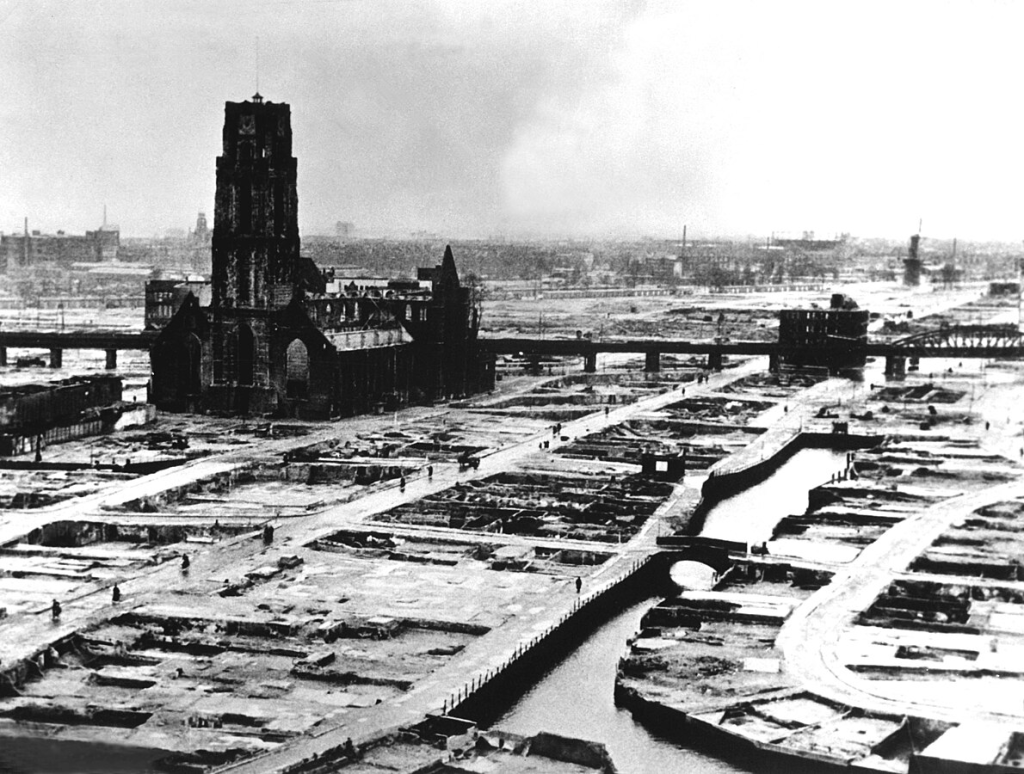
Rotterdam after being bombed.
After the Dutch capitulation, the Netherlands was under military administration until May 29, 1940. After that, a civilian administration took over under the leadership of Arthur Seyss-Inquart (1892-1946). Dutch troops were demobilized, and approximately 272,000 Dutch soldiers were taken as prisoner of war. Non-professional soldiers (reserve officers and conscripts) were quickly granted extended leave and could return to their professions. Professional soldiers (officers, non-commissioned officers, and enlisted men) were required to sign a declaration. The declaration read as follows:
“I hereby pledge on my honor that, during this war, while the Netherlands is at war with the German Reich, I will not participate in any front, either directly or indirectly, in the fight against Germany. I will not undertake or repeatedly fail to undertake any action that could cause damage, of any kind, to the German Reich.”
Professional soldiers who refused to sign this declaration remained in captivity. In total, 69 out of 12,400 professional soldiers refused to sign the declaration. By July 15, 1940, the demobilization of the Dutch army was completed.
| Losses: | |
| Netherlands (approximately) | Germany (approximately) |
| 2.322 deaths | 2.032 deaths |
| 6.000 wounded | 6.500 wounded |
| 270.000 prisoners of war | 2.000 prisoners of war |
| 500 missing |
 Soldaat Sikke Hiemstra