
Tensions in Europe
In the 1930s, tensions in Europe rose, which did not go unnoticed in the Netherlands. The Sudeten Crisis erupted in September 1938 due to Adolf Hitler’s (1899-1945) aggressive foreign policy. Hitler aimed to incorporate all areas with ethnic Germans into Nazi Germany through the Heim Ins Reich policy (Home in the Reich). He had previously annexed the Saarland (1935), the Rhineland (1936), and Austria (1938). Subsequently, Hitler turned his attention to the Sudetenland, a region in Czechoslovakia.
The Sudetenland was home to three million ethnic Germans, but Czechoslovakia had no intention of ceding this territory. Czechoslovakia decided to mobilize its military, causing Great Britain and France to fear for a new war. Both Great Britain and France wanted to avoid this, because both countries were not prepared for another war. As a result, Great Britain, France, fascist Italy (which chaired the negotiations), and Nazi Germany signed the Munich Agreement in September 1938. Consequently, Czechoslovakia, which was not invited to the negotiations, had to cede the Sudetenland to Nazi Germany.
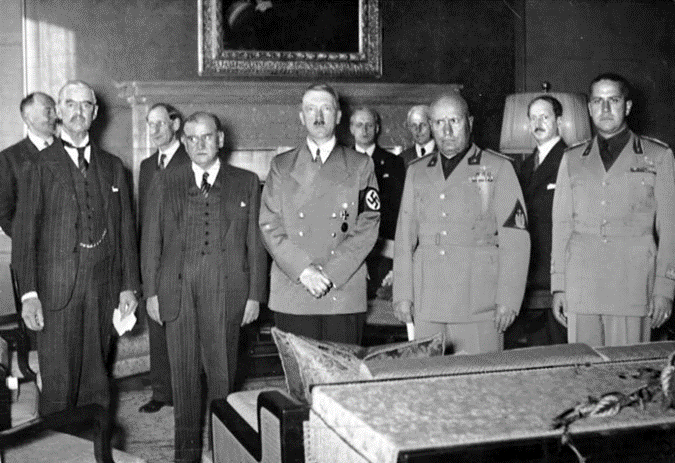
From left to right: Neville Chamberlain (1869-1940), Édouard Daladier (1884-1970), Adolf Hitler, Benito Mussolini, and Galeazzo Ciano (1903-1944) before signing the Munich Agreement.
During the Sudeten Crisis, Queen Wilhelmina (1880-1962) pressured the Dutch government, under the Colijn cabinet (1933-1939), to mobilize the Dutch army. However, the government limited itself to a strategic mobilization. Despite this, Hitler’s ambitions were not limited to the Sudetenland, as six months later, Nazi Germany also annexed the rest of Czechoslovakia. After this annexation, Wilhelmina urged for a trial mobilization, but that did not happen either.
Hitler’s successes inspired the Italian dictator Benito Mussolini (1883-1945) to invade and annex Albania in April 1939. The Dutch government only called up border battalions and other security units. The turning point came on August 23, 1939, when the Soviet Union and Nazi Germany signed the Molotov-Ribbentrop Pact. This non-aggression pact, which was violated by Nazi Germany in 1941, divided Eastern Europe into spheres of influence. The Soviet Union gained control over the Baltic States, parts of Finland, Bessarabia (now Moldova), and the eastern part of Poland. Nazi Germany gained control over western Poland. One day after the signing of the Molotov-Ribbentrop Pact, the Dutch government, under the De Geer cabinet (1939-1940), decided to begin the pre-mobilization.
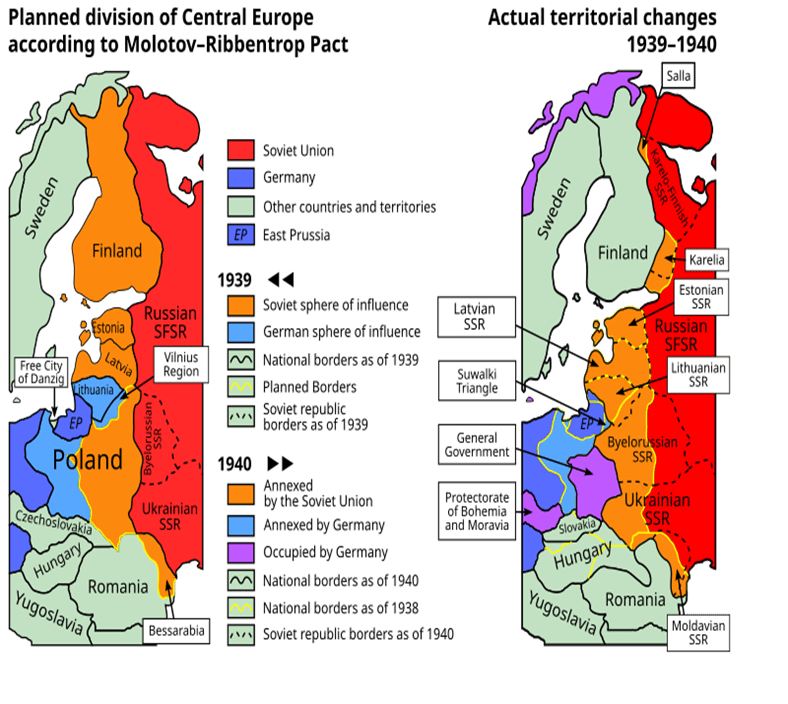
The Molotov-Ribbentrop Pact, with the proposal on the left and the actual territorial change on the right.

